Review
. 2019 Mar 8;8(1):6.
doi: 10.3390/ht8010006.

Protein Adductomics: Methodologies for Untargeted Screening of Adducts to Serum Albumin and Hemoglobin in Human Blood Samples

Affiliations
Review

Protein Adductomics: Methodologies for Untargeted Screening of Adducts to Serum Albumin and Hemoglobin in Human Blood Samples

Henrik Carlsson et al. High Throughput. .

Abstract

The reaction products of electrophiles in vivo can be measured as adducts to the abundant proteins, hemoglobin (Hb), and human serum albumin (HSA), in human blood samples. During the last decade, methods for untargeted screening of such adducts, called "adductomics", have used liquid chromatography-mass spectrometry to detect large numbers of previously unknown Hb and HSA adducts. This review presents methodologies that were developed and used in our laboratories for Hb and HSA adductomics, respectively. We discuss critical aspects regarding choice of target protein, sample preparation, mass spectrometry, data evaluation, and strategies for identification of detected unknown adducts. With this review we give an overview of these two methodologies used for protein adductomics and the precursor electrophiles that have been elucidated from the adducts.

Keywords: adductomics; electrophiles; hemoglobin; human serum albumin; mass spectrometry; protein adducts; proteins.


Conflict of interest statement

The authors declare no conflict of interest.

Figures
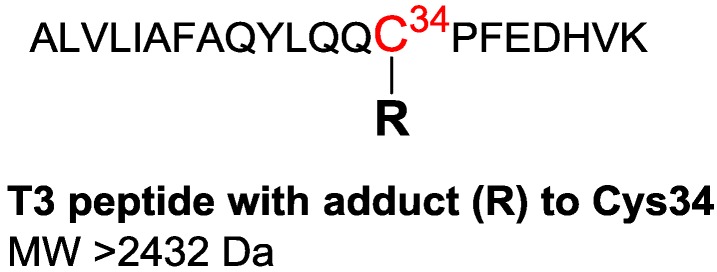
Figure 1
Figure 1
Following tryptic digestion, Cys34 is located on the third largest tryptic peptide, designated T3.
Figure 2
Figure 2
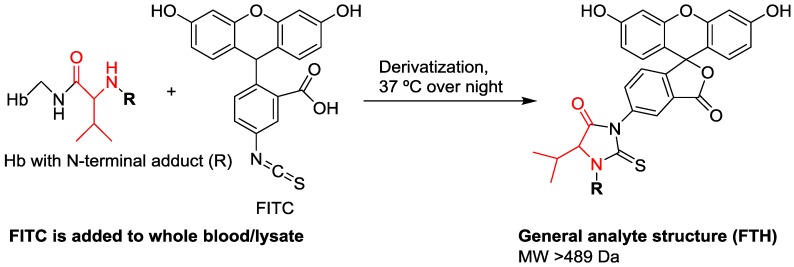
Adducted N-terminal amino acids are detached using the reagent fluorescein isothiocyanate (FITC) generating adduct derivatives in the form of fluorescein thiohydantoins (FTHs).
Figure 3
Figure 3
Fluorescein thiohydantoin (FTH) derivatives of N-terminal Hb adducts exhibit similar fragmentation pathways when performing tandem mass spectrometry (MS/MS).
Figure 4
Figure 4
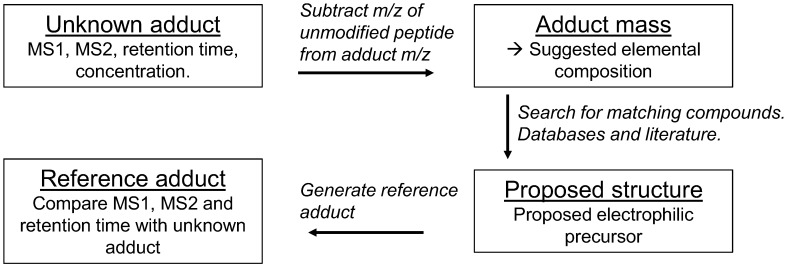
Flowchart depicting the process of identifying unknown adducts using adductome data.

References

    1. Groth U., Neumann H.G. The relevance of chemico-biological interactions for the toxic and carcinogenic effects of aromatic amines V. The pharmacokinetics of related aromatic amines in blood. Chem. Biol. Interact. 1972;4:409–419. doi: 10.1016/0009-2797(72)90061-0. - DOI - PubMed
    1. Ehrenberg L., Hiesche K.D., Osterman-Golkar S., Wennberg I. Evaluation of genetic risks of alkylating agents: Tissue doses in the mouse from air contaminated with ethylene oxide. Mutat. Res. Mol. Mech. Mutagen. 1974;24:83–103. doi: 10.1016/0027-5107(74)90123-7. - DOI - PubMed
    1. Osterman-Golkar S., Ehrenberg L., Segerbäck D., Hällström I. Evaluation of genetic risks of alkylating agents. II. Haemoglobin as a dose monitor. Mutat. Res. Mol. Mech. Mutagen. 1976;34:1–10. doi: 10.1016/0027-5107(76)90256-6. - DOI - PubMed
    1. Calleman C.J., Ehrenberg L., Jansson B., Osterman-Golkar S., Segerbäck D., Svensson K., Wachtmeister C.A. Monitoring and risk assessment by means of alkyl groups in hemoglobin in persons occupationally exposed to ethylene oxide. J. Environ. Pathol. Toxicol. 1978;2:427–442. - PubMed

    1. Törnqvist M., Osterman-Golkar S., Kautiainen A., Jensen S., Farmer P.B., Ehrenberg L. Tissue doses of ethylene oxide in cigarette smokers determined from adduct levels in hemoglobin. Carcinogenesis. 1986;7:1519–1521. doi: 10.1093/carcin/7.9.1519. - DOI - PubMed