Review
. 2019 Jul 8:42:169-186.
doi: 10.1146/annurev-neuro-070918-050233. Epub 2019 Mar 11.

Probing Computation in the Primate Visual System at Single-Cone Resolution

Affiliations
Review

Probing Computation in the Primate Visual System at Single-Cone Resolution

A Kling et al. Annu Rev Neurosci. .

Abstract

Daylight vision begins when light activates cone photoreceptors in the retina, creating spatial patterns of neural activity. These cone signals are then combined and processed in downstream neural circuits, ultimately producing visual perception. Recent technical advances have made it possible to deliver visual stimuli to the retina that probe this processing by the visual system at its elementary resolution of individual cones. Physiological recordings from nonhuman primate retinas reveal the spatial organization of cone signals in retinal ganglion cells, including how signals from cones of different types are combined to support both spatial and color vision. Psychophysical experiments with human subjects characterize the visual sensations evoked by stimulating a single cone, including the perception of color. Future combined physiological and psychophysical experiments focusing on probing the elementary visual inputs are likely to clarify how neural processing generates our perception of the visual world.

Keywords: adaptive optics; color vision; photoreceptor; receptive field; retina; single cone.


Figures

Figure 1
Figure 1
(a) Image of the cone mosaic in an individual human subject acquired using an adaptive optics-scanning laser ophthalmoscope. Each spot in the image is one cone. Image is from a patch of retina at approximately 1.5° eccentricity. Image provided by Dr. R. Sabesan. (b) Arrangement of L (red), M (green), and S (blue) cones in the mosaic shown in panel a, obtained using adaptive optics microdensitometry. The L:M ratio of ~2.5:1 and sparse S cone submosaic are typical for humans, as is the near-random packing arrangement of the L and M cones. Abbreviations: L, long wavelength–sensitive; M, middle wavelength–sensitive; S, short wavelength–sensitive. Panel b reproduced from figure 2 in Sabesan et al. (2015), published under the Creative Commons Attribution 4.0 International Public License.
Figure 2
Figure 2
RF maps at single-cone resolution. (a) RFs of four major cell types obtained with high-resolution white noise in a single recording. Reverse correlation analysis reveals separate puncta of sensitivity in each RF, corresponding to individual cone inputs. L and M cone types have different spectral properties revealed by the color of the puncta. Outlines of RF centers are shown (black lines). (b) Cone mosaic reconstructed from multiple RGCs recorded simultaneously (same experiment as in panel a). Circles represent locations of L (red), M (green), and S (blue) cones. Cones obtained from RFs of the four cells from panel a are highlighted (black lines). (c) Cone input strength in an OFF midget cell RF. (Top) Cone locations denoted by filled circles; color scheme corresponds to relative cone input strength: weaker input (blue) and stronger input (yellow). Input strengths deviate from a Gaussian model. (Bottom) Image of the same RF showing cone types. Thickness of each converging white line is proportional to the relative cone input strength to the RGC. (d) Example mosaic of OFF midget cells. Cells of the same type tile the retina, sampling from most available cones. Outlines of individual cells are coordinated with minimal overlap. Note the mixed L and M input in most OFF midgets. Abbreviations: L, long wavelength–sensitive; M, middle wavelength–sensitive; RF, receptive field; RGC, retinal ganglion cell; S, short wavelength–sensitive. Figure adapted from Field et al. (2010).
Figure 3
Figure 3
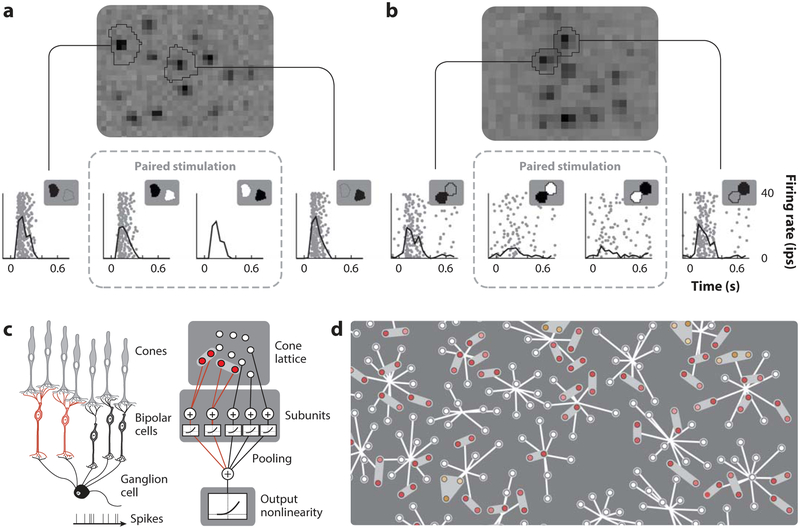
Nonlinear spatial summation in the RF. (a,b) Examples of OFF midget responses to stimulation of two individual cones in isolation (left and right raster subpanels) and concurrently with opposite contrast (middle raster subpanels). In panel a, during concurrent stimulation, the response to the light increment in this OFF cell is rectified before it reaches the cell and has no effect on firing (nonlinear summation). In panel b, RGC produces almost no response to concurrent stimulation, presumably due to linear summation and the cancellation of opposing cone signals in a common bipolar cell prior to rectification. These two cones form a linear subunit within the RF. (c) Schematic illustration of how the subunit model works: (left) schematic circuit connections forming the RF and (right) computational operations within this circuit. (d) Estimated subunits within a mosaic of OFF midget RFs. Circles denote cone locations and converging lines represent cone inputs to individual OFF midget RFs (see also Figure 2). Cone pairs and triplets with linear summation (i.e., subunits) are colored and share a gray outline. Abbreviations: RF, receptive field; RGC, retinal ganglion cell. Figure adapted from figures 1, 2, and 6 in Freeman et al. (2015), published under the Creative Commons Attribution 4.0 International Public License.
Figure 4
Figure 4
(a) Relative thresholds of individually activated L cones (red circles), with stimuli presented against a background that activated M and S cones more than L cones. Thresholds increase systematically with the number of M and S cones in the local neighborhood of the targeted L cones. A corresponding effect (not shown here) was observed when M cones were targeted against a background that activated L cones more than M cones. Panel a adapted from figure 3 in Tuten et al. (2017), published under the Creative Commons Attribution 4.0 International Public License. (b) Measured size of the neural summation area for one subject (green circle) superimposed on an image of the foveal cone mosaic of the same subject. Panel b adapted from figure 3 in Tuten et al. (2018), published under the Creative Commons Attribution 4.0 International Public License. (c) The fraction of times different color terms were used to describe brief (550 nm) monochromatic flashes whose retinal size was commensurate with a single cone. The possible color names were red, orange, yellow, yellow-green, green, blue-green, blue, purple, and white. Each bar shows data for a single subject, with subjects ordered from left to right according to increasing L:M cone ratio. Panel c adapted with permission from figure 4 in Hofer et al. (2005b). (d) Single-cone naming data for targeted cones, showing a patch of mosaic where the type of individual cones was determined using microdensitometry. The color naming results for individual targeted cones are shown by a white annulus around each such cone. The fraction of times the terms white, red, and green were used is indicated by the fraction of the annulus rendered in the corresponding color. The cone type is indicated by the color—L cone (red) and M cone (green)—in the center of the annulus. Panel d adapted from figure 3 in Sabesan et al. (2016), published under the Creative Commons Attribution NonCommercial 4.0 International Public License. Abbreviations: L, long wavelength–sensitive; M, middle wavelength–sensitive; S, short wavelength–sensitive.

References

    1. Aho AC, Donner K, Hyden C, Larsen LO, Reuter T. 1988. Low retinal noise in animals with low body temperature allows high visual sensitivity. Nature 334:348–50 - PubMed
    1. Ala-Laurila P, Rieke F. 2014. Coincidence detection of single-photon responses in the inner retina at the sensitivity limit of vision. Curr. Biol 24:2888–98 - PMC - PubMed
    1. Amthor FR, Grzywacz NM. 1991. Nonlinearity of the inhibition underlying retinal directional selectivity. Vis. Neurosci 6:197–206 - PubMed
    1. Arathorn DW, Yang Q, Vogel CR, Zhang Y, Tiruveedhula P, Roorda A. 2007. Retinally stabilized cone-targeted stimulus delivery. Opt. Express 15:13731–44 - PubMed
    1. Baccus SA. 2007. Timing and computation in inner retinal circuitry. Annu. Rev. Physiol 69:271–90 - PubMed

Publication types

LinkOut - more resources