


Development of a novel, robust and cost-efficient process for valorizing dairy waste exemplified by ethanol production
- PMID: 30857537
- PMCID: PMC6410493
- DOI: 10.1186/s12934-019-1091-3
Development of a novel, robust and cost-efficient process for valorizing dairy waste exemplified by ethanol production
Abstract
Background: Delactosed whey permeate (DWP) is a side stream of whey processing, which often is discarded as waste, despite of its high residual content of lactose, typically 10-20%. Microbial fermentation is one of the most promising approaches for valorizing nutrient rich industrial waste streams, including those generated by the dairies. Here we present a novel microbial platform specifically designed to generate useful compounds from dairy waste. As a starting point we use Corynebacterium glutamicum, an important workhorse used for production of amino acids and other important compounds, which we have rewired and complemented with genes needed for lactose utilization. To demonstrate the potential of this novel platform we produce ethanol from lactose in DWP.
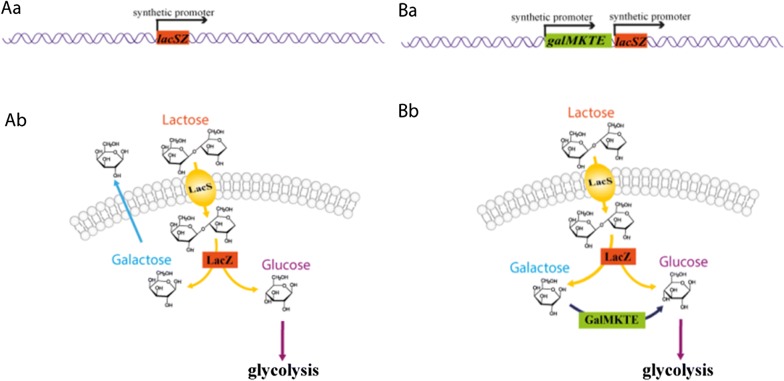
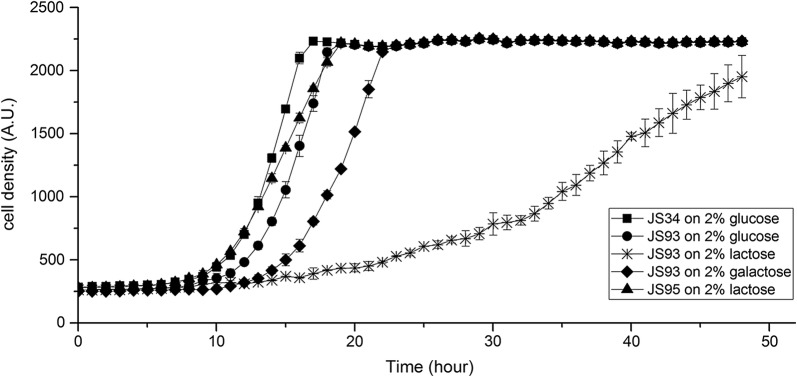
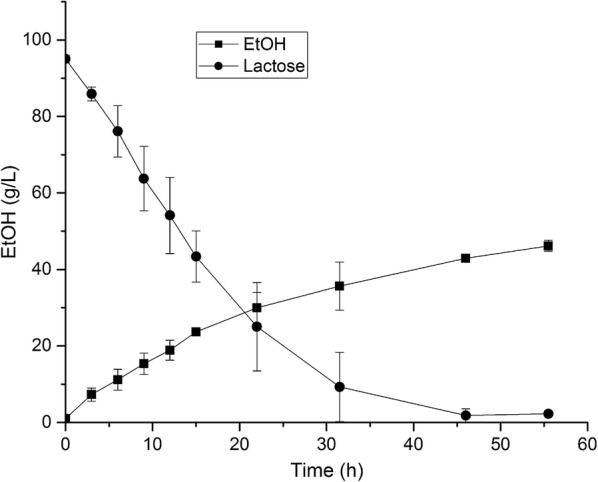
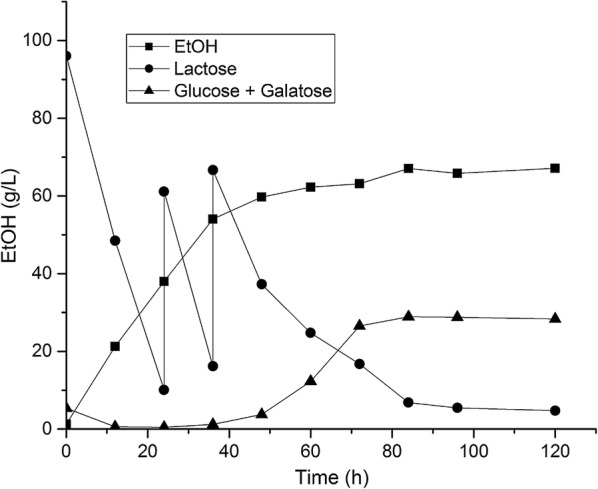
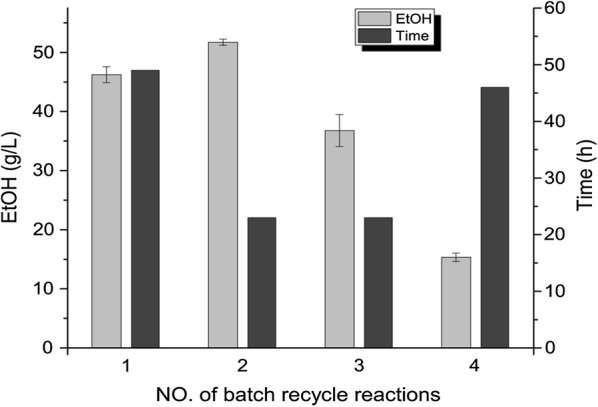
Results: First, we introduced the lacSZ operon from Streptococcus thermophilus, encoding a lactose transporter and a β-galactosidase, and achieved slow growth on lactose. The strain could metabolize the glucose moiety of lactose, and galactose accumulated in the medium. After complementing with the Leloir pathway (galMKTE) from Lactococcus lactis, co-metabolization of galactose and glucose was accomplished. To further improve the growth and increase the sugar utilization rate, the strain underwent adaptive evolution in lactose minimal medium for 100 generations. The outcome was strain JS95 that grew fast in lactose mineral medium. Nevertheless, JS95 still grew poorly in DWP. The growth and final biomass accumulation were greatly stimulated after supplementation with NH4+, Mn2+, Fe2+ and trace minerals. In only 24 h of cultivation, a high cell density (OD600 of 56.8 ± 1.3) was attained. To demonstrate the usefulness of the platform, we introduced a plasmid expressing pyruvate decarboxylase and alcohol dehydrogenase, and managed to channel the metabolic flux towards ethanol. Under oxygen-deprived conditions, non-growing suspended cells could convert 100 g/L lactose into 46.1 ± 1.4 g/L ethanol in DWP, a yield of 88% of the theoretical. The resting cells could be re-used at least three times, and the ethanol productivities obtained were 0.96 g/L/h, 2.2 g/L/h, and 1.6 g/L/h, respectively.
Conclusions: An efficient process for producing ethanol from DWP, based on C. glutamicum, was demonstrated. The results obtained clearly show a great potential for this newly developed platform for producing value-added chemicals from dairy waste.
Keywords: Corynebacterium glutamicum; Ethanol production; Lactose-utilization; Medium optimization.
Figures
References
-
- Lynd LR. Overview and evaluation of fuel ethanol from cellulosic biomass: technology, economics, the environment, and policy. Annu Rev Energy Environ. 1996;21:403–465. doi: 10.1146/annurev.energy.21.1.403. - DOI
-
- Shapouri H, Salassi M. The economic feasibility of ethanol production from sugar in the United States. USDA Rep. 2006;78. https://www.usda.gov/oce/reports/energy/EthanolSugarFeasibilityReport3.pdf. Accessed July 2006.
-
- Smith J. Next generation biofuels. Inorganica Chim Acta. 2011;460:1. doi: 10.1016/j.ica.2017.03.016. - DOI
-
- Thomas VA, Donohoe BS, Li M, Pu Y, Ragauskas AJ, Kumar R, et al. Adding tetrahydrofuran to dilute acid pretreatment provides new insights into substrate changes that greatly enhance biomass deconstruction by Clostridium thermocellum and fungal enzymes. Biotechnol Biofuels. 2017;10:1–13. doi: 10.1186/s13068-016-0693-9. - DOI - PMC - PubMed
MeSH terms
Substances
Grants and funding
LinkOut - more resources
Full Text Sources
Other Literature Sources
Molecular Biology Databases
Research Materials
