


When one phenotype is not enough: divergent evolutionary trajectories govern venom variation in a widespread rattlesnake species
- PMID: 30862287
- PMCID: PMC6458317
- DOI: 10.1098/rspb.2018.2735
When one phenotype is not enough: divergent evolutionary trajectories govern venom variation in a widespread rattlesnake species
Abstract
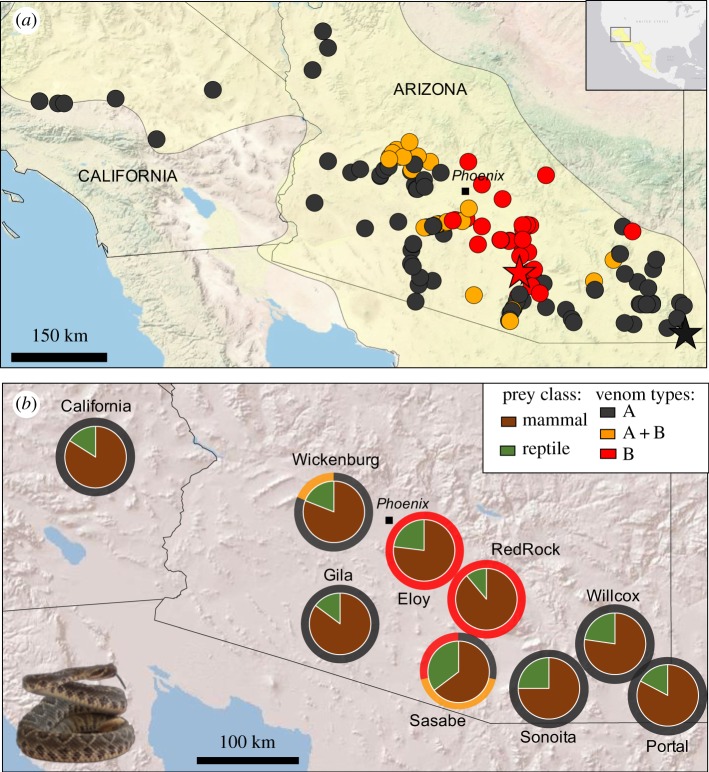
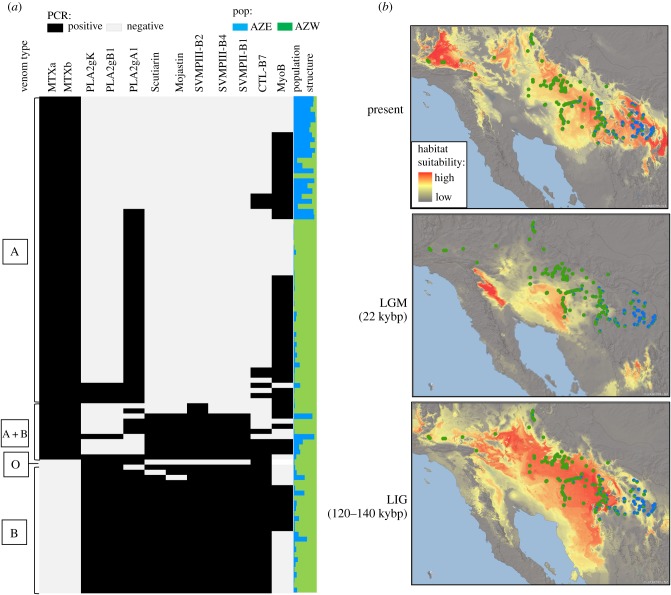
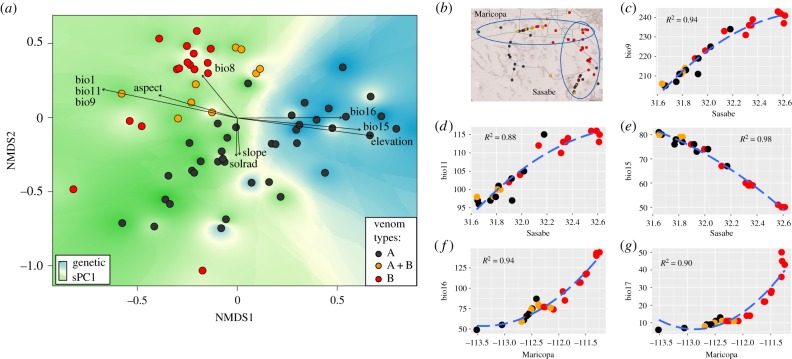
Understanding the origin and maintenance of phenotypic variation, particularly across a continuous spatial distribution, represents a key challenge in evolutionary biology. For this, animal venoms represent ideal study systems: they are complex, variable, yet easily quantifiable molecular phenotypes with a clear function. Rattlesnakes display tremendous variation in their venom composition, mostly through strongly dichotomous venom strategies, which may even coexist within a single species. Here, through dense, widespread population-level sampling of the Mojave rattlesnake, Crotalus scutulatus, we show that genomic structural variation at multiple loci underlies extreme geographical variation in venom composition, which is maintained despite extensive gene flow. Unexpectedly, neither diet composition nor neutral population structure explain venom variation. Instead, venom divergence is strongly correlated with environmental conditions. Individual toxin genes correlate with distinct environmental factors, suggesting that different selective pressures can act on individual loci independently of their co-expression patterns or genomic proximity. Our results challenge common assumptions about diet composition as the key selective driver of snake venom evolution and emphasize how the interplay between genomic architecture and local-scale spatial heterogeneity in selective pressures may facilitate the retention of adaptive functional polymorphisms across a continuous space.
Keywords: adaptive trait; diet; phenotypic variation; population structure; structural polymorphism; venom.
Conflict of interest statement
We declare we have no competing interests.
Figures
References
-
- Mayr E. 1947. Ecological factors in speciation. Evolution 1, 263–288. ( 10.1111/j.1558-5646.1947.tb02723.x) - DOI
-
- Levene H. 1953. Genetic equilibrium when more than one ecological niche is available. Am. Nat. 87, 331–333. ( 10.1086/281792) - DOI
-
- Hedrick PW. 2006. Genetic polymorphism in heterogeneous environments: the age of genomics. Annu. Rev. Ecol. Evol. Syst. 37, 67–93. ( 10.1146/annurev.ecolsys.37.091305.110132) - DOI
Publication types
MeSH terms
Substances
Associated data
LinkOut - more resources
Full Text Sources
Other Literature Sources
