. 2019 Mar 12;9(1):4182.
doi: 10.1038/s41598-019-40330-1.

TRPM2 ion channel promotes gastric cancer migration, invasion and tumor growth through the AKT signaling pathway

Affiliations

TRPM2 ion channel promotes gastric cancer migration, invasion and tumor growth through the AKT signaling pathway

Shekoufeh Almasi et al. Sci Rep. .

Abstract

Transient Receptor Potential Melastatin-2 (TRPM2) ion channel is emerging as a great therapeutic target in many types of cancer, including gastric cancer - a major health threat of cancer related-death worldwide. Our previous study demonstrated the critical role of TRPM2 in gastric cancer cells bioenergetics and survival; however, its role in gastric cancer metastasis, the major cause of patient death, remains unknown. Here, using molecular and functional assays, we demonstrate that TRPM2 downregulation significantly inhibits the migration and invasion abilities of gastric cancer cells, with a significant reversion in the expression level of metastatic markers. These effects were concomitant with decreased Akt and increased PTEN activities. Finally, TRPM2 silencing resulted in deregulation of metastatic markers and abolished the tumor growth ability of AGS gastric cancer cells in NOD/SCID mice. Taken together, our results provide compelling evidence on the important function of TRPM2 in the modulation of gastric cancer cell invasion likely through controlling the PTEN/Akt pathway.


Conflict of interest statement

The authors declare no competing interests.

Figures
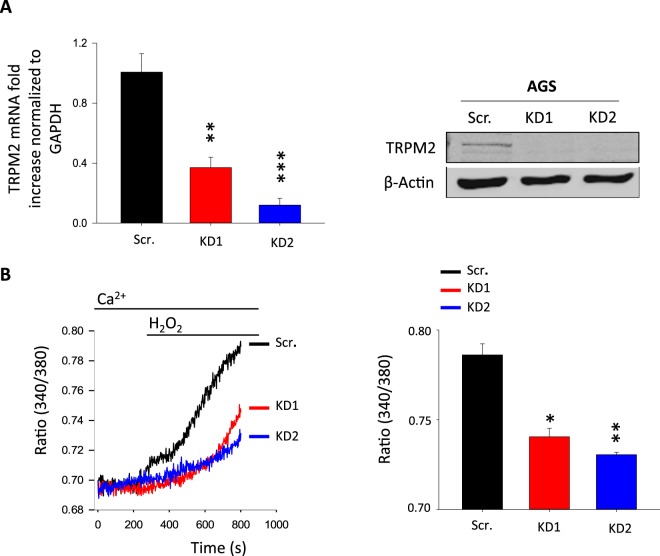
Figure 1
Figure 1
TRPM2 is functionally expressed as a calcium channel in AGS gastric cancer cells. (A) Western blot and RT-qPCR analyses of TRPM2 expression in both, AGS scramble and TRPM2-KD cells. (B) Calcium imaging analysis of TRPM2 ion channel in AGS scramble and TRPM2-KD cells. 1 mM H2O2 treatment increased the cytosolic Ca2+ level in scramble cells while this effect is significantly decreased in TRPM2-KD cells. Quantification of intracellular Ca2+ peak values is expressed as mean ± SD and represented as a bar graph. (experiments have been done in triplicate and data are an average of three experiments, t-test vs. Scr. ***p < 0.001; **p < 0.01; *p < 0.05).
Figure 2
Figure 2
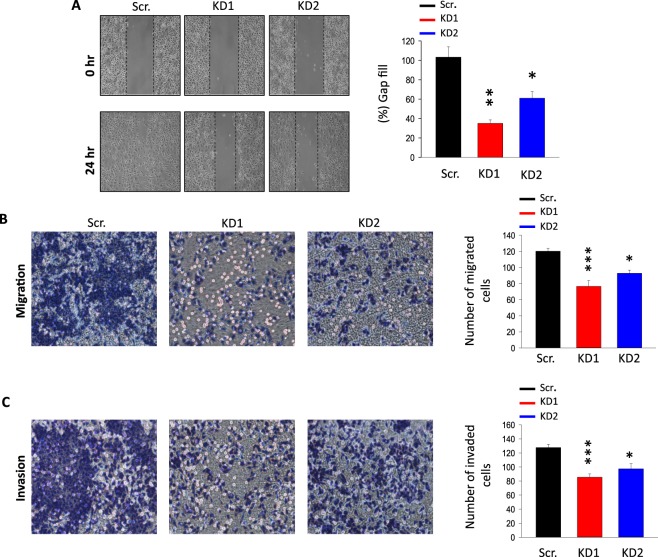
TRPM2 downregulation inhibits the migration and invasion abilities of AGS gastric cancer cells. (A) Gap closure migration assay of AGS scramble and TRPM2-KD cells. Data were recorded at the 0-time point and 24 hours later; results are presented as a bar graph. Quantification of cell motility is expressed as mean ± SD and represented as a bar graph. (B,C) Migration and invasion assays of AGS scramble and TRPM2-KD cells. Numbers of migrated and invaded cells were analyzed 24 hours after cells have been seeded in the chamber and data were summarized as bar graphs. The data are represented as the mean of three independent experiments (t-test vs. Scr. ***p < 0.001; **p < 0.01; *p < 0,05).
Figure 3
Figure 3
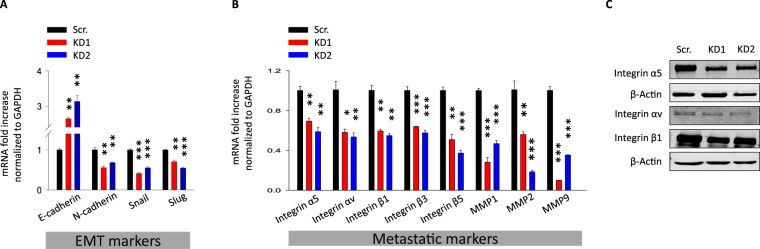
Effect of TRPM2 silencing the expression of the EMT in AGS gastric cancer cells. (A,B) RT-qPCR analysis of EMT markers, integrins and MMPs in both AGS control and TRPM2-KD cells (RT-qPCR was done in triplicate, t-test vs. scr. ***p < 0.001; **p < 0.01; *p < 0.05). (C) Cell lysates from AGS cells expressing either control ShRNA, or ShRNA-TRPM2 were analysed by immunoblotting for the endogenous expression of integrins.
Figure 4
Figure 4
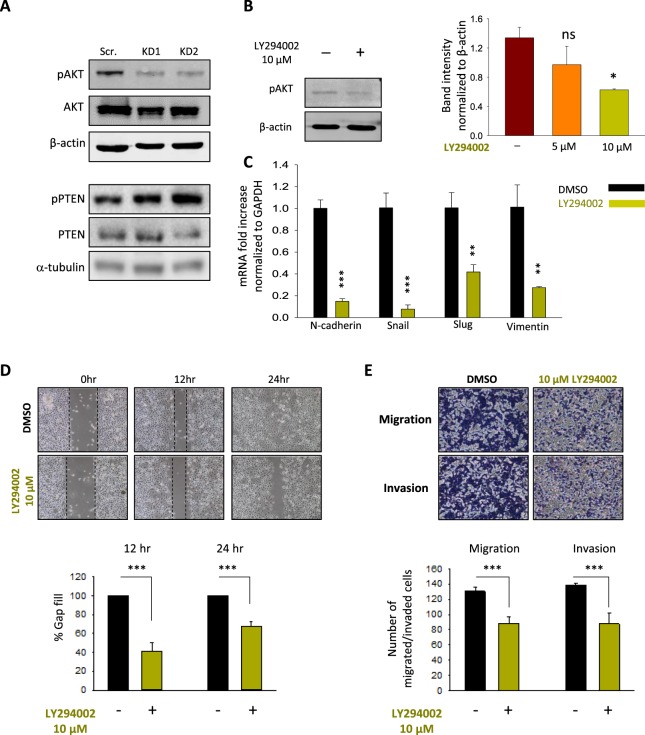
TRPM2 promotes cell migration and invasion through Akt-mediated EMT. (A) Western blot analysis of the protein level of phospho-Akt (Ser473), total Akt, phospho-PTEN (Ser380/Thr382/383) and total PTEN in AGS control and TRPM2-KD cells. (B) The protein level of phohpho-Akt before and 24 hours after treatment with 10 μM LY294002, a PI3K inhibitor (C) mRNA level of EMT markers before and 24 hours after Akt inhibition by LY294002 (D) Gap closure assay study of AGS wildtype cells at 0, 12 and 24 hours after LY294002 treatment (10 μM). The average results of three independent experiments were summarized in the corresponding bar graph. (E) In vitro analysis of migration and invasion ability of AGS cells with or without LY294002 treatment (10 μM) after 24 hrs; the number of migrated and invaded cells from three independent experiments are presented in bar graphs (t-test vs. Scr. ***p < 0.001; **p < 0.01; *p < 0.05).
Figure 5
Figure 5
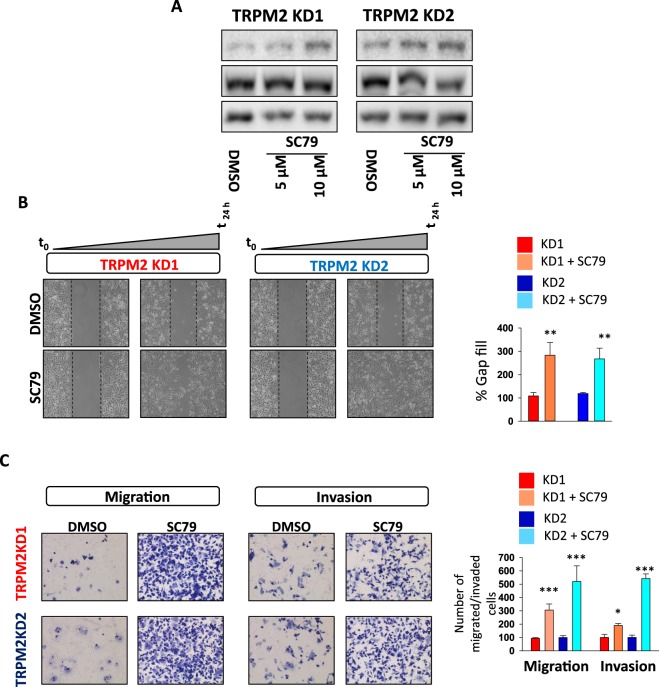
Akt activation rescued the migration and invasions abilities of TRPM2 depleted gastric cancer cells. (A) The protein level of phohpho-Akt (Ser473) before and 24 hours after treatment with Akt activator SC79 in AGS scramble and TRPM2-KD cells. (B) Gap closure assay study of TRPM2 depleted KD 1 and KD2 cells at 0 and 24 hours after SC79 treatment (10 μM). The average results of three independent experiments were summarized in the corresponding bar graph. (C) In vitro analysis of migration and invasion ability of TRPM2 depleted AGS cells with or without SC69 treatment (10 μM) after 24 hrs; number of migrated and invaded cells from three independent experiments are presented in bar graphs (t-test vs. Scr. ***p < 0.001; **p < 0.01; *p < 0.05).
Figure 6
Figure 6
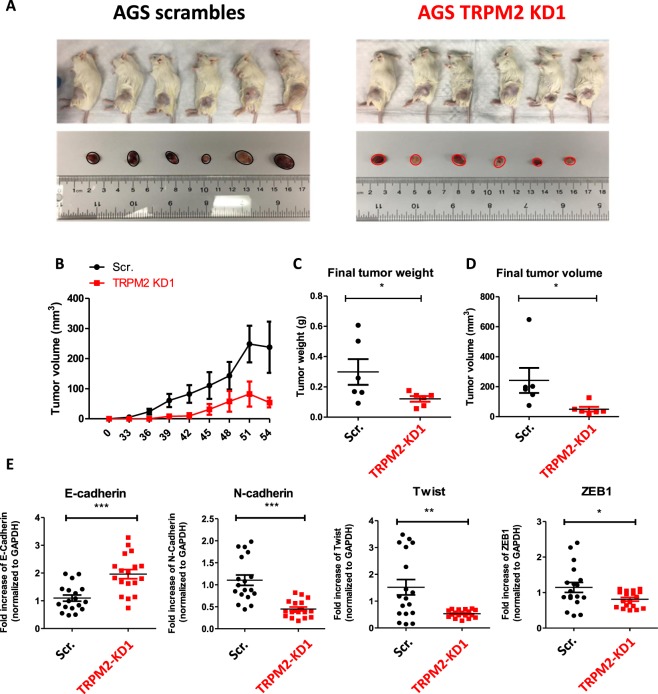
TRPM2 downregulation inhibits GC tumor growth and reverses EMT process in SCID mice. (A) Schematic presentation of scrambled and TRPM2-KD AGS tumors in male NOD/SCID mice. Mice were subcutaneously injected with 4 million cells in the left flank. Tumor size was measured every 3 days, 2 weeks post-injection, for 1.5 months. Resulted data are presented in corresponding graphs (B) Change in tumor volume for three weeks post-injection. (C,D) Final tumors’ weight and volume. (EH) RT-qPCR analysis of the mRNA expression level of EMT markers in extracted tumors (t-test vs. Scr. ***p < 0.001; **p < 0.01; *p < 0.05).

References

    1. Yang D, et al. Survival of metastatic gastric cancer: Significance of age, sex and race/ethnicity. J Gastrointest Oncol. 2011;2:77–84. doi: 10.3978/j.issn.2078-6891.2010.025. - DOI - PMC - PubMed
    1. Riihimaki M, Hemminki A, Sundquist K, Sundquist J, Hemminki K. Metastatic spread in patients with gastric cancer. Oncotarget. 2016;7:52307–52316. doi: 10.18632/oncotarget.10740. - DOI - PMC - PubMed
    1. Fenouille N, et al. The epithelial-mesenchymal transition (EMT) regulatory factor SLUG (SNAI2) is a downstream target of SPARC and AKT in promoting melanoma cell invasion. Plos one. 2012;7:e40378. doi: 10.1371/journal.pone.0040378. - DOI - PMC - PubMed
    1. Kang MH, et al. Inhibition of PI3 kinase/Akt pathway is required for BMP2-induced EMT and invasion. Oncology reports. 2009;22:525–534. - PubMed
    1. Liu J, et al. PI3K/Akt/HIF-1alpha signaling pathway mediates HPV-16 oncoprotein-induced expression of EMT-related transcription factors in non-small cell lung cancer cells. Journal of Cancer. 2018;9:3456–3466. doi: 10.7150/jca.26112. - DOI - PMC - PubMed

Publication types

MeSH terms