


A pragmatic behavior-based habit index for adherence to nebulized treatments among adults with cystic fibrosis
- PMID: 30863018
- PMCID: PMC6388736
- DOI: 10.2147/PPA.S186417
A pragmatic behavior-based habit index for adherence to nebulized treatments among adults with cystic fibrosis
Abstract
Background: Habit, a psychological process that automatically generates urges to perform a behavior in associated settings, is potentially an important determinant of medication adherence. Habit is challenging to measure because, as a psychological construct, it cannot be directly observed. We describe a method of using routinely available objective adherence data from electronic data capture (EDC) to generate a behavior-based index of adherence habit and demonstrate how this index can be applied.
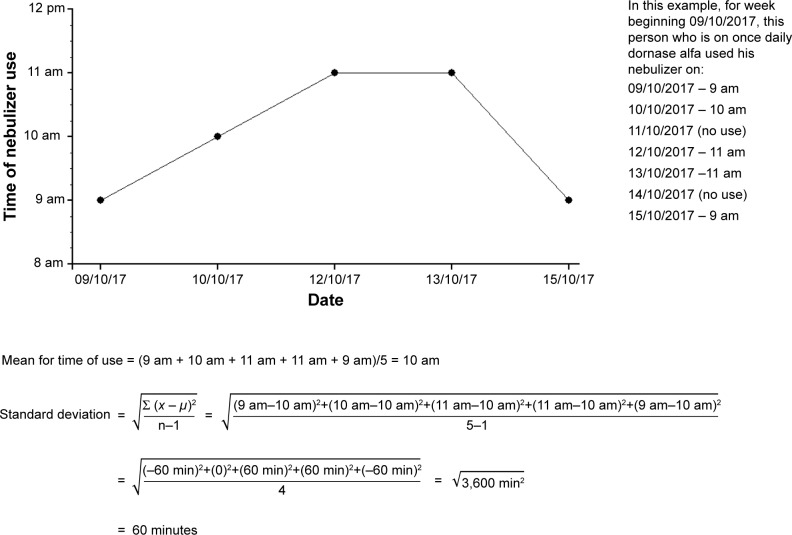
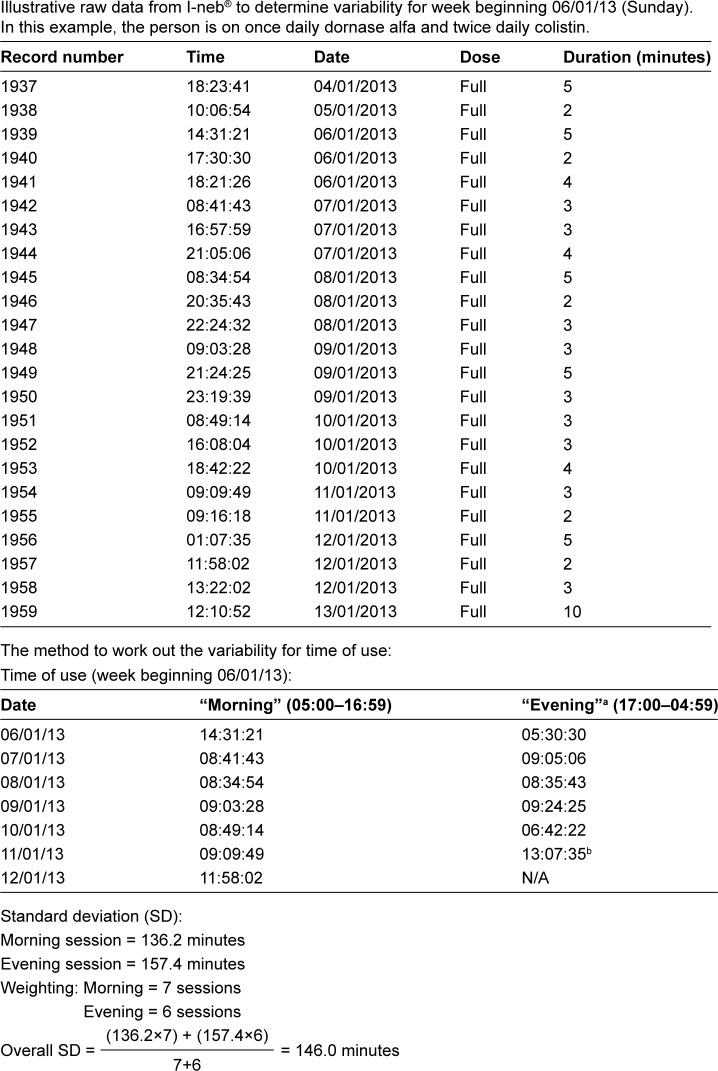
Methods to generate the habit index: Our proposed habit index is a "frequency in context" measure. It estimates habit as a multiplicative product of behavior frequency (generated from weekly percentage adherence) and context stability (inferred from time of nebulizer use). Although different timescales can be used, we chose to generate weekly habit scores since we believe that this is the most granular level at which context stability can be reasonably calculated.
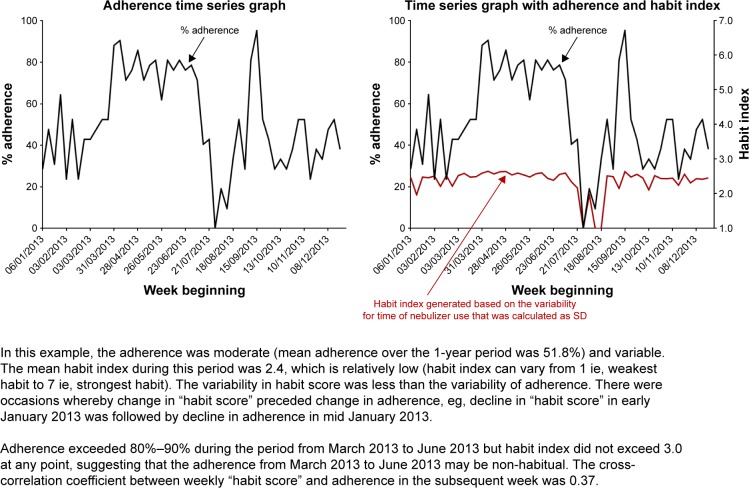
An application of the habit index: A hallmark of habit is to predict future behavior, hence we used time series method to cross-correlate the habit index with nebulizer adherence in the subsequent week among 123 adults with cystic fibrosis (52, 42.3% female; median age 25 years) over a median duration of 153 weeks (IQR 74-198 weeks). The mean cross-correlation coefficient (R) between the habit index and subsequent adherence was 0.40 (95% CI 0.36-0.44). Adjusting for current adherence, the unstandardized regression coefficient (B) for the habit index was 0.30 (95% CI -1.04 to 1.65).
Conclusion: We have described a pragmatic method to infer "habit" from adherence data routinely captured with EDC and provided proof-of-principle evidence regarding the feasibility of this concept. The continuous stream of data from EDC allows the habit index to unobtrusively assess "habit" at various time points over prolonged periods, and hence the habit index may be applicable in habit formation studies.
Keywords: cystic fibrosis; habits; medication adherence; nebulizers and vaporizers.
Conflict of interest statement
Disclosure This report is independent research arising from a doctoral research fellowship to Zhe Hui Hoo (DRF-2014-07-092 and supported by the National Institute for Health Research. The views expressed in this publication are those of the author(s) and not necessarily those of the NHS, the National Institute for Health Research, or the Department of Health. The other authors report no conflicts of interest in this work.
Figures
References
-
- Chowdhury R, Khan H, Heydon E, et al. Adherence to cardiovascular therapy: a meta-analysis of prevalence and clinical consequences. Eur Heart J. 2013;34(38):2940–2948. - PubMed
-
- Sokol MC, McGuigan KA, Verbrugge RR, Epstein RS. Impact of medication adherence on hospitalization risk and healthcare cost. Med Care. 2005;43(6):521–530. - PubMed
-
- Butler JA, Roderick P, Mullee M, Mason JC, Peveler RC. Frequency and impact of nonadherence to immunosuppressants after renal transplantation: a systematic review. Transplantation. 2004;77(5):769–776. - PubMed
-
- Osterberg L, Blaschke T. Adherence to medication. N Engl J Med. 2005;353(5):487–497. - PubMed
Grants and funding
LinkOut - more resources
Full Text Sources
Research Materials
