. 2019 Feb 18:14:1269-1279.
doi: 10.2147/IJN.S188791. eCollection 2019.

Modulated electro-hyperthermia-enhanced liposomal drug uptake by cancer cells

Affiliations

Modulated electro-hyperthermia-enhanced liposomal drug uptake by cancer cells

Yuk-Wah Tsang et al. Int J Nanomedicine. .

Erratum in

Abstract

Purpose: Modulated electro-hyperthermia (mEHT) stands to be a significant technological advancement in the hyperthermia field, utilizing autofocusing electromagnetic power on the cell membrane to create massive apoptosis. Since mEHT possesses the unique ability to excite cell membranes, we hypothesized that mEHT could enhance the uptake of liposomal drugs by enhancing phagocytic activity.

Materials and methods: Water bath control and mEHT were used to compare the enhancement of liposome-encapsulated doxorubicin (Lipodox®) uptake by cancer cells. Cancer cells were made visible by doxorubicin fluorescence to investigate drug uptake. Viable cell yield was determined via the Trypan Blue exclusion method. Various substrates were used to investigate the mechanism of drug-uptake enhancement. The murine colon carcinoma model, CT26, was used to confirm the tissue infiltration of Lipodox® and its therapeutic effect.

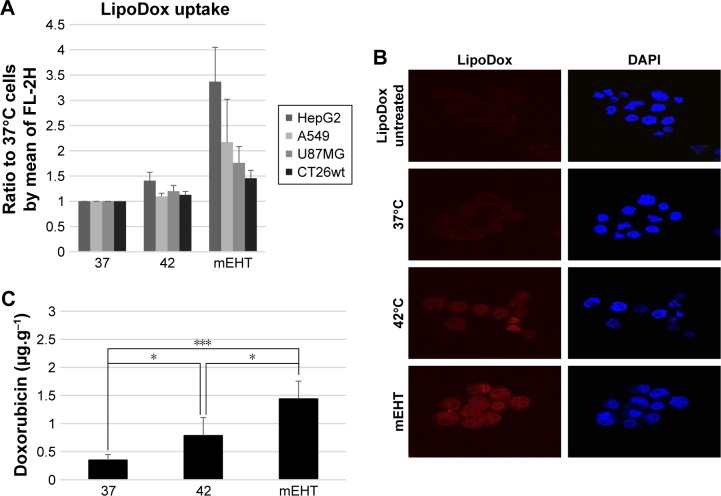
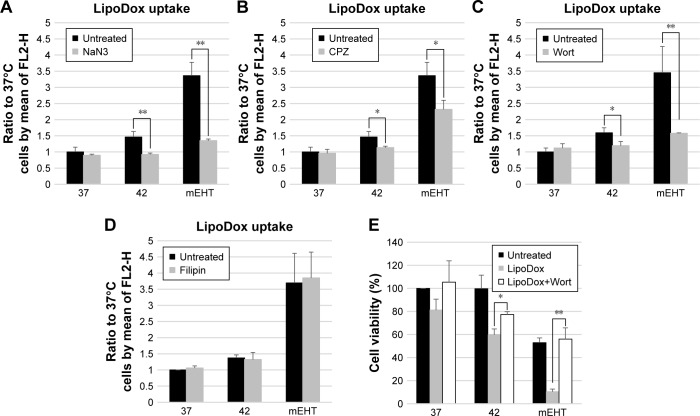
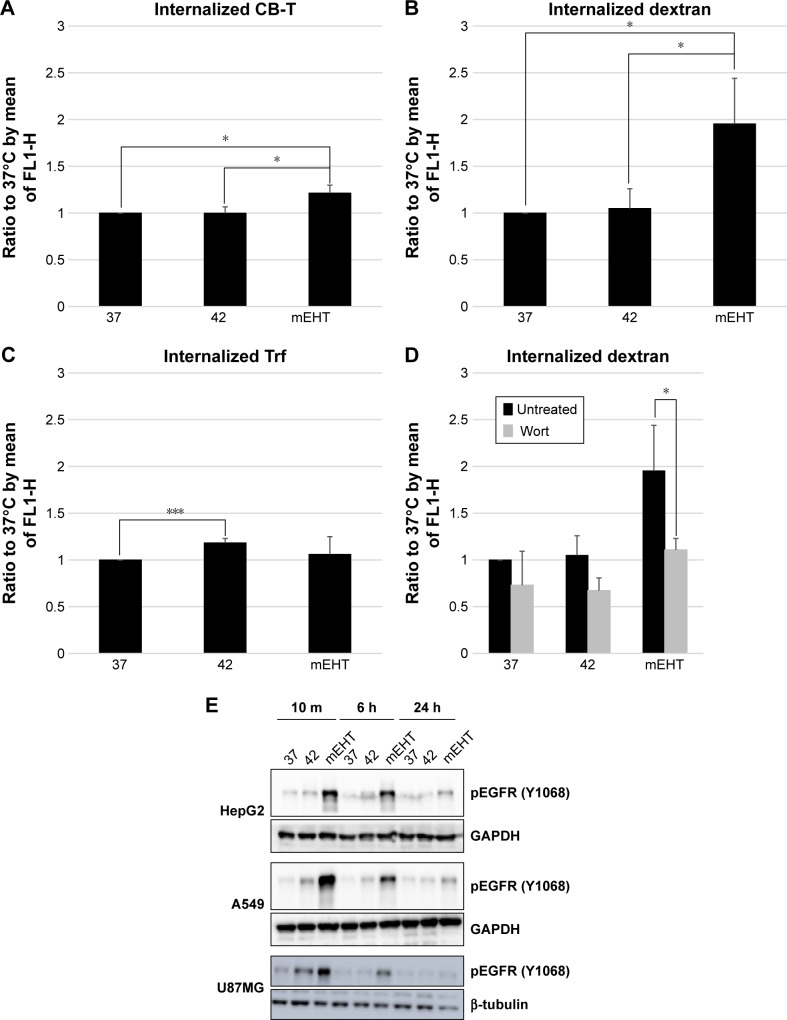
Results: mEHT treatment showed a significant enhancement of Lipodox® uptake of doxorubicin fluorescence compared with 37°C or 42°C water bath treatment. Tumor tissue sections also confirmed that mEHT treatment achieved the highest doxorubicin concentration in vivo (1.44±0.32 µg/g in mEHT group and 0.79±0.32 µg/g in 42°C water bath). Wortmannin was used to inhibit the macropinocytosis effect and 70 kDa dextran-FITC served as uptake substance. The uptake of dextran-FITC by cancer cells significantly increased after mEHT treatment whereas such enhancement was significantly inhibited by wortmannin.

Conclusion: The result showed mEHT-induced particle-uptake through macropinocytosis. mEHT-enhanced uptake of Lipodox® may amplify the therapeutic effect of liposomal drugs. This novel finding warrants further clinical investigation.

Keywords: cancer treatment; doxorubicin; hyperthermia; liposome; micropinocytosis.


Conflict of interest statement

Disclosure The authors report no conflicts of interest in this work.

Figures
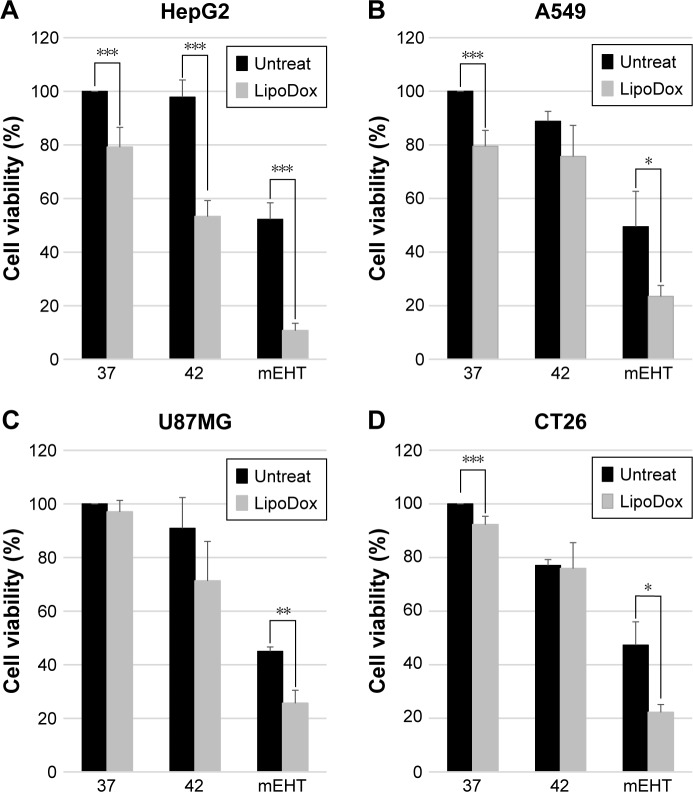
Figure 1
Figure 1
Inhibition of cell viability with mEHT plus Lipodox® treatment. Notes: Cancer cells (A) HepG2, (B) A549, (C) U87MG, (D) CT26 were incubated under three conditions: in a water bath at 37°C as control, in a water bath at 42°C, and with mEHT at 42°C for 30 minutes. Cells for viability assay were cultured for 24 hours after treatment, and viable cell yield was determined by the Trypan Blue exclusion method. Histograms for the percentage of Trypan Blue-negative cells are shown. Data represent mean ± SD (n=3). *P<0.05, **P<0.01, ***P<0.005. Abbreviations: Lipodox®, liposome-encapsulated doxorubicin; mEHT, modulated electro-hyperthermia.
Figure 2
Figure 2
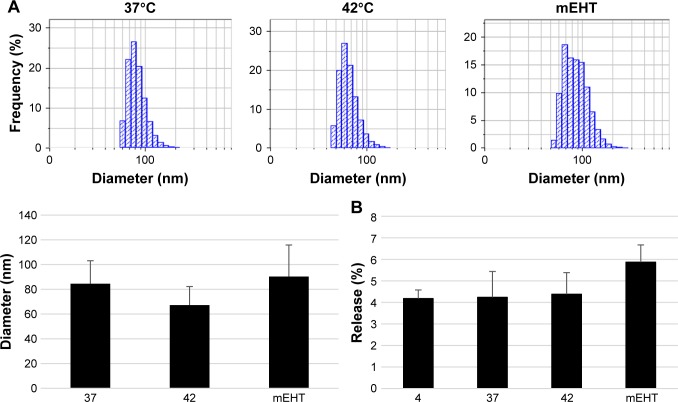
Size distribution and Lipodox®’s doxorubicin-release rate with HT treatment. Notes: (A) The particle size of Lipodox® was measured by DLS after incubation under three different conditions: in water bath at 37°C as control, in water bath at 42°C, and with mEHT at 42°C for 30 minutes. (B) Free form of doxorubicin was measured in the Lipodox®-containing medium after incubation under different conditions: in water baths at 4°C, 37°C, 42°C, and with mEHT at 42°C for 30 minutes. Abbreviations: DLS, dynamic light scattering; HT, hyperthermia; Lipodox®, liposome-encapsulated doxorubicin; mEHT, modulated electro-hyperthermia.
Figure 3
Figure 3
Increased Lipodox® uptake in vitro and in vivo due to mEHT treatment. Notes: (A) Cellular uptake of Lipodox® by various cancer cells (HepG2, A549, U87MG, and CT26wt). Cells were treated for 24 hours with 50 µM of Lipodox® followed by either incubation in water bath at 37°C as control, in water bath at 42°C, and with mEHT at 42°C for 30 minutes. Flow cytometry was used to quantify the uptake of Lipodox® by the cells. Data represent results from experiments repeated three times independently. (B) Fluorescence microscopy images of HepG2 cells which were treated with Lipodox® at 50 µM for 24 hours, followed by incubation in water bath at 37°C as control, in water bath at 42°C, and with mEHT at 42°C for 30 minutes. Nuclei were stained with DAPI (blue), and doxorubicin was indicated by red fluorescence. Magnification 400×. (C) mEHT increased Lipodox® uptake in vivo. Four hours after Lipodox® intravenous treatment (10 mg/kg), CT26-bearing mice were treated in three groups under incubation in water bath at 37°C as control, in water bath at 42°C, and with mEHT at 42°C for 30 minutes. Fifteen mice were divided into three groups, each containing five mice. The tumors were dissected and the concentration of doxorubicin was measured by spectrofluorometry. *P<0.05, ***P<0.005. Abbreviations: Lipodox®, liposome-encapsulated doxorubicin; mEHT, modulated electro-hyperthermia.
Figure 4
Figure 4
Effect of endocytic-inhibitors on accumulation of Lipodox® and cell viability in HepG2 cells. Notes: Cells were either untreated or pretreated under separate conditions with various inhibitors. (A) NaN3 as ATPase-inhibitor, (B) CPZ, (C) wortmannin, (D) filipin for 30 minutes at 37°C prior to adding Lipodox® (50 µM). The fluorescence signal was measured following incubation for 3 hours at 37°C in all cases. (E) HepG2 cells for viability assay were cultured for 24 hours after treatment, and viable cell yields were determined by the Trypan Blue exclusion method. Data represent mean ± SD (n=3). *P<0.05 and **P<0.01 compared to control. Abbreviations: CPZ, chlorpromazine; Lipodox®, liposome-encapsulated doxorubicin; Wort, wortmannin.
Figure 5
Figure 5
The stimulation of endocytosis signaling pathway with mEHT treatment. Notes: The roles of (A) cholera toxin B subunit signaling pathway (caveolin pathway), (B) dextran (micropinocytosis), and (C) transferrin (clathrin pathway) in endocytosis of mEHT treatment in HepG2 cells were evaluated. (D) Wortmannin (0.1 µM) was used to observe the dextran uptake inhibition effect. (E) The activation of EGFR was determined by immunoblotting for Y1068 phosphorylation. Lysates of HepG2, A549, and U87MG were harvested after mEHT treatment at 10 minutes, 6 hours, and 24 hours. GAPDH and beta-actin were served as internal control. *P<0.05, ***P<0.005. Abbreviations: mEHT, modulated electro-hyperthermia; Wort, wortmannin; CB-T, Cholera toxin B subunit; Trf, transferrin.
Figure 6
Figure 6
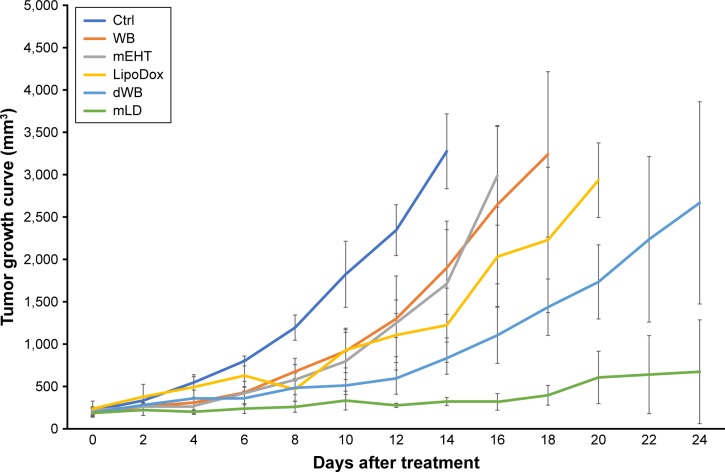
Decreased tumor growth with in vivo treatment of inbred colon cancer mice model. Notes: CT26-injected BALB/c mice were untreated (control [Ctrl], n=6) or treated under different conditions: WB (n=6), mEHT (n=7), Lipodox® (n=7), dWB (n=7), and Lipodox® plus mEHT (n=7). Tumors were measured at days 0–24 after treatment. Tumor growth curves showed that Lipodox® plus mEHT treatments inhibited tumor growth significantly better than other groups. Abbreviations: dWB, Lipodox® plus WB; mEHT, modulated electro-hyperthermia; mLD, Lipodox® plus mEHT; WB, water bath.

References

    1. Andocs G, Renner H, Balogh L, Fonyad L, Jakab C, Szasz A. Strong synergy of heat and modulated electromagnetic field in tumor cell killing. Strahlenther Onkol. 2009;185(2):120–126. - PubMed
    1. Szasz A, Vincze G, Szasz O, Szasz N. An energy analysis of extracellular hyperthermia. Electromagn Biol Med. 2003;22(2–3):103–115.
    1. Andocs G, Szasz O, Szasz A. Oncothermia treatment of cancer: from the laboratory to clinic. Electromagn Biol Med. 2009;28(2):148–165. - PubMed
    1. Szasz A, Szasz N, Szasz O. Oncothermia: a new kind of oncologic hyperthermia Oncothermia: Principles and Practices. Netherlands: Springer; 2010. pp. 173–392.
    1. Szasz A, Vincze G. Dose concept of oncological hyperthermia: heat-equation considering the cell destruction. J Can Res Ther. 2006;2(4):171–181. - PubMed

MeSH terms