Review
. 2019 Feb 20:14:1311-1333.
doi: 10.2147/IJN.S189587. eCollection 2019.

3D printing approaches for cardiac tissue engineering and role of immune modulation in tissue regeneration

Affiliations
Review

3D printing approaches for cardiac tissue engineering and role of immune modulation in tissue regeneration

Muhammad Qasim et al. Int J Nanomedicine. .

Abstract

Conventional tissue engineering, cell therapy, and current medical approaches were shown to be successful in reducing mortality rate and complications caused by cardiovascular diseases (CVDs). But still they have many limitations to fully manage CVDs due to complex composition of native myocardium and microvascularization. Fabrication of fully functional construct to replace infarcted area or regeneration of progenitor cells is important to address CVDs burden. Three-dimensional (3D) printed scaffolds and 3D bioprinting technique have potential to develop fully functional heart construct that can integrate with native tissues rapidly. In this review, we presented an overview of 3D printed approaches for cardiac tissue engineering, and advances in 3D bioprinting of cardiac construct and models. We also discussed role of immune modulation to promote tissue regeneration.

Keywords: cardiovascular diseases; cell therapy; regeneration; scaffolds.


Conflict of interest statement

Disclosure The authors report no conflicts of interest in this work.

Figures
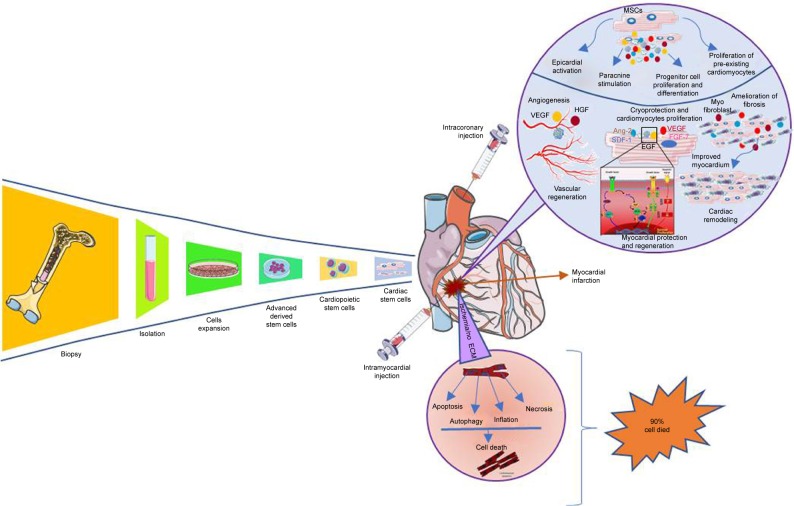
Figure 1
Figure 1
Cell therapy to treat MI, isolation, injection, repair, and apoptosis. Abbreviations: HGF, human growth factor; MI, myocardial infarction; MSC, mesenchymal stem cell; VEGF, vascular endothelial growth factor.
Figure 2
Figure 2
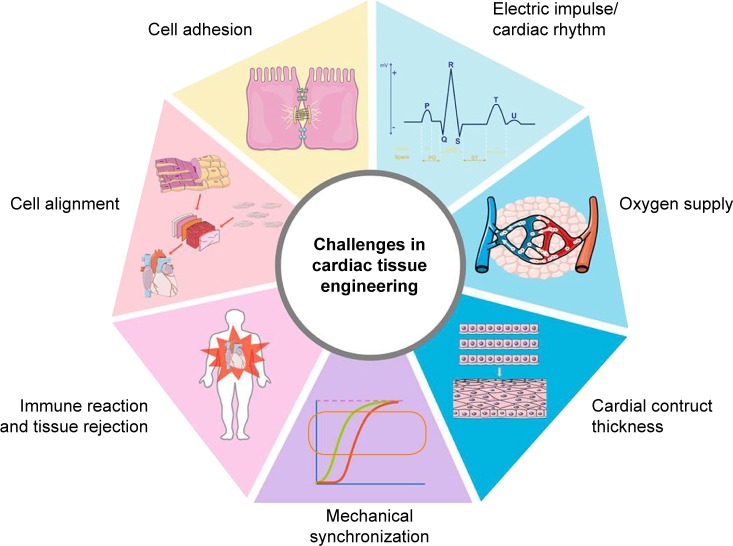
Graphical representation of challenges in cardiac tissue engineering.
Figure 3
Figure 3
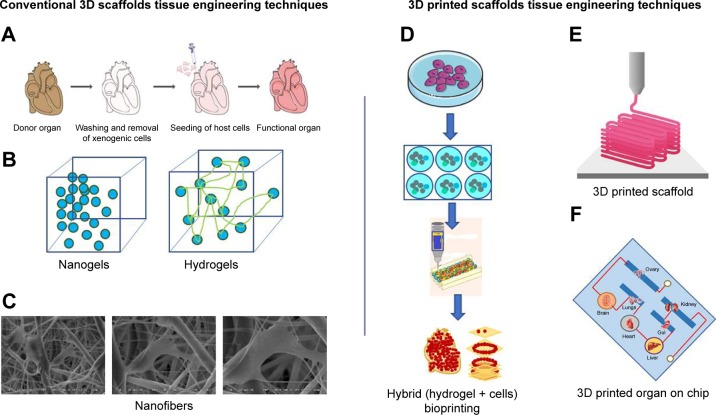
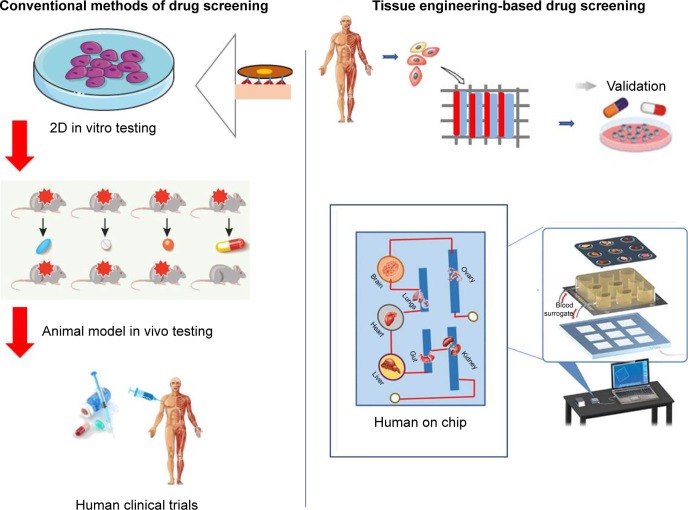
Comparison of conventional and modern 3D printed scaffold-based tissue engineering techniques: (A) decellularization, (B) hydrogels, (C) nanofibers, (D) spheroids and hydrogel hybrid bioprinting, (E) 3D scaffold printing, and (F) 3D printed microfluidics chip. Abbreviation: 3D, three-dimensional.
Figure 4
Figure 4
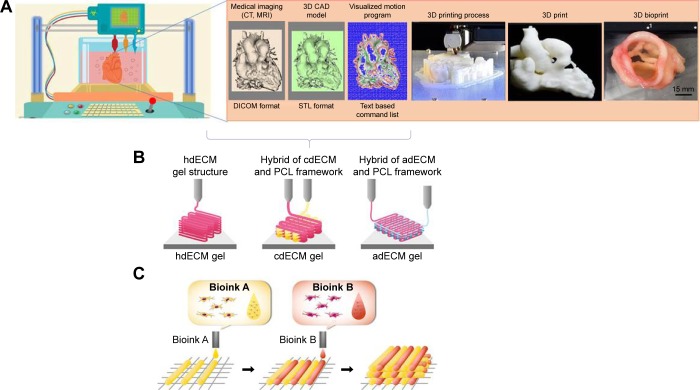
Process of 3D bioprinting, (A) steps of 3D bioprinting, (B) pre-scaffold fabrication bioprinting, (C) simultaneous hybrid 3D bioprinting. Abbreviations: 3D, three-dimensional; CAD, computer-aided design; PCL, polycaprolactone; hdECM, heart decellularized-extracellular matrix; cdECM, cartilage decellularized-extracellular matrix; adECM, adipose decellularized-extracellular matrix.
Figure 5
Figure 5
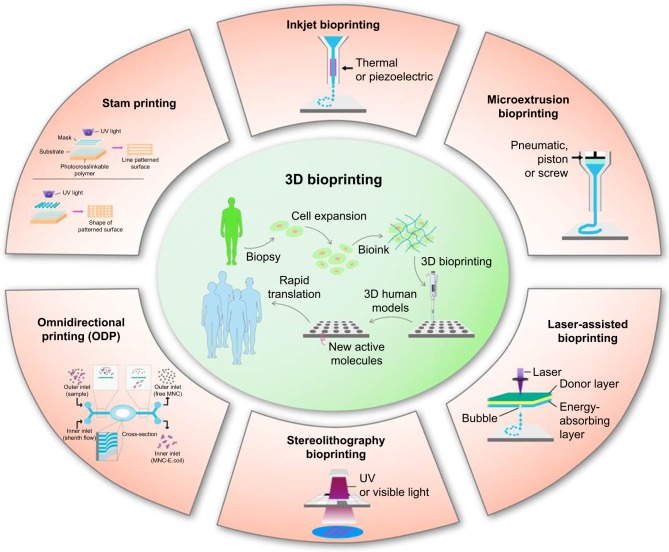
3D bioprinting technology and its types. Abbreviations: 3D, three-dimensional; UV, ultraviolet.
Figure 6
Figure 6
Conventional vs 3D microfluidics-based drug screening model for cardiotoxicity testing. Abbreviation: 3D, three-dimensional.
Figure 7
Figure 7
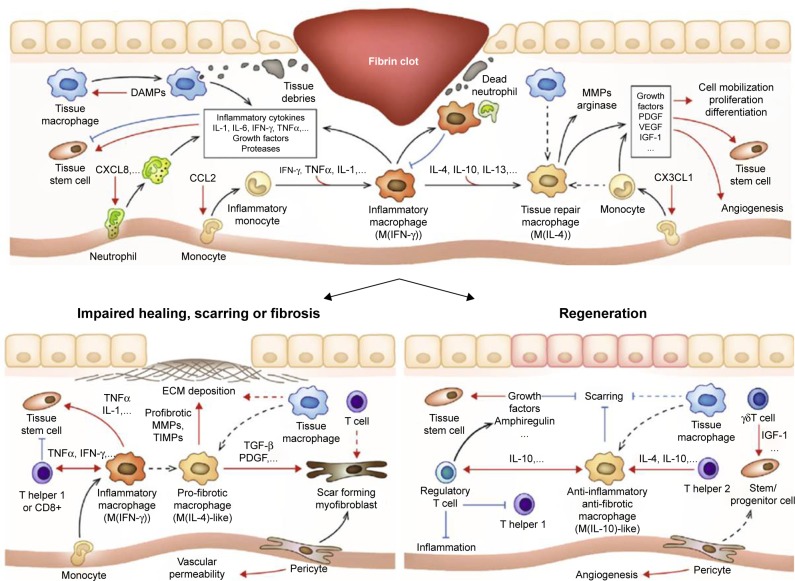
Multiple immunologic reactions during tissue repair and regeneration process. Notes: Biomaterials-based tissue-engineered scaffolds are developed to deliver molecules, which promote regenerative pathways rather than proinflammatory pathways. Reprinted from Acta Biomater, 53, Julier Z, Park AJ, Briquez PS, Martino MM, Promoting tissue regeneration by modulating the immune system, 13–28, Copyright (2017), with permission from Elsevier. Abbreviations: ECM, extracellular matrix; IFN, interferon; IGF, insulin-like growth factor; MMP, matrix metalloproteinase; PDGF, platelet-derived growth factor; TIMP, tissue inhibitor of metalloproteinase; TNF, tumor necrosis factor; VEGF, vascular endothelial growth factor.

References

    1. Roth GA, Johnson C, Abajobir A, et al. Global, regional, and national burden of cardiovascular diseases for 10 causes, 1990 to 2015. J Am Coll Cardiol. 2017;70(1):1–25. - PMC - PubMed
    1. Writing Group Members. Mozaffarian D, Benjamin EJ, et al. Heart disease and stroke Statistics-2016 update: a report from the American Heart Association. Circulation. 2016;133(4):e38–e360. - PubMed
    1. Townsend N, Nichols M, Scarborough P, Rayner M. Cardiovascular disease in Europe – epidemiological update 2015. Eur Heart J. 2015;36(40):2696–2705. - PubMed
    1. Carabello BA, Crawford FA. Valvular heart disease. N Engl J Med. 1997;337(1):32–41. - PubMed
    1. Mickell JJ, Mathews RA, Park SC, et al. Left atrioventricular valve atresia: clinical management. Circulation. 1980;61(1):123–127. - PubMed