


Histamine H3 receptor antagonist E177 attenuates amnesia induced by dizocilpine without modulation of anxiety-like behaviors in rats
- PMID: 30863075
- PMCID: PMC6388968
- DOI: 10.2147/NDT.S193125
Histamine H3 receptor antagonist E177 attenuates amnesia induced by dizocilpine without modulation of anxiety-like behaviors in rats
Abstract
Background: Alzheimer disease (AD) is the main cause of dementia in elderly people. The potential of histamine H3 receptor (H3R) antagonists as a pharmacological treatment of several neuropsychiatric diseases is well established.
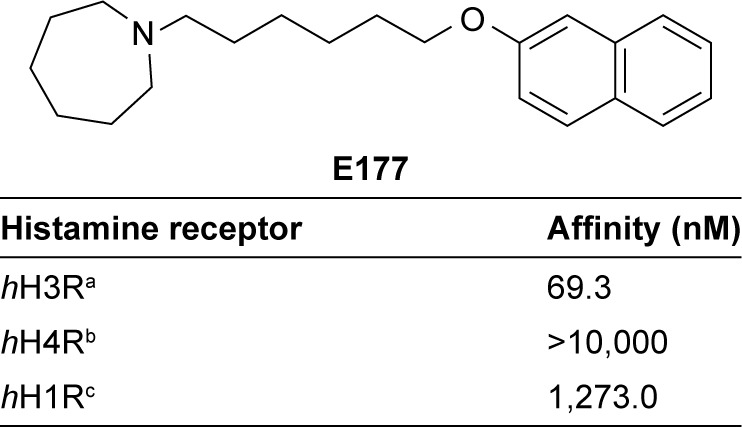
Methods: The novel non-imidazole-based H3R antagonist E177 was screened for its pro-cognitive effects on the inhibitory avoidance paradigm (IAP) and novel object recognition (NOR) task in a dizocilpine (DIZ)-induced model of amnesia in male Wistar rats. Donepezil, an acetylcholine esterase inhibitor, was used as the reference drug.
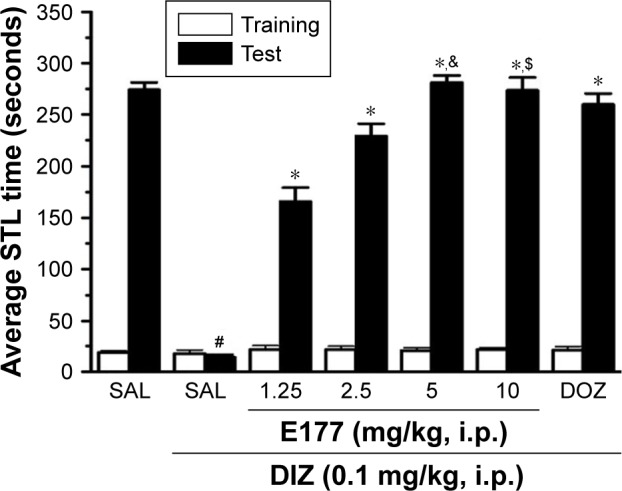
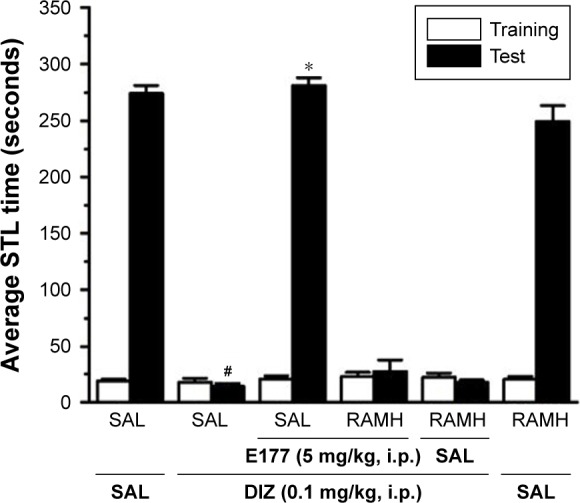
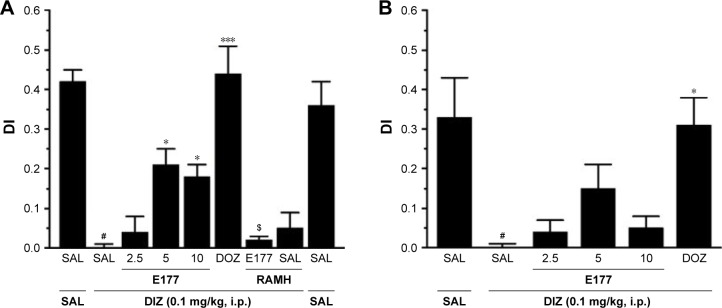
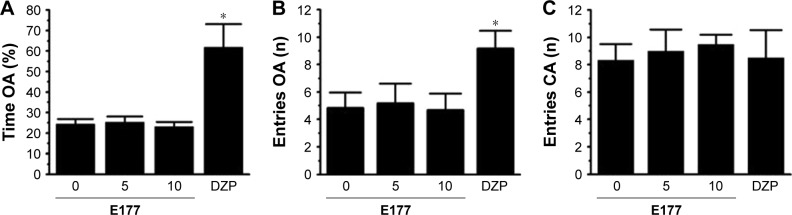
Results: Acute systemic treatment with E177 (1.25, 2.5, 5, and 10 mg/kg intraperitoneally [i.p.]) significantly attenuated the cognitive impairments induced by DIZ in the IAP (all P-values <0.05, n=7), and the protective effect of the most promising dose of E177 (5 mg/kg) was abrogated when H3R agonist R-(α)-methylhistamine (RAMH; 10 mg/kg i.p.) was co-administered (P=0.281 for DIZ-amnesia group vs DIZ + E177 + RAMH group, n=7). The discrimination index calculated for E177 (5 mg/kg, i.p.) showed a significant memory-enhancing effect on DIZ-induced short-term memory impairment in the NOR task (P<0.05, n=6), with the enhancement nullified when animals were co-administered RAMH (10 mg/kg). Moreover, the results revealed that E177 (5 and 10 mg/kg, i.p.) did not alter the anxiety levels and locomotor activity of animals naïve to the open-field test (all P-values >0.05, n=8) or the elevated plus maze test (all P-values >0.05, n=6-8), which indicated that the E177-induced enhancement of memory performance in the IAP or NOR task was unrelated to changes in emotional response or in spontaneous locomotor activity.
Conclusion: The observed results suggested a possible contribution of H3Rs in the alteration of brain neurotransmitters that accompany neurodegenerative diseases, such as AD.
Keywords: Histamine H3 receptors; antagonist; anxiety; dizocilpine-induced amnesia; elevated plus maze; inhibitory avoidance paradigm; memory; novel object recognition; open field test.
Conflict of interest statement
Disclosure The authors report no conflicts of interest in this work.
Figures
References
-
- Kivipelto M, Mangialasche F, Ngandu T. Lifestyle interventions to prevent cognitive impairment, dementia and Alzheimer disease. Nat Rev Neurol. 2018;14(11):653–666. - PubMed
-
- Ozaki T, Katsumata Y, Arai A. Association between changes in the use of psychotropic drugs and behavioural and psychological symptoms of dementia over 1 year among long-term care facility residents. Psychogeriatrics. 2018 Oct;:18. Epub. - PubMed
-
- Shaik JB, Palaka BK, Penumala M, et al. Synthesis, pharmacological assessment, molecular modeling and in silico studies of fused tricyclic coumarin derivatives as a new family of multifunctional anti-Alzheimer agents. Eur J Med Chem. 2016;107:219–232. - PubMed
-
- Khunnawutmanotham N, Chimnoi N, Saparpakorn P, Techasakul S. Synthesis and anti-acetylcholinesterase activity of scopoletin derivatives. Bioorg Chem. 2016;65:137–145. - PubMed
LinkOut - more resources
Full Text Sources
Research Materials
