Validation of the Korean-Everyday Cognition (K-ECog)
- PMID: 30863265
- PMCID: PMC6406041
- DOI: 10.3346/jkms.2019.34.e67
Validation of the Korean-Everyday Cognition (K-ECog)
Abstract
Background: In the early diagnosis of dementia, an important factor is the evaluation of activities of daily living. The Everyday Cognition (ECog) scale was developed to measure functional changes that are the everyday correlates of specific neuropsychological impairments. This study aimed to examine the validity of the Korean version of Everyday Cognition (K-ECog).
Methods: The participants were 268 cognitively normal older adults (NA), 151 amnestic mild cognitive impairment (aMCI), and 77 dementia of the Alzheimer's type (DAT). The Korean-Mini Mental State Examination (K-MMSE), Korean-Montreal Cognitive Assessment (K-MoCA), and Short form of the Geriatric Depression Scale (SGDS) were administered to all the participants. The K-ECog and Korean-Instrumental Activities of Daily Living (K-IADL) were rated by their informants.
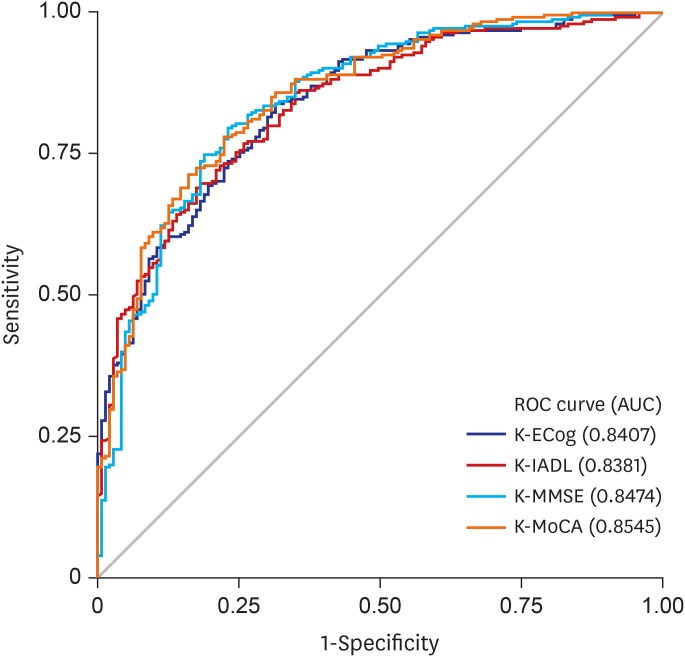
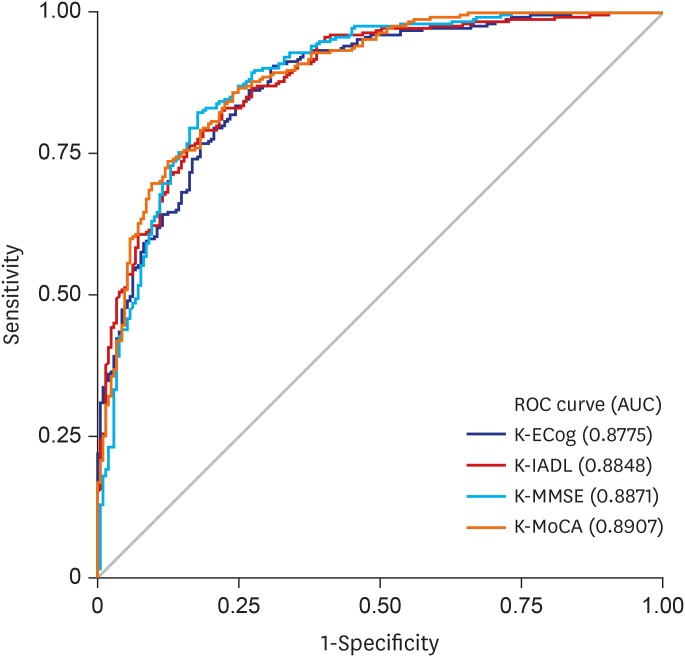
Results: Internal consistency (Cronbach's α) of K-ECog global function was 0.93, and its test-retest reliability (Pearson's r) was 0.73. K-ECog was significantly correlated with K-IADL (0.66), K-MMSE (-0.38), and K-MoCA (-0.26). Confirmatory factor analysis of K-ECog yielded seven factor model that the original ECog proposed. K-ECog global score and six domain scores were significantly different across the NA, aMCI, and DAT groups. Receiver operating characteristic curve analyses showed that K-ECog effectively differentiated aMCI and DAT patients from NA, suggesting that K-ECog is as sensitive for detecting functional impairments as K-IADL. The proposed optimal cut-off score to differentiate aMCI from NA was 1.41.
Conclusion: K-ECog is proven reliable and valid for clinical use. K-ECog can be used to distinguish very early stages of impaired ADL and cognitive impairment in the community.
Keywords: Activities of Daily Living; Dementia; Everyday Cognition; Mild Cognitive Impairment.
Conflict of interest statement
Disclosure: The authors have no potential conflicts of interest to disclose.
Figures

References
-
- Petersen RC, Smith GE, Waring SC, Ivnik RJ, Tangalos EG, Kokmen E. Mild cognitive impairment: clinical characterization and outcome. Arch Neurol. 1999;56(3):303–308. - PubMed
-
- Albert MS, DeKosky ST, Dickson D, Dubois B, Feldman HH, Fox NC, et al. The diagnosis of mild cognitive impairment due to Alzheimer's disease: recommendations from the National Institute on Aging-Alzheimer's Association workgroups on diagnostic guidelines for Alzheimer's disease. Alzheimers Dement. 2011;7(3):270–279. - PMC - PubMed
-
- Rockwood K. The measuring, meaning and importance of activities of daily living (ADLs) as an outcome. Int Psychogeriatr. 2007;19(3):467–482. - PubMed
MeSH terms
LinkOut - more resources
Full Text Sources
Medical