Review
. 2019 Feb 26:10:154.
doi: 10.3389/fphys.2019.00154. eCollection 2019.

Xenbase: Facilitating the Use of Xenopus to Model Human Disease

Affiliations
Review

Xenbase: Facilitating the Use of Xenopus to Model Human Disease

Mardi J Nenni et al. Front Physiol. .

Abstract

At a fundamental level most genes, signaling pathways, biological functions and organ systems are highly conserved between man and all vertebrate species. Leveraging this conservation, researchers are increasingly using the experimental advantages of the amphibian Xenopus to model human disease. The online Xenopus resource, Xenbase, enables human disease modeling by curating the Xenopus literature published in PubMed and integrating these Xenopus data with orthologous human genes, anatomy, and more recently with links to the Online Mendelian Inheritance in Man resource (OMIM) and the Human Disease Ontology (DO). Here we review how Xenbase supports disease modeling and report on a meta-analysis of the published Xenopus research providing an overview of the different types of diseases being modeled in Xenopus and the variety of experimental approaches being used. Text mining of over 50,000 Xenopus research articles imported into Xenbase from PubMed identified approximately 1,000 putative disease- modeling articles. These articles were manually assessed and annotated with disease ontologies, which were then used to classify papers based on disease type. We found that Xenopus is being used to study a diverse array of disease with three main experimental approaches: cell-free egg extracts to study fundamental aspects of cellular and molecular biology, oocytes to study ion transport and channel physiology and embryo experiments focused on congenital diseases. We integrated these data into Xenbase Disease Pages to allow easy navigation to disease information on external databases. Results of this analysis will equip Xenopus researchers with a suite of experimental approaches available to model or dissect a pathological process. Ideally clinicians and basic researchers will use this information to foster collaborations necessary to interrogate the development and treatment of human diseases.

Keywords: Xenbase; Xenopus; cell-free egg extract; human disease; model organism database; ontologies; oocyte.


Figures
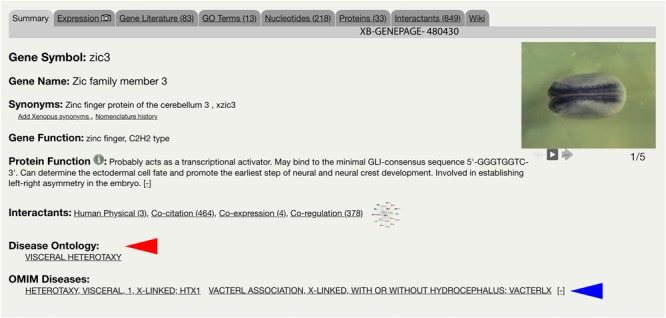
FIGURE 1
FIGURE 1
Xenbase Gene Page for zic3. Gene-disease annotations are located below Interactants on the Summary tab of the Xenbase Gene Page. Disease Ontology (DO) annotations (red arrowhead) are made via DO-OMIM cross reference or manual curation. OMIM annotations (blue arrowhead) are imported from the National Center for Biotechnology Information (NCBI). DO and OMIM terms link to Xenbase Disease Pages.
FIGURE 2
FIGURE 2
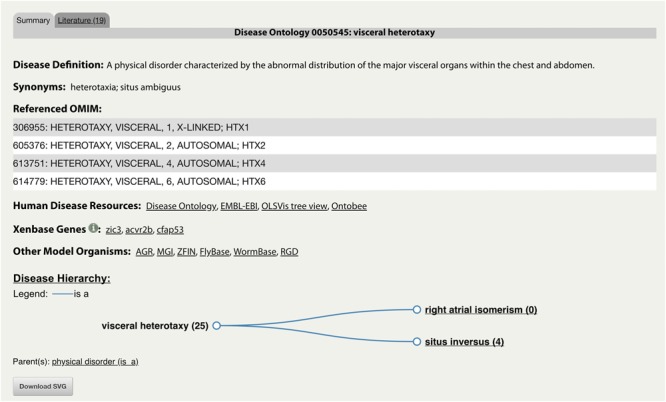
Xenbase Disease Page for “DOID:0050545: visceral heterotaxy.” An example of a new Disease Page with disease-specific supporting information including associated human and model organism resource links. The representative disease and its descendants are displayed in a Disease Hierarchy with the number of associated Xenbase articles in parentheses. The Literature tab provides a list of all associated Xenbase articles.
FIGURE 3
FIGURE 3
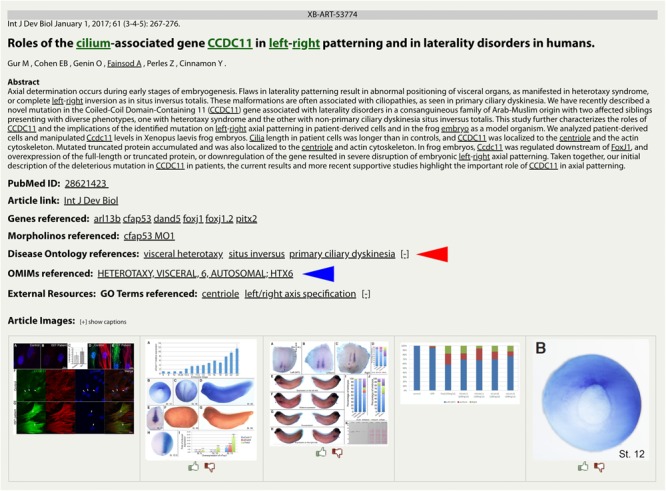
DO and OMIM references on a Xenbase Article Page. Disease terms link directly to the collated data on a Disease Page for DO (red arrowhead) annotations and OMIM (blue arrowhead) annotations. Multiple disease annotations can be seen by clicking the [+/–] toggle to show more or fewer results. Article Pages also list GO terms as keywords to cover the major topics of an article.
FIGURE 4
FIGURE 4
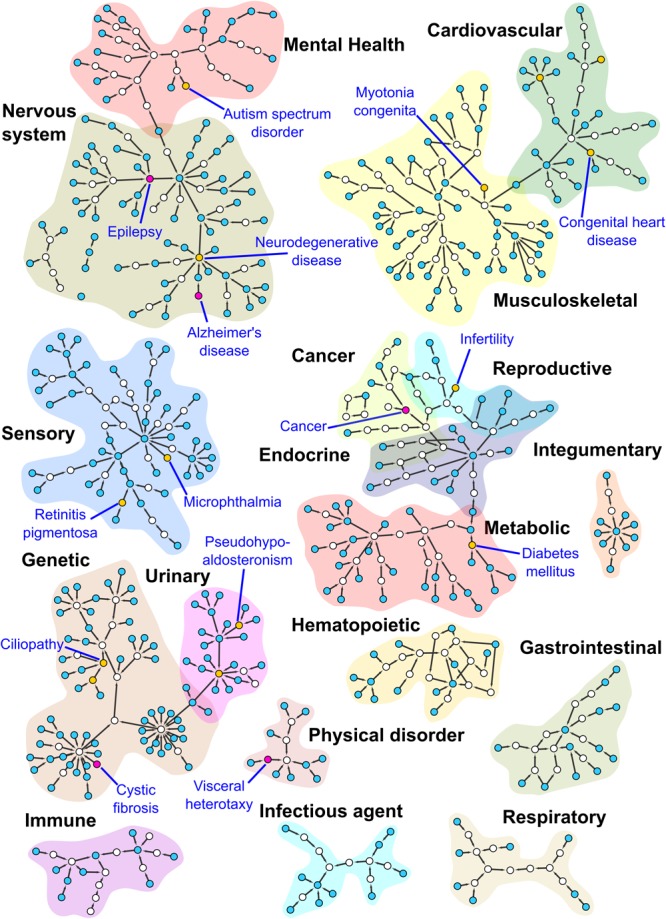
Subnetworks from the DO. This figure shows MCL clustered subnetworks from a subset of the DO, consisting of terms annotated during our curation of the Xenbase human disease corpus detailed in the Supplementary Material. Nodes in the network are colored according to the number of direct annotations to the term they represent. Empty nodes have no direct annotations, blue nodes 1–5, yellow nodes 6–14 and purple nodes 15 and higher. Purple nodes and the yellow node(s) with the highest number of annotations for each cluster have been labeled. Cluster regions corresponding to high level DO terms have been highlighted for contrast and labeled. Some small subnetworks and singleton nodes have been moved to proximity with the high level DO term to which they are associated.
FIGURE 5
FIGURE 5
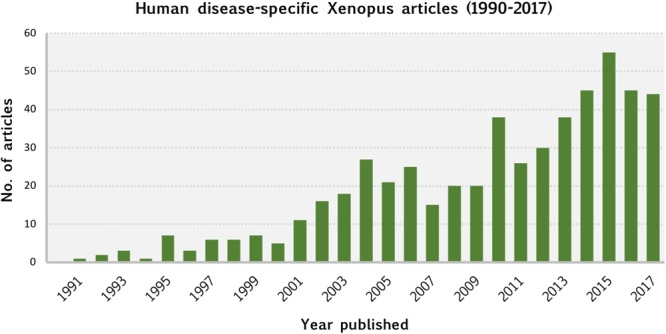
Human disease-specific Xenopus articles (1990–2017). This chart shows the number of articles published, by year, between 1990 and 2017 that our curation identified as utilizing Xenopus as a model system for studying human disease. Publication dates were obtained from NCBI’s PubMed database.

References

    1. Ashburner M., Ball C. A., Blake J. A., Botstein D., Butler H., Cherry J. M., et al. (2000). Gene ontology: tool for the unification of biology. The Gene Ontology Consortium. Nat. Genet. 25 25–29. 10.1038/75556 - DOI - PMC - PubMed
    1. Aslan Y., Tadjuidje E., Zorn A. M., Cha S. W. (2017). High-efficiency non-mosaic CRISPR-mediated knock-in and indel mutation in F0 Xenopus. Development 144 2852–2858. 10.1242/dev.152967 - DOI - PMC - PubMed
    1. Bantle J. A., Fort D. J., Rayburn J. R., DeYoung D. J., Bush S. J. (1990). Further validation of FETAX: evaluation of the developmental toxicity of five known mammalian teratogens and non-teratogens. Drug Chem. Toxicol. 13 267–282. 10.3109/01480549009032286 - DOI - PubMed
    1. Bell M. R., Belarde J. A., Johnson H. F., Aizenman C. D. (2011). A neuroprotective role for polyamines in a Xenopus tadpole model of epilepsy. Nat. Neurosci. 14 505–512. 10.1038/nn.2777 - DOI - PubMed
    1. Bello S. M., Shimoyama M., Mitraka E., Laulederkind S. J. F., Smith C. L., Eppig J. T., et al. (2018). Disease Ontology: improving and unifying disease annotations across species. Dis. Model. Mech. 11:dmm032839. 10.1242/dmm.032839 - DOI - PMC - PubMed

LinkOut - more resources