


Gut Hormones and Their Effect on Bone Metabolism. Potential Drug Therapies in Future Osteoporosis Treatment
- PMID: 30863364
- PMCID: PMC6399108
- DOI: 10.3389/fendo.2019.00075
Gut Hormones and Their Effect on Bone Metabolism. Potential Drug Therapies in Future Osteoporosis Treatment
Abstract
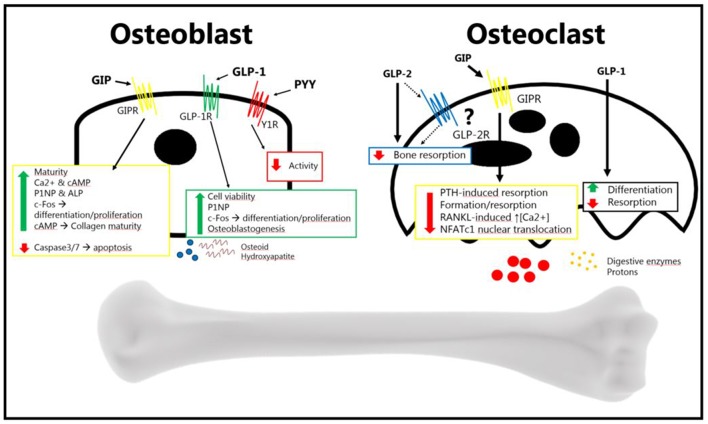
Bone homeostasis displays a circadian rhythm with increased resorption during the night time as compared to day time, a difference that seems-at least partly-to be caused by food intake during the day. Thus, ingestion of a meal results in a decrease in bone resorption, but people suffering from short bowel syndrome lack this response. Gut hormones, released in response to a meal, contribute to this link between the gut and bone metabolism. The responsible hormones appear to include glucose-dependent insulinotropic polypeptide (GIP) and glucagon-like peptide-1 (GLP-1), known as incretin hormones due to their role in regulating glucose homeostasis by enhancing insulin release in response to food intake. They interact with their cognate receptors (GIPR and GLP-1R), which are both members of the class B G protein-coupled receptors (GPCRs), and already recognized as targets for treatment of metabolic diseases, such as type 2 diabetes mellitus (T2DM) and obesity. Glucagon-like peptide-2 (GLP-2), secreted concomitantly with GLP-1, acting via another class B receptor (GLP-2R), is also part of this gut-bone axis. Several studies, including human studies, have indicated that these three hormones inhibit bone resorption and, moreover, that GIP increases bone formation. Another hormone, peptide YY (PYY), is also secreted from the enteroendocrine L-cells (together with GLP-1 and GLP-2), and acts mainly via interaction with the class A GPCR NPY-R2. PYY is best known for its effect on appetite regulation, but recent studies have also shown an effect of PYY on bone metabolism. The aim of this review is to summarize the current knowledge of the actions of GIP, GLP-1, GLP-2, and PYY on bone metabolism, and to discuss future therapies targeting these receptors for the treatment of osteoporosis.
Keywords: GIP; GLP-1; GLP-2; PYY; bone metabolism; gut hormones; osteoporosis.
Figures
References
-
- Kitay AM, Geibel JP. Stomach and bone In: McCabe LR, Parameswaran N. editors. Understanding the Gut-Bone Axis. Mechanisms and Therapeutic Implications. Cham: Springer; p. 97–131.
-
- Silva MJ, Gibson LJ. Modeling the mechanical behaviour of vertebal trabecular bone: effects of age-related changes in microstructure. Bone (1997) 21:191–9. - PubMed
Publication types
LinkOut - more resources
Full Text Sources
Miscellaneous
