Pattern of recurrence after CyberKnife stereotactic body radiotherapy for peripheral early non-small cell lung cancer
- PMID: 30863591
- PMCID: PMC6384354
- DOI: 10.21037/jtd.2018.12.115
Pattern of recurrence after CyberKnife stereotactic body radiotherapy for peripheral early non-small cell lung cancer
Abstract
Background: The treatment efficacy after CyberKnife stereotactic body radiotherapy (SBRT) have not been adequately addressed. The purpose of this study was to investigate pattern of recurrence according to irradiation field after CyberKnife SBRT for early-stage non-small cell lung cancer (NSCLC).
Methods: This retrospective study included patients with peripheral cT1/2N0M0 NSCLC that was treated with SBRT using a CyberKnife between May 2013 and March 2016 at single institute and followed up by more than two imaging examinations. Both operable and inoperable patients were included. Overall survival (OS) and progression-free survival (PFS) curves were estimated using the Kaplan-Meier method with 95% confidence intervals (CI). Cumulative incidence curves of recurrence were calculated and compared using the Gray's test.
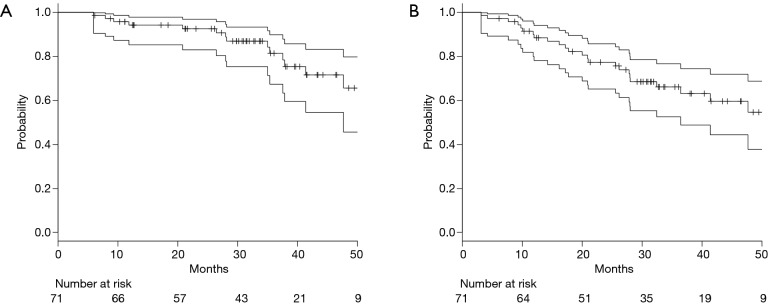
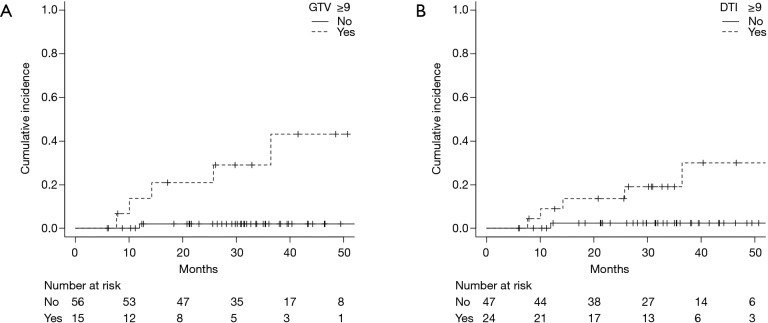
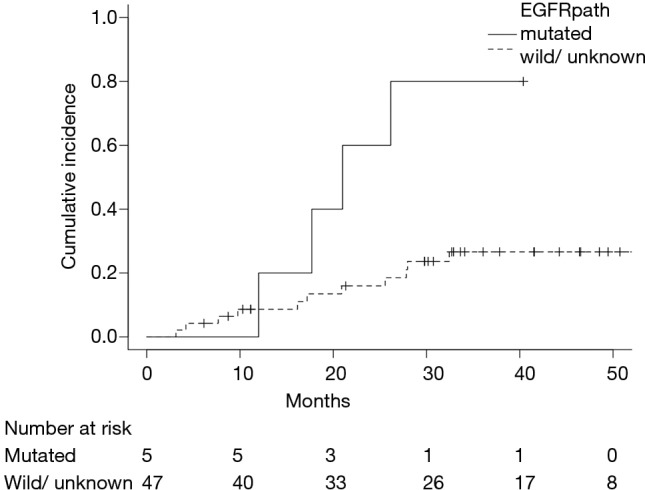
Results: Total 71 patients were included and analyzed in this study. The median follow-up period for surviving patients was 34 months (range, 7-64 months). The 2-year OS and PFS rate were 93% (95% CI: 83-97%) and 77% (95% CI: 65-86%), respectively. The 2-year cumulative incidence rate of infield recurrence and out-of-field recurrence were 6% (95% CI: 2-14%) and 17% (95% CI: 9-27%), respectively. Gross tumor volume (GTV) ≥9 mL and diagnosis-to-treatment interval (DTI) ≥90 days were significantly associated with infield recurrence (P<0.001 and P=0.007), and epidermal growth factor receptor (EGFR) mutation was significantly associated with out-of-field recurrence (P=0.014).
Conclusions: Treatment efficacy after CyberKnife SBRT for peripheral early-stage NSCLC was identical to previous conventional linac-based SBRT reports. With short follow-up period, it was found that GTV and DTI were the significant predictive factor of infield recurrence, and EGFR mutation was the significant predictive factor of out-of-field recurrence.
Keywords: CyberKnife; Stereotactic body radiotherapy (SBRT); epidermal growth factor receptor (EGFR); lung cancer; recurrence.
Conflict of interest statement
Conflicts of Interest: The authors have no conflicts of interest to declare.
Figures
References
-
- Ohri N, Werner-Wasik M, Grills IS, et al. Modeling local control after hypofractionated stereotactic body radiation therapy for stage I non-small cell lung cancer: a report from the elekta collaborative lung research group. Int J Radiat Oncol Biol Phys 2012;84:e379-84. 10.1016/j.ijrobp.2012.04.040 - DOI - PMC - PubMed
LinkOut - more resources
Full Text Sources
Research Materials
Miscellaneous