


Understanding Social Communication Differences in Autism Spectrum Disorder and First-Degree Relatives: A Study of Looking and Speaking
- PMID: 30864059
- PMCID: PMC7261276
- DOI: 10.1007/s10803-019-03969-3
Understanding Social Communication Differences in Autism Spectrum Disorder and First-Degree Relatives: A Study of Looking and Speaking
Abstract
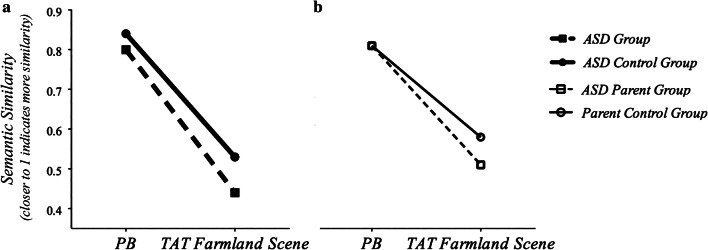
This study examined narrative ability in ASD and parents across two contexts differing in structure and emotional content, and explored gaze patterns that may underlie narrative differences by presenting narrative tasks on an eye tracker. Participants included 37 individuals with ASD and 38 controls, 151 parents of individuals with ASD and 63 parent controls. The ASD and ASD parent groups demonstrated lower narrative quality than controls in the less structured narrative task only. Subtler, context-dependent differences emerged in gaze and showed some associations with narrative quality. Results indicate a narrative ability profile that may reflect genetic liability to ASD, and subtle links between visual attention and complex language skills that may be influenced by ASD genetic risk.
Keywords: Autism spectrum disorder; Communication; Eye gaze; Language; Narrative; Visual attention.
Conflict of interest statement
The authors declare that they have no disclosures or conflict of interest.
Figures



References
-
- Association AP. Diagnostic and statistical manual of mental disorders (DSM-IV) 4. Washington, DC: American Psychiatric Association; 1994.
-
- Association AP. Diagnostic and statistical manual of mental disorders: DSM-5. 5. Arlington: American Psychiatric Association; 2013.
-
- Bamberg M. The acquisition of narratives: Learning to use language. Berlin-New York-Amsterdam: Mouton de Gruyter; 1987.
MeSH terms
Grants and funding
LinkOut - more resources
Full Text Sources
Medical
