


Comment
doi: 10.1152/ajprenal.00102.2019.
Epub 2019 Mar 13.
Targeting a fibrotic bottleneck may provide an opening in the treatment of LUTS
Affiliations
- PMID: 30864837
- PMCID: PMC6620586
- DOI: 10.1152/ajprenal.00102.2019
Item in Clipboard
Comment
Targeting a fibrotic bottleneck may provide an opening in the treatment of LUTS
Am J Physiol Renal Physiol.
.
No abstract available
Conflict of interest statement
No conflicts of interest, financial or otherwise, are declared by the authors.
Figures
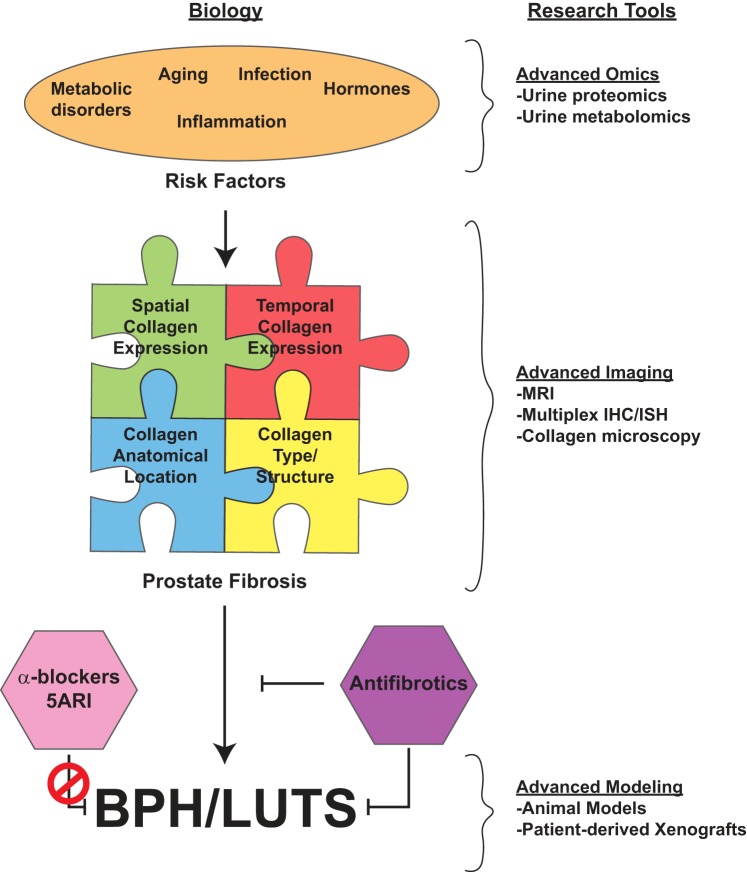
Schematic of prostate fibrosis and benign prostatic hyperplasia (BPH)/lower urinary tract symptoms (LUTS). Some factors contributing to the development of fibrosis include infection (2a), metabolic disorders (e.g., type 2 diabetes and obesity), hormones, and aging. These can be interrogated for biomarkers with proteomic and metabolomics tools. The impact of fibrosis on BPH/LUTS must include an understanding of spatial (i.e., cell types) and temporal (progressive remodeling) collagen expression, anatomic location (periurethral vs. diffuse throughout prostate) of collagen expression, and type of collagen (e.g., collagen-1, -2,…-29) and structure (i.e., collagen fiber metrics) within the prostate. The research tools necessary to examine fibrosis include a variety of advanced imaging and staining modalities, including picrosirius red, Masson’s trichrome, PolScope, and multiphoton microscopy. Current treatments for BPH/LUTS [i.e., 5α-reductase inhibitors (5ARIs) and α-blockers] are ineffective at treating fibrosis-mediated disease. Instead, antifibrotic treatments need to be developed using preclinical animal and patient-derived models to prevent or treat fibrosis-mediated BPH/LUTS. IHC, immunohistochemistry; ISH, in situ hybridization.
Comment on
-
Uropathogenic Escherichia coli-induced fibrosis, leading to lower urinary tract symptoms, is associated with type 2 cytokine signaling.Am J Physiol Renal Physiol. 2019 Apr 1;316(4):F682-F692. doi: 10.1152/ajprenal.00222.2018. Epub 2019 Jan 9. Am J Physiol Renal Physiol. 2019. PMID: 30623726 Free PMC article.
References
-
- Ashok A, Keener R, Rubenstein M, Stookey S, Bajpai S, Hicks J, Alme AK, Drake CG, Zheng Q, Trabzonlu L, Yegnasubramanian S, De Marzo AM, Bieberich CJ. Consequences of interleukin 1β-triggered chronic inflammation in the mouse prostate gland: altered architecture associated with prolonged CD4+ infiltration mimics human proliferative inflammatory atrophy. Prostate. In press. doi: 10.1002/pros.23784. - DOI - PubMed
Publication types
MeSH terms
Substances
Grants and funding
LinkOut - more resources
Full Text Sources
Medical
