


Reproductive Factors and Mammographic Density: Associations Among 24,840 Women and Comparison of Studies Using Digitized Film-Screen Mammography and Full-Field Digital Mammography
- PMID: 30865217
- PMCID: PMC6545283
- DOI: 10.1093/aje/kwz033
Reproductive Factors and Mammographic Density: Associations Among 24,840 Women and Comparison of Studies Using Digitized Film-Screen Mammography and Full-Field Digital Mammography
Abstract
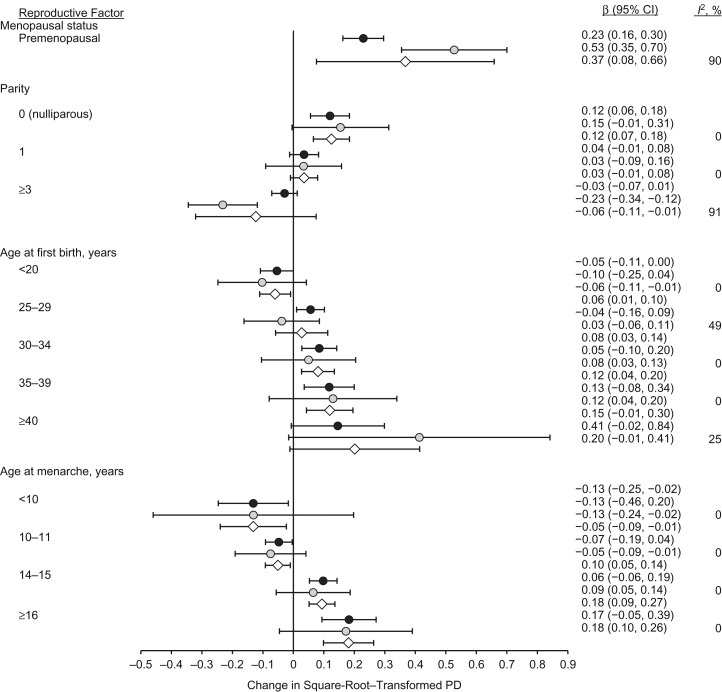
Breast density is a modifiable factor that is strongly associated with breast cancer risk. We sought to understand the influence of newer technologies of full-field digital mammography (FFDM) on breast density research and to determine whether results are comparable across studies using FFDM and previous studies using traditional film-screen mammography. We studied 24,840 screening-age (40-74 years) non-Hispanic white women who were participants in the Research Program on Genes, Environment and Health of Kaiser Permanente Northern California and underwent screening mammography with either Hologic (Hologic, Inc., Marlborough, Massachusetts) or General Electric (General Electric Company, Boston, Massachusetts) FFDM machines between 2003 and 2013. We estimated the associations of parity, age at first birth, age at menarche, and menopausal status with percent density and dense area as measured by a single radiological technologist using Cumulus software (Canto Software, Inc., San Francisco, California). We found that associations between reproductive factors and mammographic density measured using processed FFDM images were generally similar in magnitude and direction to those from prior studies using film mammography. Estimated associations for both types of FFDM machines were in the same direction. There was some evidence of heterogeneity in the magnitude of the effect sizes by machine type, which we accounted for using random-effects meta-analysis when combining results. Our findings demonstrate the robustness of quantitative mammographic density measurements across FFDM and film mammography platforms.
Keywords: breast cancer; mammographic density; mammography; risk factors.
© The Author(s) 2019. Published by Oxford University Press on behalf of the Johns Hopkins Bloomberg School of Public Health. All rights reserved. For permissions, please e-mail: journals.permissions@oup.com.
Figures
References
-
- Boyd NF, Guo H, Martin LJ, et al. . Mammographic density and the risk and detection of breast cancer. N Engl J Med. 2007;356(3):227–236. - PubMed
-
- McCormack VA, dos Santos Silva I. Breast density and parenchymal patterns as markers of breast cancer risk: a meta-analysis. Cancer Epidemiol Biomarkers Prev. 2006;15(6):1159–1169. - PubMed
-
- Boyd NF, Rommens JM, Vogt K, et al. . Mammographic breast density as an intermediate phenotype for breast cancer. Lancet Oncol. 2005;6(10):798–808. - PubMed
-
- Schetter SE, Hartman TJ, Liao J, et al. . Differential impact of body mass index on absolute and percent breast density: implications regarding their use as breast cancer risk biomarkers. Breast Cancer Res Treat. 2014;146(2):355–363. - PubMed
Publication types
MeSH terms
Grants and funding
LinkOut - more resources
Full Text Sources
Medical
