


Using high-resolution residential greenspace measures in an urban environment to assess risks of allergy outcomes in children
- PMID: 30865906
- PMCID: PMC6563346
- DOI: 10.1016/j.scitotenv.2019.03.009
Using high-resolution residential greenspace measures in an urban environment to assess risks of allergy outcomes in children
Abstract
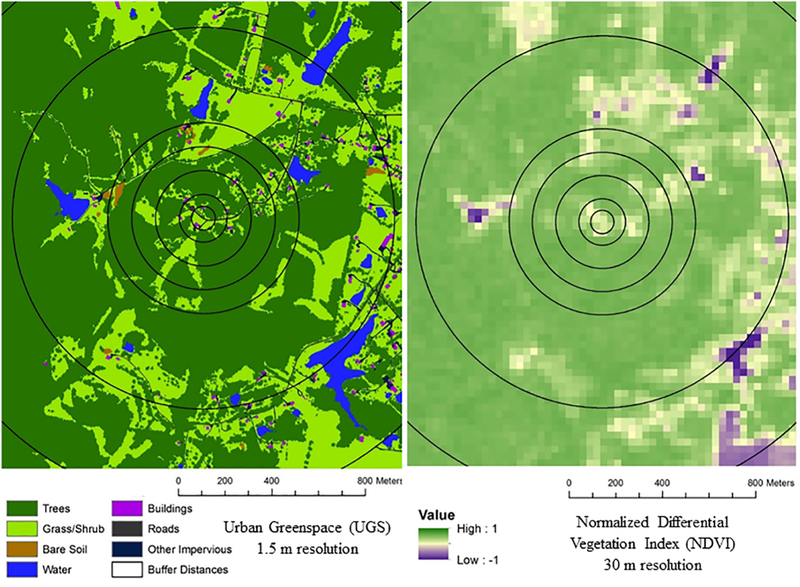
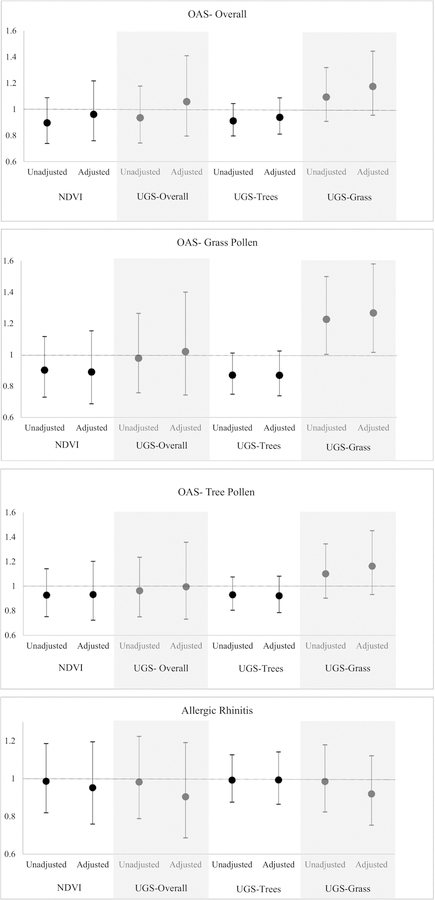
Despite reported health benefits of urban greenspace (gs), the epidemiological evidence is less clear for allergic disease. To address a limitation of previous research, we examined the associations of medium- and high-resolution residential gs measures and tree and/or grass canopies with allergic outcomes for children enrolled in the longitudinal cincinnati childhood allergy and air pollution study (ccaaps). We estimated residential gs based on 400 m radial buffers around participant addresses (n = 478) using the normalized differential vegetation index (ndvi) and land cover-derived urban greenspace (ugs) (tree and grass coverage, combined and separate) at 30 m and 1.5-2.5 m resolution, respectively. Associations between outdoor aeroallergen sensitization and allergic rhinitis at age 7 and residential gs measures at different exposure windows were examined using multivariable logistic regression models. A 10% increase in ugs-derived grass coverage was associated with an increased risk of sensitization to grass pollens (adjusted odds ratio [aor]: 1.27; 95% confidence interval = 1.02-1.58). For each 10% increase in ugs-derived tree canopy coverage, nonstatistically significant decreased odds were found for grass pollen sensitization, tree pollen sensitization, and sensitization to either (aor range = 0.87-0.94). Results similar in magnitude to ugs-tree canopy coverage were detected for ndvi and allergic sensitizations. High-resolution (down to 1.5 m) gs measures of grass- and tree-covered areas showed associations in opposite directions for different allergy outcomes. These data suggest that measures strongly correlated with tree canopy (e.g., ndvi) may be insufficient to detect health effects associated with proximity to different types of vegetation or help elucidate mechanisms related to specific gs exposure pathways.
Keywords: Allergic disease in children; Allergic rhinitis; Allergic sensitization; Normalized differential vegetation index (NDVI); Urban greenspace (UGS).
Published by Elsevier B.V.
Conflict of interest statement
COMPETING INTERESTS
The authors report no competing interests financial or otherwise.
Figures
Similar articles
-
Urban tree canopy and asthma, wheeze, rhinitis, and allergic sensitization to tree pollen in a New York City birth cohort.Environ Health Perspect. 2013 Apr;121(4):494-500. doi: 10.1289/ehp.1205513. Epub 2013 Jan 15. Environ Health Perspect. 2013. PMID: 23322788 Free PMC article.
-
Residential greenness is differentially associated with childhood allergic rhinitis and aeroallergen sensitization in seven birth cohorts.Allergy. 2016 Oct;71(10):1461-71. doi: 10.1111/all.12915. Epub 2016 May 6. Allergy. 2016. PMID: 27087129
-
Residing near allergenic trees can increase risk of allergies later in life: LISA Leipzig study.Environ Res. 2020 Dec;191:110132. doi: 10.1016/j.envres.2020.110132. Epub 2020 Aug 24. Environ Res. 2020. PMID: 32853665
-
Prevention of allergic disease in childhood: clinical and epidemiological aspects of primary and secondary allergy prevention.Pediatr Allergy Immunol. 2004 Jun;15 Suppl 16:4-5, 9-32. doi: 10.1111/j.1399-3038.2004.0148b.x. Pediatr Allergy Immunol. 2004. PMID: 15125698 Review.
-
Exposure to urban greenspace and pathways to respiratory health: An exploratory systematic review.Sci Total Environ. 2022 Jul 10;829:154447. doi: 10.1016/j.scitotenv.2022.154447. Epub 2022 Mar 11. Sci Total Environ. 2022. PMID: 35283125
Cited by
-
Environmental Exposures may Hold the Key; Impact of Air Pollution, Greenness, and Rural/Farm Lifestyle on Allergic Outcomes.Curr Allergy Asthma Rep. 2023 Feb;23(2):77-91. doi: 10.1007/s11882-022-01061-y. Epub 2023 Jan 7. Curr Allergy Asthma Rep. 2023. PMID: 36609951 Free PMC article. Review.
-
An Overview of Environmental Risk Factors for Food Allergy.Int J Environ Res Public Health. 2022 Jan 10;19(2):722. doi: 10.3390/ijerph19020722. Int J Environ Res Public Health. 2022. PMID: 35055544 Free PMC article. Review.
-
Spatial resolution of Normalized Difference Vegetation Index and greenness exposure misclassification in an urban cohort.J Expo Sci Environ Epidemiol. 2022 Mar;32(2):213-222. doi: 10.1038/s41370-022-00409-w. Epub 2022 Jan 29. J Expo Sci Environ Epidemiol. 2022. PMID: 35094014 Free PMC article.
-
Green Space Quality and Health: A Systematic Review.Int J Environ Res Public Health. 2021 Oct 20;18(21):11028. doi: 10.3390/ijerph182111028. Int J Environ Res Public Health. 2021. PMID: 34769549 Free PMC article.
-
The benefits of nature exposure: The need for research that better informs implementation.Proc Natl Acad Sci U S A. 2023 Oct 31;120(44):e2304126120. doi: 10.1073/pnas.2304126120. Epub 2023 Oct 23. Proc Natl Acad Sci U S A. 2023. PMID: 37871200 Free PMC article.
References
-
- AMEC Environment & Infrastructure I. Cincinnati & Hamilton County, Ohio Urban Tree Canopy (UTC) assessment Cincinnati Parks, Cincinnati, OH, 2011.
-
- ArcGIS. ArcGIS desktop: release 10.3.3 Environmental Systems Research Institute, Redlands, CA, 2012.
-
- Asher MI, Keil U, Anderson HR, Beasley R, Crane J, Martinez F, et al. International Study of Asthma and Allergies in Childhood (ISAAC): rationale and methods. Eur Respir J 1995; 8: 483–91. - PubMed
-
- Berland A, Schwarz K, Hermann D, Hopton M. How environmental justice patterns are shaped by place: terrain and tree canopy in Cincinnati, Ohio, USA: Cities and the Environment; 2015; 8: article 1.
MeSH terms
Substances
Grants and funding
LinkOut - more resources
Full Text Sources
Medical
