Patient Experiences With Oral Chemotherapy: Adherence, Symptoms, and Quality of Life
- PMID: 30865917
- PMCID: PMC6626621
- DOI: 10.6004/jnccn.2018.7098
Patient Experiences With Oral Chemotherapy: Adherence, Symptoms, and Quality of Life
Abstract
Background: Oral therapies are increasingly common in oncology care. However, data are lacking regarding the physical and psychologic symptoms patients experience, or how these factors relate to medication adherence and quality of life (QoL).
Materials and methods: From December 2014 through August 2016, a total of 181 adult patients who were prescribed oral targeted therapy or chemotherapy enrolled in a randomized study of adherence and symptom management at Massachusetts General Hospital Cancer Center. Patients completed baseline assessments of adherence with electronic pill cap, QoL, symptom severity, mood, social support, fatigue, and satisfaction with clinicians and treatment. Relationships among these factors were examined using Pearson product-moment correlations and multivariable linear regression.
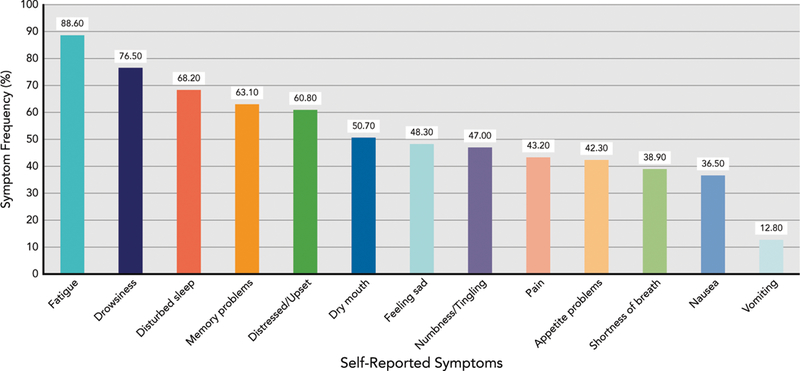
Results: At baseline, the mean electronic pill cap adherence rate showed that patients took 85.57% of their oral therapy. The most commonly reported cancer-related symptoms were fatigue (88.60%), drowsiness (76.50%), disturbed sleep (68.20%), memory problems (63.10%), and emotional distress (60.80%). Patients who reported greater cancer-related symptom severity had lower adherence (r= -0.20). In a multivariable regression, greater depressive and anxiety symptoms, worse fatigue, less social support, lower satisfaction with clinicians and treatment, and higher symptom burden were associated with worse QoL (F[10, 146]=50.53; adjusted R2=0.77). Anxiety symptoms were most strongly associated with clinically meaningful decrements in QoL (β= -7.10; SE=0.22).
Conclusions: Patients prescribed oral therapies struggle with adherence, and cancer-related symptom burden is high and related to worse adherence and QoL. Given perceptions that oral therapies are less impairing, these data underscore the strong need to address adherence issues, symptom burden, and QoL for these patients.
Figures
Comment in
-
Orally Administered Cancer Therapy: Breaking Down Barriers to Adherence and Quality of Life.J Natl Compr Canc Netw. 2019 Mar 1;17(3):290-292. doi: 10.6004/jnccn.2018.7284. J Natl Compr Canc Netw. 2019. PMID: 30865921 No abstract available.
References
-
- Neuss MN, Polovich M, McNiff K, et al. 2013 updated American Society of Clinical Oncology/Oncology Nursing Society chemotherapy administration safety standards including standards for the safe administration and management of oral chemotherapy. Oncol Nurs Forum 2013;40:225–233. - PubMed
-
- Borner M, Scheithauer W, Twelves C, et al. Answering patients’ needs: oral alternatives to intravenous therapy. Oncologist 2001;6(Suppl 4):12–16. - PubMed
-
- Weingart SN, Brown E, Bach PB, et al. NCCN task force report: oral chemotherapy. J Natl Compr Canc Netw 2008;6(Suppl 3):S1–14. - PubMed
Publication types
MeSH terms
Grants and funding
LinkOut - more resources
Full Text Sources
Medical
Miscellaneous