Review
. 2019 May;34(5):797-809.
doi: 10.1002/jbmr.3708. Epub 2019 Mar 28.

The Therapeutic Potential of MicroRNAs as Orthobiologics for Skeletal Fractures

Affiliations
Review

The Therapeutic Potential of MicroRNAs as Orthobiologics for Skeletal Fractures

Michael Hadjiargyrou et al. J Bone Miner Res. 2019 May.

Abstract

The repair of a fractured bone is critical to the well-being of humans. Failure of the repair process to proceed normally can lead to complicated fractures, exemplified by either a delay in union or a complete nonunion. Both of these conditions lead to pain, the possibility of additional surgery, and impairment of life quality. Additionally, work productivity decreases, income is reduced, and treatment costs increase, resulting in financial hardship. Thus, developing effective treatments for these difficult fractures or even accelerating the normal physiological repair process is warranted. Accumulating evidence shows that microRNAs (miRNAs), small noncoding RNAs, can serve as key regulatory molecules of fracture repair. In this review, a brief description of the fracture repair process and miRNA biogenesis is presented, as well as a summary of our current knowledge of the involvement of miRNAs in physiological fracture repair, osteoporotic fractures, and bone defect healing. Further, miRNA polymorphisms associated with fractures, miRNA presence in exosomes, and miRNAs as potential therapeutic orthobiologics are also discussed. This is a timely review as several miRNA-based therapeutics have recently entered clinical trials for nonskeletal applications and thus it is incumbent upon bone researchers to explore whether miRNAs can become the next class of orthobiologics for the treatment of skeletal fractures.

Keywords: BONE DEFECT; EXOSOME; FRACTURE REPAIR; MICRORNA (miRNA); NONUNION; ORTHOBIOLOGIC; OSTEOPOROSIS.


Figures

Figure 1.
Figure 1.
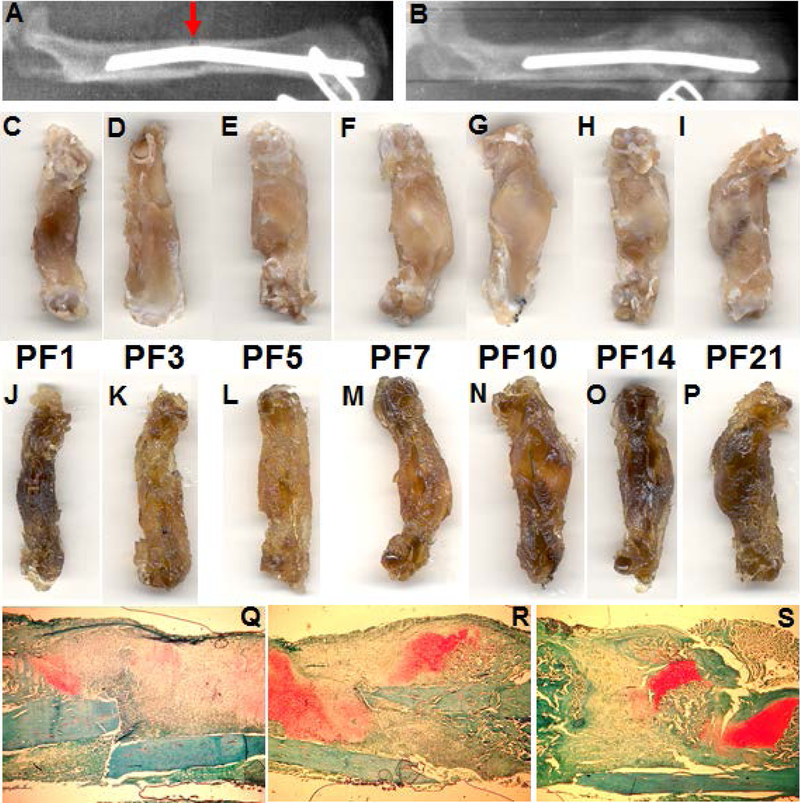
Fracture repair process. A, X-ray image of a fractured (indicated by red arrow) rat femur (image take immediately after fracture); B, the same femur at post-fracture day (PFD) 21 shows the presence of the fracture callus; C-I, fractured rat femurs at PFD 1, 3, 5, 7, 10, 14, 21, respectively. J-P, same as C-I, following decalcification. Q-S, sections of PF day 7, 14, 21 callus, respectively, stained with safranin-o fast green. Images C and J, clearly show the hematoma that develops after the fracture (PFD1). Images F-I and M-P show the presence of the cartilaginous callus (PFD 7–21) which are also indicated as the red areas in Q, R and S (PFD 7, 14 and 21). Images N-O also show the reestablishment of the vasculature, especially O and P.
Figure 2.
Figure 2.
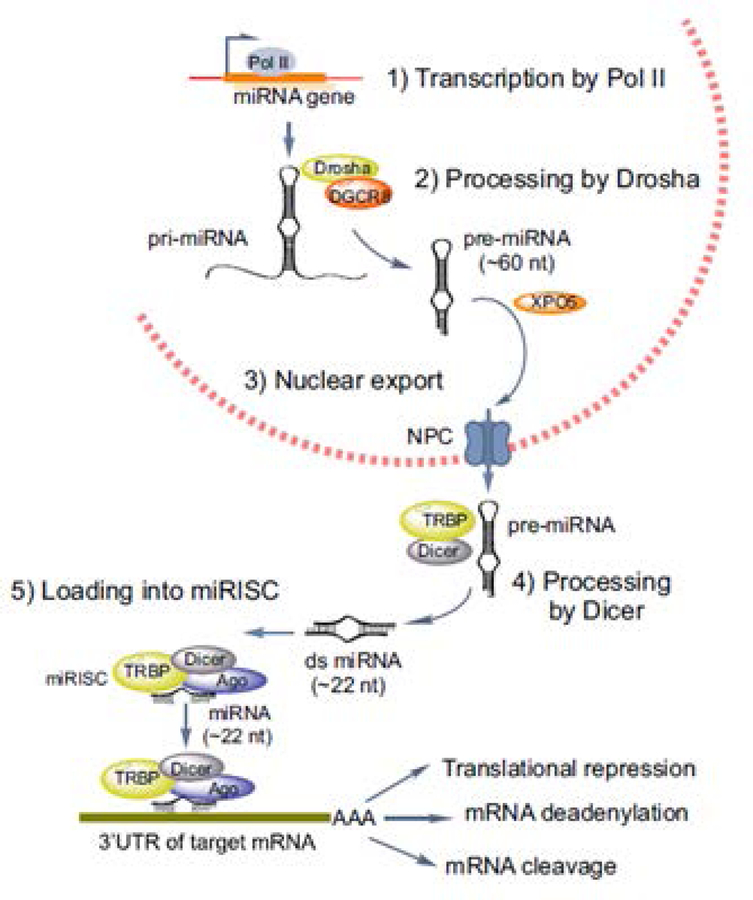
MicroRNA biogenesis. The steps resulting in the functional production of functional miRNAs are schematically represented in this figure. Adopted from Lekka and Hall, (26) with permission.
Figure 3.
Figure 3.
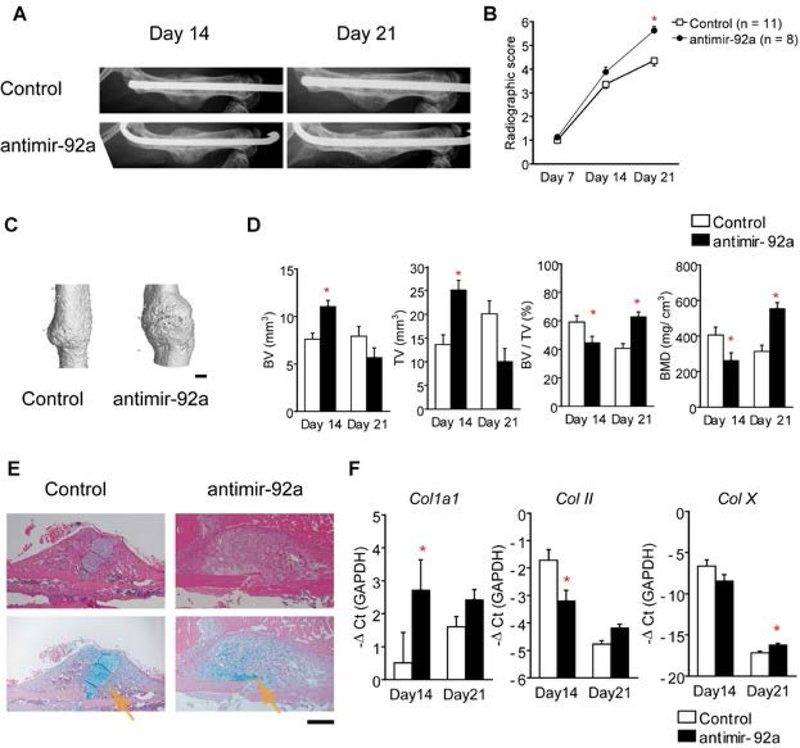
Inhibition of miR-92a enhanced endochondral bone formation in mice with a femoral fracture. An antisense oligonucleotide to miR-92a (antimir-92a) or a scrambled control were delivered into mice with a femoral fracture intravenously on days 0 and post-fracture days 4, 7, 11, and 14. (A) Radiological images of the femurs at post-fracture days 14 and 21. (B) Radiographic score from x-ray images indicating bone formation. (C) Representative 3D mCT image of a fractured femur on post-fracture day 14. Scale bar = 1 mm. (D) TV and BV of the callus, BV/TV, and BMD on post-fracture day 14 and 21. (E) Histology of the fracture callus stained by HE or HE/Alcian-blue from post-fracture day 14. Arrows indicate Alcian-blue–positive cartilage. Scale bar = 500μm. (F) Callus mRNA levels of Col1a1, Col II, and Col X from post-fracture day 14 and 21 as determined by qRT-PCR. The data are shown as mean±SEM. *p<0.05. Adopted Murata et al. (41) with permission.
Figure 4.
Figure 4.
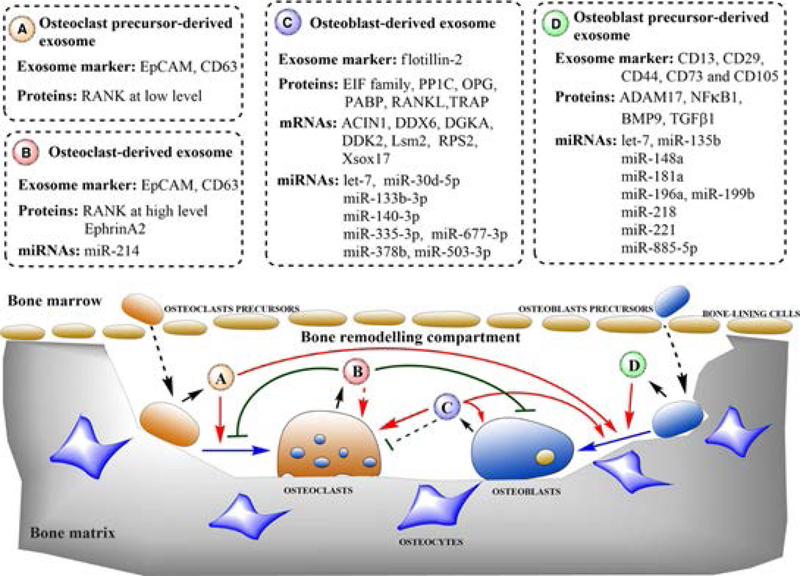
Schematic diagram showing the roles of bone cell derived exosomes. Osteoclast precursor-derived exosomes (A) stimulate differentiation of osteoclasts and osteoblasts. Osteoclast-derived exosomes (B) reduce the osteoclast number and osteoblastic bone formation. Osteoblast-derived exosomes (C) promote differentiation of osteoblasts and osteoclasts and establish a positive feedback in bone growth. Osteoblast precursor-derived exosomes (D) induce MSCs to differentiate into osteoblasts. Boxes indicate the primary contents of bone-derived exosomes involved in bone remodeling. Short black arrows indicate the secretion process. Dotted black arrows indicate the translocation of cells. Solid blue arrows indicate cell differentiation. Solid red arrows and green lines indicate the activation and inhibition of cellular processes, respectively. Dotted lines indicate unclear mechanisms. Adopted by Xie et al., (63) with permission.

References

    1. Hadjiargyrou M, O’Keefe RJ. The convergence of fracture repair and stem cells: interplay of genes, aging, environmental factors and disease. J Bone Miner Res 2014. 29(11):2307–22. - PMC - PubMed
    1. Hadjiargyrou M, Lombardo F, Zhao S, et al. Transcriptional profiling of bone regeneration. Insight into the molecular complexity of wound repair. J Biol Chem 2002;277(33):30177–82. - PubMed
    1. Duchamp de Lageneste O, Julien A, Abou-Khalil R, Frangi G, Carvalho C, Cagnard N, Cordier C, Conway SJ, Colnot C. Periosteum contains skeletal stem cells with high bone regenerative potential controlled by Periostin. Nat Commun 2018. 9(1):773. - PMC - PubMed
    1. Bragdon BC, Bahney CS. Origin of Reparative Stem Cells in Fracture Healing. Curr Osteoporos Rep 2018. 16(4):490–503. - PMC - PubMed
    1. Komatsu DE, Hadjiargyrou M. Activation of the transcription factor HIF-1 and its target genes, VEGF, HO-1, iNOS, during fracture repair. Bone 2004. 34(4):680–8. - PubMed

Publication types