


Automatic Pulmonary Nodule Detection Applying Deep Learning or Machine Learning Algorithms to the LIDC-IDRI Database: A Systematic Review
- PMID: 30866425
- PMCID: PMC6468920
- DOI: 10.3390/diagnostics9010029
Automatic Pulmonary Nodule Detection Applying Deep Learning or Machine Learning Algorithms to the LIDC-IDRI Database: A Systematic Review
Abstract
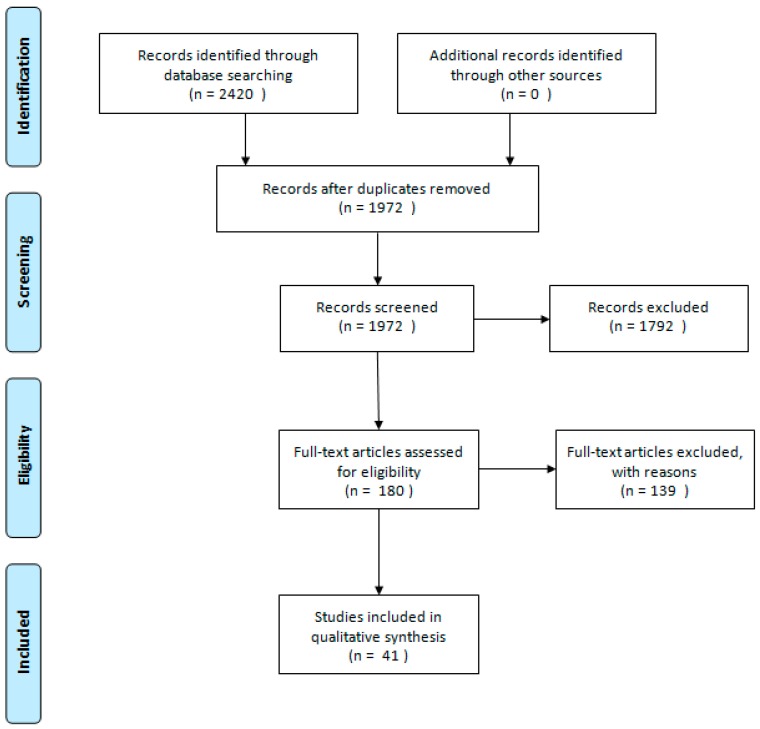
The aim of this study was to provide an overview of the literature available on machine learning (ML) algorithms applied to the Lung Image Database Consortium Image Collection (LIDC-IDRI) database as a tool for the optimization of detecting lung nodules in thoracic CT scans. This systematic review was compiled according to Preferred Reporting Items for Systematic Reviews and Meta-Analyses (PRISMA) guidelines. Only original research articles concerning algorithms applied to the LIDC-IDRI database were included. The initial search yielded 1972 publications after removing duplicates, and 41 of these articles were included in this study. The articles were divided into two subcategories describing their overall architecture. The majority of feature-based algorithms achieved an accuracy >90% compared to the deep learning (DL) algorithms that achieved an accuracy in the range of 82.2%⁻97.6%. In conclusion, ML and DL algorithms are able to detect lung nodules with a high level of accuracy, sensitivity, and specificity using ML, when applied to an annotated archive of CT scans of the lung. However, there is no consensus on the method applied to determine the efficiency of ML algorithms.
Keywords: deep learning; machine learning; nodule detection.
Conflict of interest statement
The authors declare no conflict of interest.
Figures
References
-
- Armato S.G., McLennan G., Bidaut L., McNitt-Gray M.F., Meyer C.R., Reeves A.P., Zhao B., Aberle D.R., Henschke C.I., Hoffman E.A., et al. The Lung Image Database Consortium (LIDC) and Image Database Resource Initiative (IDRI): A Completed Reference Database of Lung Nodules on CT Scans. Med. Phys. 2011;38:915–931. doi: 10.1118/1.3528204. - DOI - PMC - PubMed
Publication types
LinkOut - more resources
Full Text Sources
Other Literature Sources
