. 2019 Mar 7;11(3):569.
doi: 10.3390/nu11030569.

Hypertension Associated with Fructose and High Salt: Renal and Sympathetic Mechanisms

Affiliations

Hypertension Associated with Fructose and High Salt: Renal and Sympathetic Mechanisms

Dragana Komnenov et al. Nutrients. .

Abstract

Hypertension is a leading cause of cardiovascular and chronic renal disease. Despite multiple important strides that have been made in our understanding of the etiology of hypertension, the mechanisms remain complex due to multiple factors, including the environment, heredity and diet. This review focuses on dietary contributions, providing evidence for the involvement of elevated fructose and salt consumption that parallels the increased incidence of hypertension worldwide. High fructose loads potentiate salt reabsorption by the kidney, leading to elevation in blood pressure. Several transporters, such as NHE3 and PAT1 are modulated in this milieu and play a crucial role in salt-sensitivity. High fructose ingestion also modulates the renin-angiotensin-aldosterone system. Recent attention has been shifted towards the contribution of the sympathetic nervous system, as clinical trials demonstrated significant reductions in blood pressure following renal sympathetic nerve ablation. New preclinical data demonstrates the activation of the renal sympathetic nerves in fructose-induced salt-sensitive hypertension, and reductions of blood pressure after renal nerve ablation. This review further demonstrates the interplay between sodium handling by the kidney, the renin-angiotensin-aldosterone system, and activation of the renal sympathetic nerves as important mechanisms in fructose and salt-induced hypertension.

Keywords: fructose; hypertension; renal sympathetic nerve activity; renal transporters; renin-angiotensin-aldosterone system; sodium.


Conflict of interest statement

The authors declare no conflict of interest.

Figures
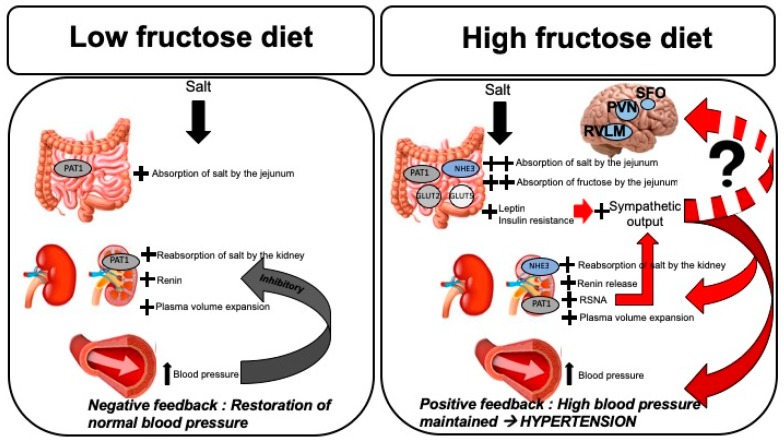
Figure 1
Figure 1
Mechanisms of fructose-induced salt-sensitive hypertension. Left panel: In the absence of high dietary fructose, absorption of salt in the small intestine (jejunum) and proximal tubule of the kidney is accomplished by PAT1. Increased sodium load leads to plasma volume expansion which activates RAS, resulting in elevation of blood pressure. Either increased plasma renin activity or increased blood pressure alone are capable of initiating the negative feedback mechanism to dampen NaCl reabsorption and decrease RAS activation, resulting in restoration of blood pressure back to normal. Right panel: When dietary fructose intake is high in conjunction with high salt, intestinal fructose absorption with Glut 5 and Glut 2 and sodium is absorption via PAT1 and NHE3 in increase. Proximal tubular sodium reabsorption is increased by both PAT1 and NHE3. Elevated fructose load leads to increased levels of circulating leptin and insulin, resulting in insulin resistance. These hormones lead to increased sympathetic outputs. In addition to activation of RAS and Na+ reabsorption, increased RSNA also participates in elevating blood pressure, ultimately resulting in the loss of the negative feedback mechanism. Increased afferent inputs to the central barosensitive regions may also contribute to hypertension by creating a feedforward situation via efferent sympathetic nerves. PAT1, putative anion transporter 1; NHE3, sodium/hydrogen exchanger 3; Glut 5 and Glut 2, glucose transporters 5 and 2, respectively; RAS, renin-angiotensin-aldosterone system; RSNA, renal sympathetic nerve activity; SFO, subfornical organ; PVN, paraventricular nucleus; RVLM, rostral ventrolateral medulla.

References

    1. Carretero O.A., Oparil S. Essential hypertension. Part I: Definition and etiology. Circulation. 2000;101:329–335. doi: 10.1161/01.CIR.101.3.329. - DOI - PubMed
    1. Messerli F.H., Williams B., Ritz E. Essential hypertension. Lancet. 2007;370:591–603. doi: 10.1016/S0140-6736(07)61299-9. - DOI - PubMed
    1. Egan B.M., Zhao Y., Axon R.N. US trends in prevalence, awareness, treatment, and control of hypertension, 1988–2008. JAMA. 2010;303:2043–2050. doi: 10.1001/jama.2010.650. - DOI - PubMed
    1. Yano Y., Reis J.P., Colangelo L.A., Shimbo D., Viera A.J., Allen N.B., Gidding S.S., Bress A.P., Greenland P., Muntner P., et al. Association of Blood Pressure Classification in Young Adults Using the 2017 American College of Cardiology/American Heart Association Blood Pressure Guideline with Cardiovascular Events Later in Life. JAMA. 2018;320:1774–1782. doi: 10.1001/jama.2018.13551. - DOI - PMC - PubMed
    1. Dorans K.S., Mills K.T., Liu Y., He J. Trends in Prevalence and Control of Hypertension According to the 2017 American College of Cardiology/American Heart Association (ACC/AHA) Guideline. J. Am. Heart Assoc. 2018;7 doi: 10.1161/JAHA.118.008888. - DOI - PMC - PubMed

MeSH terms
