Comparative Study
. 2019;8(1):197-210.
doi: 10.1080/22221751.2018.1563458.

Differential effects of depot medroxyprogesterone acetate administration on vaginal microbiome in Hispanic White and Black women

Affiliations
Comparative Study

Differential effects of depot medroxyprogesterone acetate administration on vaginal microbiome in Hispanic White and Black women

Liying Yang et al. Emerg Microbes Infect. 2019.

Abstract

The use of depot medroxyprogesterone acetate (DMPA), a 3-monthly injectable hormonal contraceptive, is associated with an increased risk of HIV acquisition possibly through alteration of the vaginal microbiome. In this longitudinal interventional study, we investigated the impact of DMPA administration on the vaginal microbiome in Hispanic White and Black women at the baseline (visit 1), 1 month (visit 2), and 3 months (visit 3) following DMPA treatment by using 16S rRNA gene sequencing. No significant changes in the vaginal microbiome were observed after DMPA treatment when Hispanic White and Black women were analysed as a combined group. However, DMPA treatment enriched total vaginosis-associated bacteria (VNAB) and Prevotella at visit 2, and simplified the correlational network in the vaginal microbiome in Black women, while increasing the network size in Hispanic White women. The microbiome in Black women became more diversified and contained more VNAB than Hispanic White women after DMPA treatment. While the Firmicutes to Bacteroidetes (F/B) ratio and Lactobacillus to Prevotella (L/P) ratio were comparable between Black and Hispanic White women at visit 1, both ratios were lower in Black women than in Hispanic White women at visit 2. In conclusion, DMPA treatment altered the community network and enriched VNAB in Black women but not in Hispanic White women. The Lactobacillus deficiency and enrichment of VNAB may contribute to the increased risk of HIV acquisition in Black women. Future studies on the impact of racial differences on the risk of HIV acquisition will offer insights into developing effective strategies for HIV prevention. Abbreviations: DMPA: depot medroxyprogesterone acetate; PCR: polymerase chain reaction; OTU: operational taxonomic unit; STI: sexually transmitted infections; VNAB: vaginosis-associated bacteria.

Keywords: HIV acquisition; Vaginal microbiome; bacterial vaginosis-associated bacteria; depot medroxyprogesterone acetate; network.


Figures
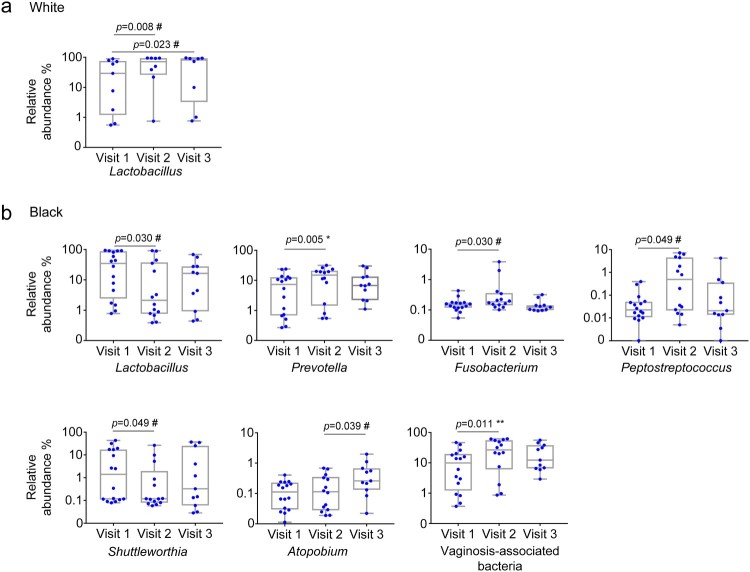
Figure 1.
Figure 1.
Differential genera between naive and DMPA-treated vaginal microbiomes in Hispanic White and Black women. Microbiome of vaginal swabs from the participants with pre- and post-DMPA administration was analysed. Difference in the relative abundance of genera was evaluated between two of the three visits using the Wilcoxon signed rank test for paired samples for White (a) and Black (b) women. A change in the microbial composition was considered as significant if p < 0.05 and FDR adjusted p < 0.20 (#>0.2, * ≤ 0.2, ** ≤ 0.1, *** ≤ 0.05).
Figure 2.
Figure 2.
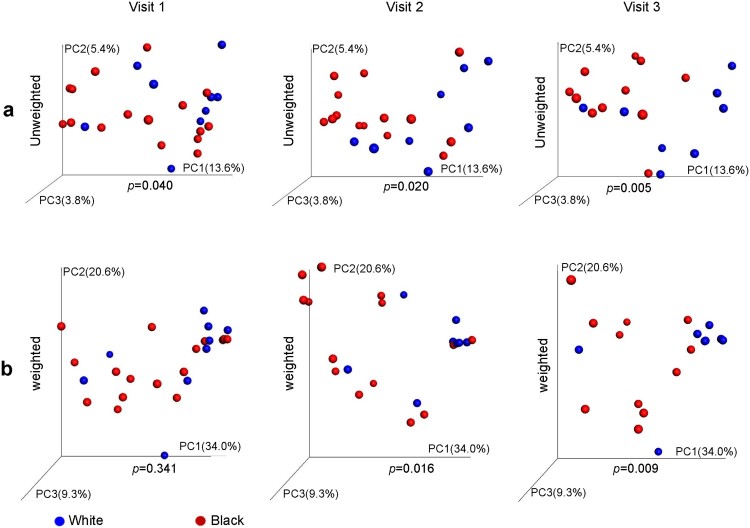
Difference of vaginal microbiome in β-diversity between Hispanic White and Black women before and after DMPA treatment. Vaginal microbiome from the participants with pre- and post-DMPA administration was analysed. β-diversity between White and Black women was analysed by PCoA) using either unweighted (a) or weighted UniFrac distance metrics with p-values calculated by microbiome regression-based kernel association test (MiKART).
Figure 3.
Figure 3.
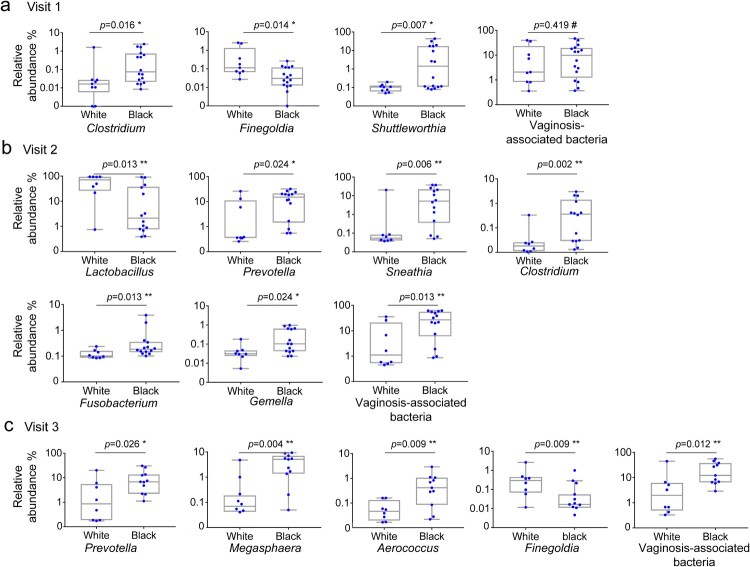
Taxonomic difference of the vaginal microbiome between Hispanic White and Black women before and after DMPA treatment. Vaginal microbiome from the participants with pre- and post-DMPA administration was analysed. Difference in the relative abundance of genera was evaluated between White and Black women using Wilcoxon rank-sum test for unpaired samples at visit 1 (a), visit 2 (b) and visit 3 (c). A change in the microbial composition was considered as significant if p < 0.05 and FDR adjusted p < 0.20 (#>0.2, * ≤ 0.2, ** ≤ 0.1, *** ≤ 0.05).
Figure 4.
Figure 4.
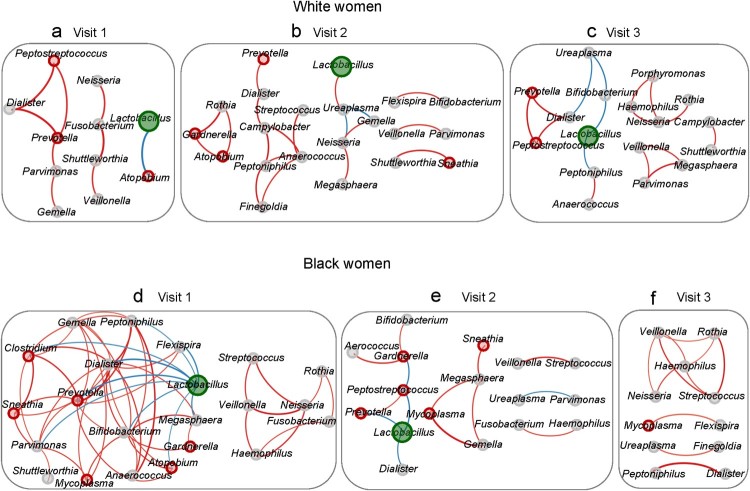
Effect of DMPA on the interactive structure of the vaginal microbiome. Vaginal microbiome from the participants with pre- and post-DMPA administration was analysed. Correlational networks were constructed using pairwise Spearman's rank correlations among genera. In a network system, module represents a set of genera (nodes) linked to each other by many connection lines, while linked by few connections to nodes of other modules. A relationship was considered significant if r > 0.7 and p < 0.01. Red connections indicate a positive correlation while blue connections a negative correlation. The thickness of a connection line is in proportion to the r-value in the correlation. The node for Lactobacillus is coloured in green while VNAB in red and NVNAB in grey. The size of a node represents the relative abundance of a genus. The baseline network was defined at visit 1 (a,d), the deviation of the network from the baseline in response to DMPA at visit 2 (b,e), and the long-lasting effect of DMPA on the network at visit 3 (c,f) in Hispanic White (a–c) and Black women (d–f).
Figure 5.
Figure 5.
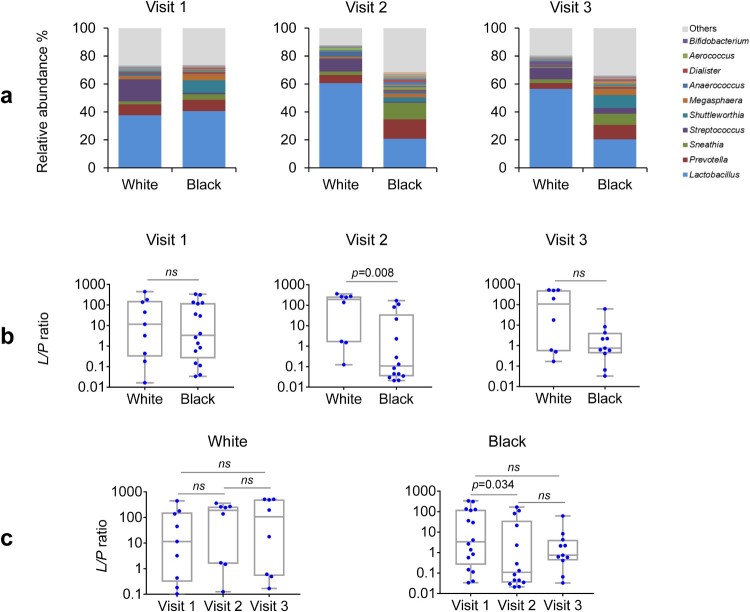
Racial difference in Lactobacillus to Prevotella ratio in the vaginal microbiome before and after DMPA treatment. Vaginal microbiome from the participants with pre- and post-DMPA administration was analysed. The genus-level community structures are shown for both Hispanic White and Black women at the three visits (a). The “Others” indicated by grey colour is the combined unclassified genera and low abundant genera (<0.1%) that were not included in taxonomic analyses. Lactobacillus to Prevotella (L/P) ratios in the vaginal microbiome after DMPA treatment were compared among and between the three visits in White or Black women and at the three visits (b). The L/P ratios were also compared between White or Black women at the three visits (c). P-values were calculated using the Kruskal–Wallis test for comparisons among the three visits and the Wilcoxon rank-sum test between two visits or two racial groups. A change in a ratio was considered as significant if p < 0.05.

References

    1. Ralph LJ, McCoy SI, Shiu K, et al. Does hormonal contraceptive use increase women’s risk of HIV acquisition? A meta-analysis of observational studies. Lancet Infect Dis. 2015;15:181–189. doi: 10.1016/S1473-3099(14)71052-7. - DOI - PMC - PubMed
    1. Morrison CS, Chen P-L, Kwok C, et al. Hormonal contraception and the risk of HIV acquisition: an individual participant data meta-analysis. PLoS Med. 2015;12:e1001778. doi: 10.1371/journal.pmed.1001778. - DOI - PMC - PubMed
    1. Polis CB, Curtis KM, Hannaford PC, et al. An updated systematic review of epidemiological evidence on hormonal contraceptive methods and HIV acquisition in women. AIDS. 2016;30:2665–2683. doi: 10.1097/QAD.0000000000001228. - DOI - PMC - PubMed
    1. Hapgood JP, Kaushic C, Hel Z.. Hormonal contraception and HIV-1 acquisition: biological mechanisms. Endocr Rev. 2018;39:36–78. doi: 10.1210/er.2017-00103. - DOI - PMC - PubMed
    1. Birse KD, Romas LM, Guthrie BL, et al. Genital injury signatures and microbiome alterations associated with depot medroxyprogesterone acetate usage and intravaginal drying practices. J Infect Dis. 2017;215:590–598. - PMC - PubMed

Publication types

MeSH terms

LinkOut - more resources