


Repeated isolation of tick-borne encephalitis virus from adult Dermacentor reticulatus ticks in an endemic area in Germany
- PMID: 30867015
- PMCID: PMC6416925
- DOI: 10.1186/s13071-019-3346-6
Repeated isolation of tick-borne encephalitis virus from adult Dermacentor reticulatus ticks in an endemic area in Germany
Abstract
Background: Tick-borne encephalitis (TBE) virus is transmitted to humans and animals through tick bites and is thought to circulate in very strictly defined natural environments called natural foci. The most common tick serving as a vector for the TBE virus in central Europe is Ixodes ricinus; it is rarely found in other tick species and in Dermacentor reticulatus it has, so far, only been reported in Poland.
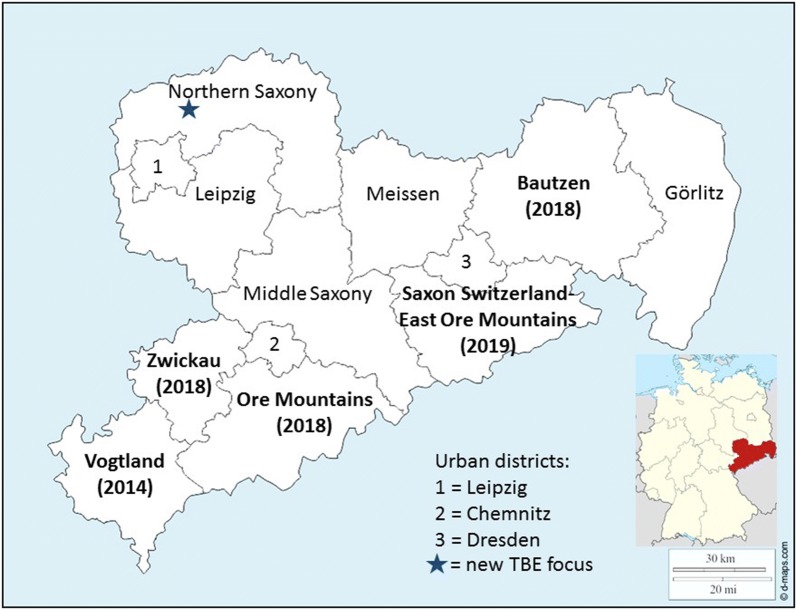
Methods: Between autumn 2016 and spring 2018 ticks were collected by the flagging method in a new TBE focus in the district of northern Saxony, Germany, outside the known risk areas as defined by the national Robert Koch Institute. Ticks were morphologically identified and tested in pools for the presence of TBE virus using a real-time RT-PCR. TBE virus from positive pools was isolated in A549 cells, and the E gene sequences were determined after conventional RT-PCR, followed by a phylogenetic comparison.
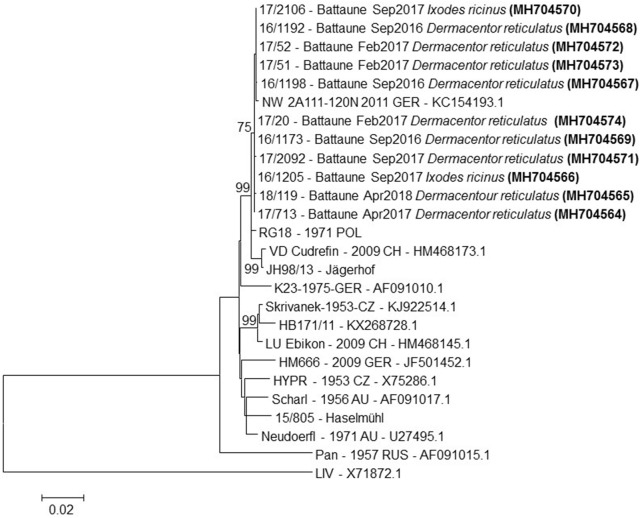
Results: TBE virus was detected in 11 pools, 9 times in flagged adults D. reticulatus (n = 1534; MIR: 0.59%, CI: 0.29-11.3%) and only twice in I. ricinus nymphs (n = 349; MIR: 0.57%, CI: 0.02-2.2%). All other ticks, I. ricinus males (n = 33), females (n = 30) and larvae (n = 58), as well as 5 I. inopinatus (2 females, 3 males) and 14 Haemaphysalis concinna (3 females, 11 nymphs), tested negative for TBE virus. TBE virus was not detected in I. ricinus during the summer, when D. reticulatus is not active. Sequence comparison of the entire E gene of the isolated virus strains resembled each other with only 3 nucleotide differences. The most closely related viral sequences belong to TBE virus strains from Poland and Neustadt an der Waldnaab (county of Neustadt an der Waldnaab, Bavaria), approximately 200 km east and 200 km south-west of the new focus, respectively.
Conclusions: TBE virus was found in northern Saxony, Germany, with similar MIRs in D. reticulatus and I. ricinus, indicating that D. reticulatus plays an equal role to I. ricinus in virus circulation when both tick species are sympatric.
Keywords: Dermacentor reticulatus; Germany; Saxony; TBE virus.
Conflict of interest statement
The authors declare that they have no competing interests.
Figures
References
-
- Estrada-Peña A, Nava S, Petney T. Ticks of Europe and North Africa: a guide to species identification. Cham, Switzerland: Springer; 2017.
-
- Chitimia-Dobler L, Mackenstedt U, Petney TN. Transmission/Natural cycle. In: Dobler G, Erber W, Schimitt H-J, editors. Tick-borne Encephalitis (TBE) Singapore: Globel Health Press Pte Ltd; 2018. pp. 41–57.
MeSH terms
Grants and funding
LinkOut - more resources
Full Text Sources
