Multicenter Study
. 2019 Mar 13:364:l772.
doi: 10.1136/bmj.l772.

Joint association of urinary sodium and potassium excretion with cardiovascular events and mortality: prospective cohort study

Affiliations
Multicenter Study

Joint association of urinary sodium and potassium excretion with cardiovascular events and mortality: prospective cohort study

Martin O'Donnell et al. BMJ. .

Abstract

Objective: To evaluate the joint association of sodium and potassium urinary excretion (as surrogate measures of intake) with cardiovascular events and mortality, in the context of current World Health Organization recommendations for daily intake (<2.0 g sodium, >3.5 g potassium) in adults.

Design: International prospective cohort study.

Setting: 18 high, middle, and low income countries, sampled from urban and rural communities.

Participants: 103 570 people who provided morning fasting urine samples.

Main outcome measures: Association of estimated 24 hour urinary sodium and potassium excretion (surrogates for intake) with all cause mortality and major cardiovascular events, using multivariable Cox regression. A six category variable for joint sodium and potassium was generated: sodium excretion (low (<3 g/day), moderate (3-5 g/day), and high (>5 g/day) sodium intakes) by potassium excretion (greater/equal or less than median 2.1 g/day).

Results: Mean estimated sodium and potassium urinary excretion were 4.93 g/day and 2.12 g/day, respectively. After a median follow-up of 8.2 years, 7884 (6.1%) participants had died or experienced a major cardiovascular event. Increasing urinary sodium excretion was positively associated with increasing potassium excretion (unadjusted r=0.34), and only 0.002% had a concomitant urinary excretion of <2.0 g/day of sodium and >3.5 g/day of potassium. A J-shaped association was observed of sodium excretion and inverse association of potassium excretion with death and cardiovascular events. For joint sodium and potassium excretion categories, the lowest risk of death and cardiovascular events occurred in the group with moderate sodium excretion (3-5 g/day) and higher potassium excretion (21.9% of cohort). Compared with this reference group, the combinations of low potassium with low sodium excretion (hazard ratio 1.23, 1.11 to 1.37; 7.4% of cohort) and low potassium with high sodium excretion (1.21, 1.11 to 1.32; 13.8% of cohort) were associated with the highest risk, followed by low sodium excretion (1.19, 1.02 to 1.38; 3.3% of cohort) and high sodium excretion (1.10, 1.02 to 1.18; 29.6% of cohort) among those with potassium excretion greater than the median. Higher potassium excretion attenuated the increased cardiovascular risk associated with high sodium excretion (P for interaction=0.007).

Conclusions: These findings suggest that the simultaneous target of low sodium intake (<2 g/day) with high potassium intake (>3.5 g/day) is extremely uncommon. Combined moderate sodium intake (3-5 g/day) with high potassium intake is associated with the lowest risk of mortality and cardiovascular events.


Conflict of interest statement

Competing interests: All authors have completed the ICMJE uniform disclosure form at www.icmje.org/coi_disclosure.pdf and declare: no support from any additional organisation for the submitted work. A detailed list of funders is provided in the supplementary appendix. The authors have no financial relationships with any organisations, or other relationships or activities, that might have influenced the submitted work in the previous three years.

Figures
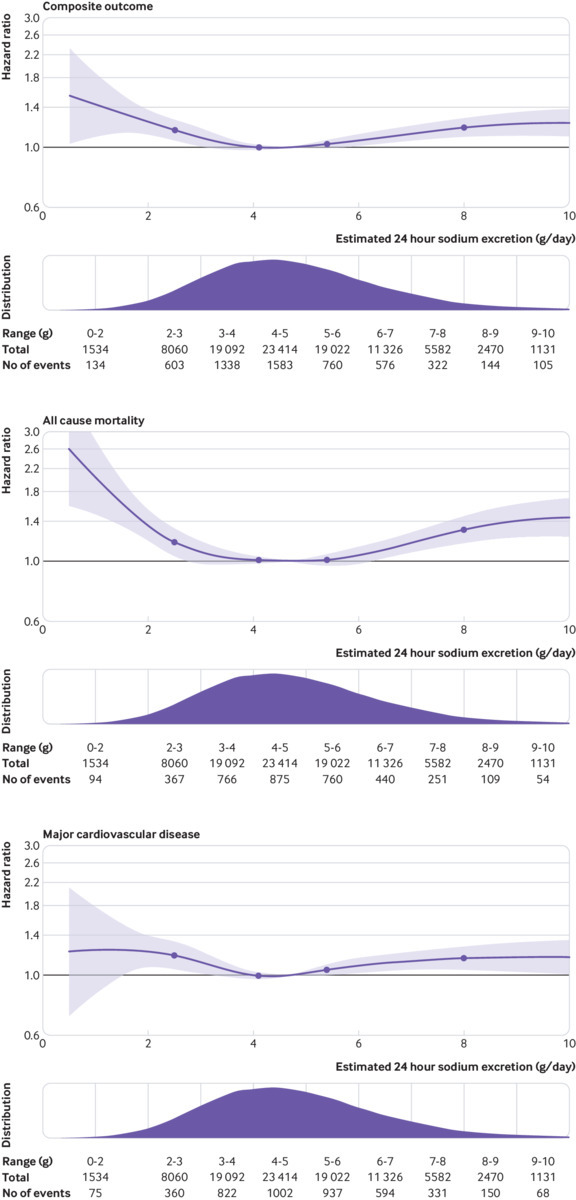
Fig 1
Fig 1
Restricted cubic spline plot of association of estimated 24 hour urinary sodium excretion with composite of all cause mortality and major cardiovascular events, mortality, and major cardiovascular events (composite of cardiovascular death or myocardial infarction or stroke or heart failure). Plots adjusted for age (included as spline function), sex, education, current and former alcohol intake (units weekly), diabetes mellitus, body mass index, physical activity, history of cardiovascular events, use of cardiovascular drugs (blood pressure lowering, statins, or antidiabetics), history of tuberculosis, cancer, HIV, and current and former smoking. Dashed lines indicate 95% confidence intervals. Median intake is reference standard (4.9 g/day). Salt approximates 2.5×sodium g/day. Spline curve was truncated at 10 g/day in all plots
Fig 2
Fig 2
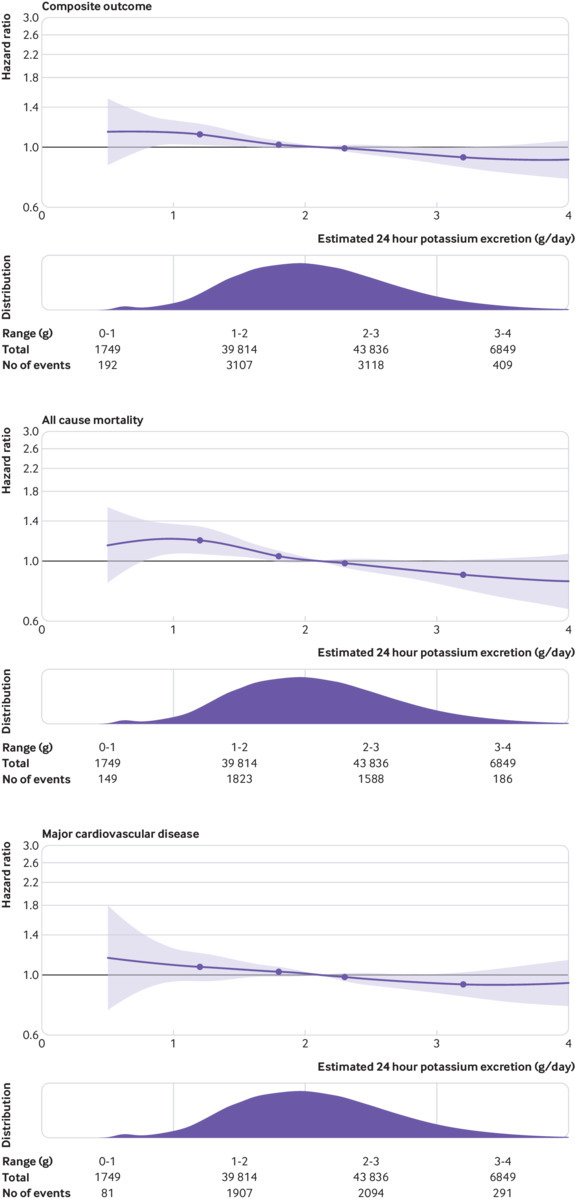
Restricted cubic spline plot of association of estimated 24 hour urinary potassium excretion with composite of all cause mortality and major cardiovascular events, mortality, and major cardiovascular events (composite of cardiovascular death, myocardial infarction, stroke, and heart failure). Plots adjusted for age (included as spline function), sex, education, current and former alcohol intake (units weekly), diabetes mellitus, body mass index, physical activity, history of cardiovascular events, use of cardiovascular drugs (blood pressure lowering, statins, or antidiabetics), history of tuberculosis, cancer, HIV, and current and former smoking. Spline was truncated at 4 g/day in all plots
Fig 3
Fig 3
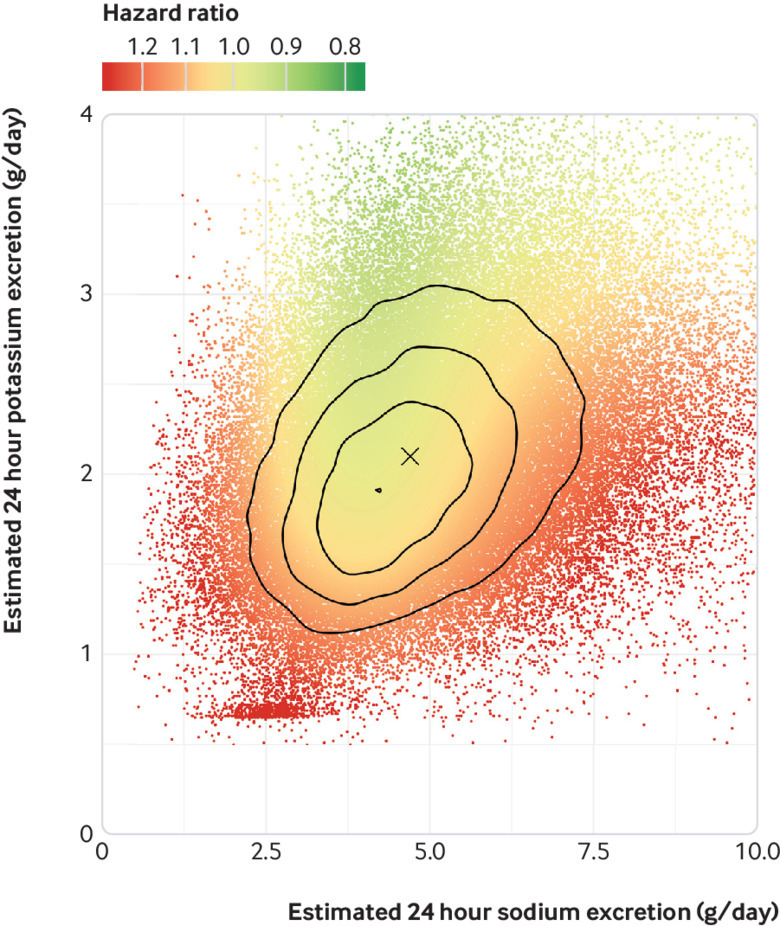
Heat map of risk for composite of cardiovascular events or death showing lowest risk in region of moderate sodium intake 3-5 g/day and higher potassium intake and highest risk in region of extremes of sodium excretion and low potassium excretion. The reference hazard for these hazard ratios was set at a value of sodium daily excretion/intake of 5.00 g and potassium daily excretion/intake of 2.25 g (median excretion of sodium and potassium), marked as X. The overlaid lines represent joint distribution quartiles; each region contains a quarter of the analysed participants. r=0.34
Fig 4
Fig 4
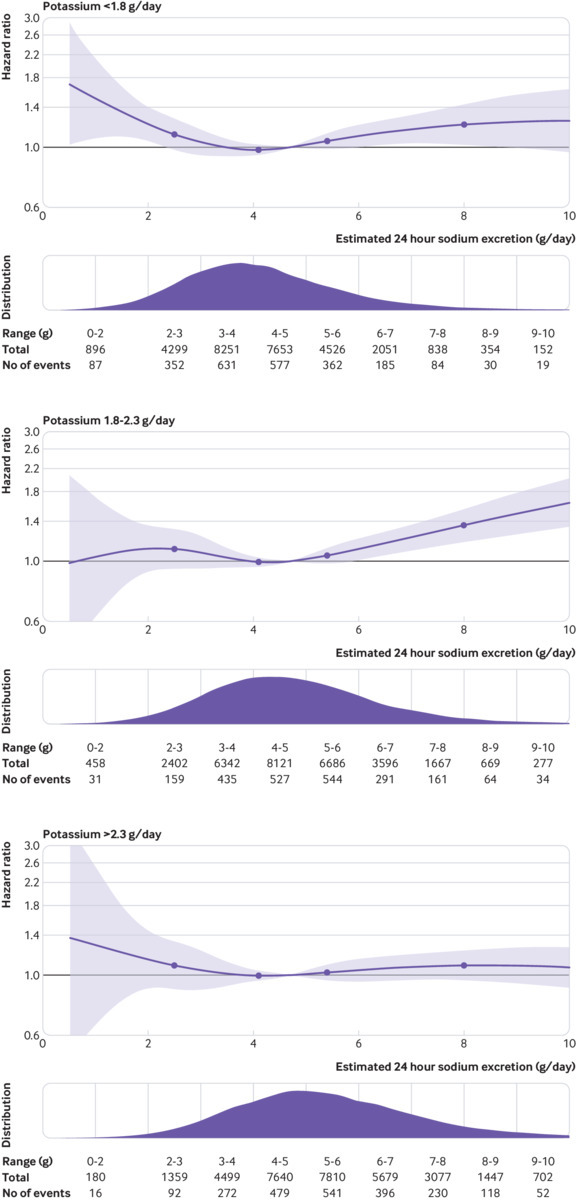
Association of urinary sodium excretion within tertiles of urinary potassium excretion. P for interaction is significant (P=0.007) for urinary potassium excretion×urinary sodium excretion above median intake, with lower magnitude of association with higher urinary potassium excretion. Plots adjusted for age (included as spline function), sex, education, current and former alcohol intake (units weekly), diabetes mellitus, body mass index, physical activity, history of cardiovascular events, use of cardiovascular drugs (blood pressure lowering, statins, or antidiabetics), history of tuberculosis, cancer, HIV, and current and former smoking
Fig 5
Fig 5
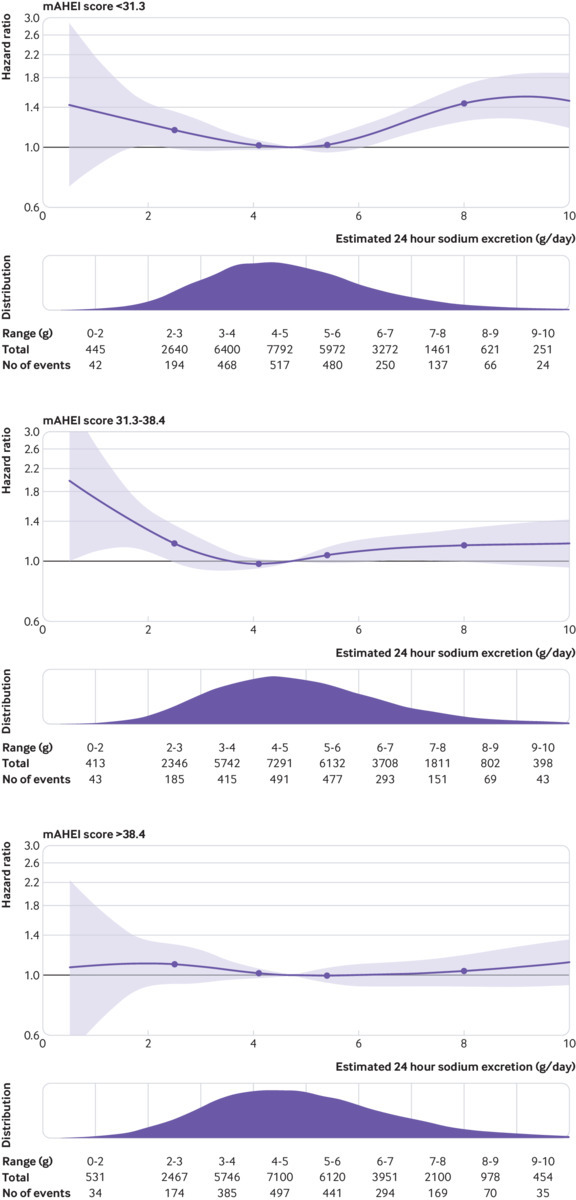
Association of urinary sodium excretion within tertiles of modified alternative healthy eating index (mAHEI) score. P for interactions not significant. Plots adjusted for age (included as spline function), sex, education, current and former alcohol intake (units weekly), diabetes mellitus, body mass index, physical activity, history of cardiovascular events, use of cardiovascular drugs (blood pressure lowering, statins, or antidiabetics), history of tuberculosis, cancer, HIV, and current and former smoking

References

    1. Morris RC, Jr, Schmidlin O, Frassetto LA, Sebastian A. Relationship and interaction between sodium and potassium. J Am Coll Nutr 2006;25(Suppl):262S-70S. 10.1080/07315724.2006.10719576 - DOI - PubMed
    1. Kotchen TA, Cowley AW, Jr, Frohlich ED. Salt in health and disease--a delicate balance. N Engl J Med 2013;368:1229-37. 10.1056/NEJMra1212606 - DOI - PubMed
    1. Palmer BF. Regulation of Potassium Homeostasis. Clin J Am Soc Nephrol 2015;10:1050-60. 10.2215/CJN.08580813 - DOI - PMC - PubMed
    1. World Health Organization. Guideline: Sodium Intake for Adults and Children. WHO. 2012 ISBN 978 92 4 150483 6. - PubMed
    1. World Health Organization. Guideline: Potassium Intake for Adults and Children. WHO. 2012 ISBN 978 92 4 150482 9. - PubMed

Publication types