. 2019 May 15;93(11):e02273-18.
doi: 10.1128/JVI.02273-18. Print 2019 Jun 1.

Viral Factors Important for Efficient Replication of Influenza A Viruses in Cells of the Central Nervous System

Affiliations

Viral Factors Important for Efficient Replication of Influenza A Viruses in Cells of the Central Nervous System

Jurre Y Siegers et al. J Virol. .

Abstract

Central nervous system (CNS) disease is one of the most common extrarespiratory tract complications of influenza A virus infections. Remarkably, zoonotic H5N1 virus infections are more frequently associated with CNS disease than seasonal or pandemic influenza viruses. Little is known about the interaction between influenza A viruses and cells of the CNS; therefore, it is currently unknown which viral factors are important for efficient replication. Here, we determined the replication kinetics of a seasonal, pandemic, zoonotic, and lab-adapted influenza A virus in human neuron-like (SK-N-SH) and astrocyte-like (U87-MG) cells and primary mouse cortex neurons. In general, highly pathogenic avian influenza (HPAI) H5N1 virus replicated most efficiently in all cells, which was associated with efficient attachment and infection. Seasonal H3N2 and to a lesser extent pandemic H1N1 virus replicated in a trypsin-dependent manner in SK-N-SH but not in U87-MG cells. In the absence of trypsin, only HPAI H5N1 and WSN viruses replicated. Removal of the multibasic cleavage site (MBCS) from HPAI H5N1 virus attenuated, but did not abrogate, replication. Taken together, our results showed that the MBCS and, to a lesser extent, the ability to attach are important determinants for efficient replication of HPAI H5N1 virus in cells of the CNS. This suggests that both an alternative hemagglutinin (HA) cleavage mechanism and preference for α-2,3-linked sialic acids allowing efficient attachment contribute to the ability of influenza A viruses to replicate efficiently in cells of the CNS. This study further improves our knowledge on potential viral factors important for the neurotropic potential of influenza A viruses.IMPORTANCE Central nervous system (CNS) disease is one of the most common extrarespiratory tract complications of influenza A virus infections, and the frequency and severity differ between seasonal, pandemic, and zoonotic influenza viruses. However, little is known about the interaction of these viruses with cells of the CNS. Differences among seasonal, pandemic, and zoonotic influenza viruses in replication efficacy in CNS cells, in vitro, suggest that the presence of an alternative HA cleavage mechanism and ability to attach are important viral factors. Identifying these viral factors and detailed knowledge of the interaction between influenza virus and CNS cells are important to prevent and treat this potentially lethal CNS disease.

Keywords: CNS disease; H1N1; H3N2; H5N1; encephalitis; extrarespiratory; influenza A virus; pathogenesis; viral replication; virus attachment.


Figures

FIG 1
FIG 1
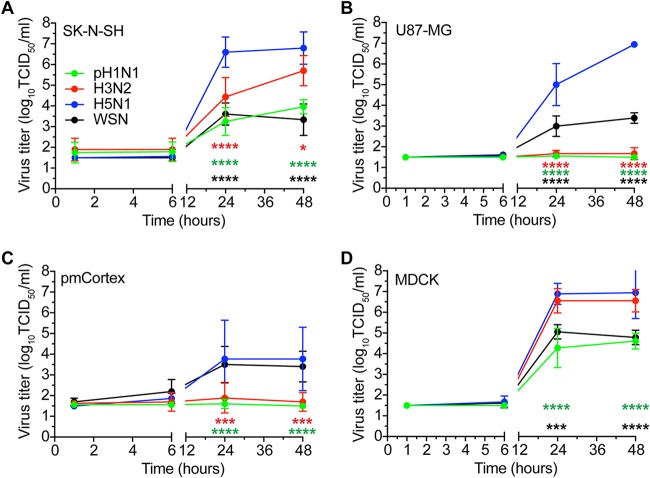
In the presence of trypsin, HPAI H5N1 virus replicates most efficiently in SK-N-SH, U87-MG, pmCortex, and MDCK cells. (A to D) Growth kinetics of pH1N1, H3N2, HPAI H5N1, and WSN viruses in SK-N-SH, U87-MG, pmCortex, and MDCK cells (MOI of 0.1) in the presence of trypsin. Data are presented as means ± SDs from at least three independent experiments. Two-way analysis of variance (ANOVA) with Dunnett’s multiple-comparison tests for individual viruses against HPAI H5N1 virus. *, P ≤ 0.05; ***, P ≤ 0.001; ****, P ≤ 0.0001.
FIG 2
FIG 2
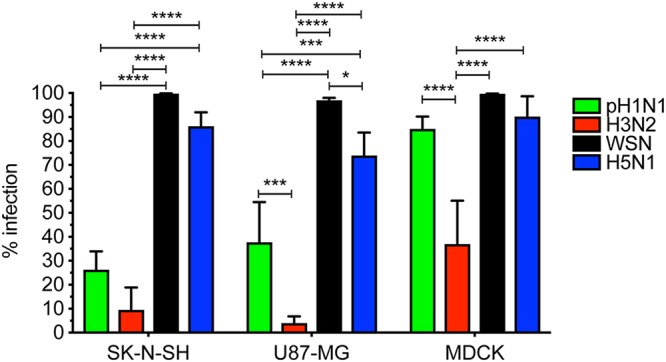
HPAI H5N1 and WSN viruses infect cells more efficiently than pH1N1 and H3N2 viruses. Percentages of infection in SK-N-SH, U87-MG, and MDCK cells were determined by FACS 8 hpi with either pH1N1, H3N2, WSN, or HPAI H5N1 virus (MOI of 3). Data are presented as means ± SDs from at least three independent experiments. Statistical analysis was performed using the two-way ANOVA with Tukey’s multiple-comparison test. *, P ≤ 0.05; ***, P ≤ 0.001; ****, P ≤ 0.0001.
FIG 3
FIG 3
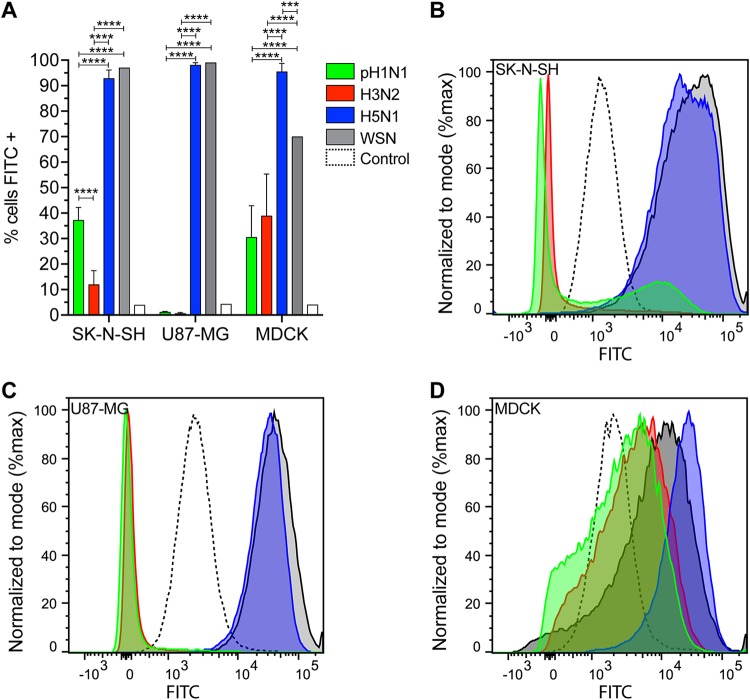
HPAI H5N1 and WSN viruses attach more efficiently to SK-N-SH and U87-MG cells than pH1N1 and H3N2 viruses. Virus attachment of pH1N1, H3N2, HPAI H5N1, and WSN viruses (using 100 hemagglutination units [HAU] units) to SK-N-SH, U87-MG, and MDCK cells. (A) Percentages of cells to which viruses attached. (B to D) Representative histograms of SK-N-SH, U87-MG, and MDCK cells. Dotted lines indicate cell control. Data in panel A are presented as means ± SDs from at least three independent experiments. Two-way ANOVA with Tukey’s multiple-comparison test. ***, P ≤ 0.001; ****, P ≤ 0.0001.
FIG 4
FIG 4
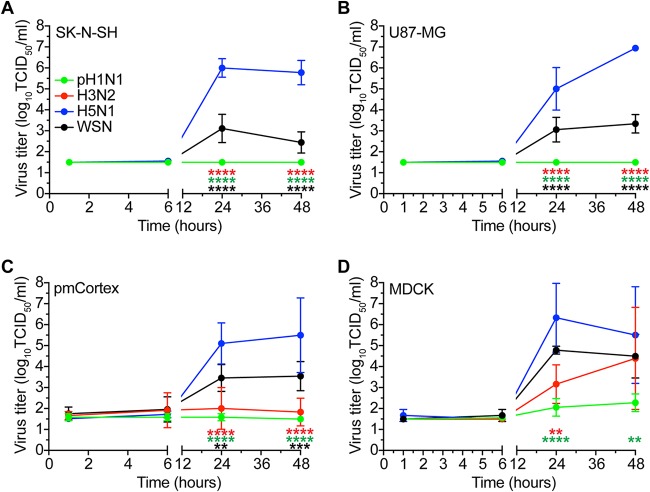
In the absence of trypsin, HPAI H5N1 virus grows most efficiently in SK-N-SH, U87-MG, MDCK, and pmCortex cells. (A to D) Growth kinetics of pH1N1, H3N2, HPAI H5N1, and WSN viruses in SK-N-SH, U87-MG, MDCK, and pmCortex cells (MOI of 0.1) in the absence of trypsin. Data are presented as means ± SDs from at least three independent experiments. Two-way ANOVA with Dunnett’s multiple-comparison test against H5N1 virus. **, P ≤ 0.01 ***, P ≤ 0.001; ****, P ≤ 0.0001.
FIG 5
FIG 5
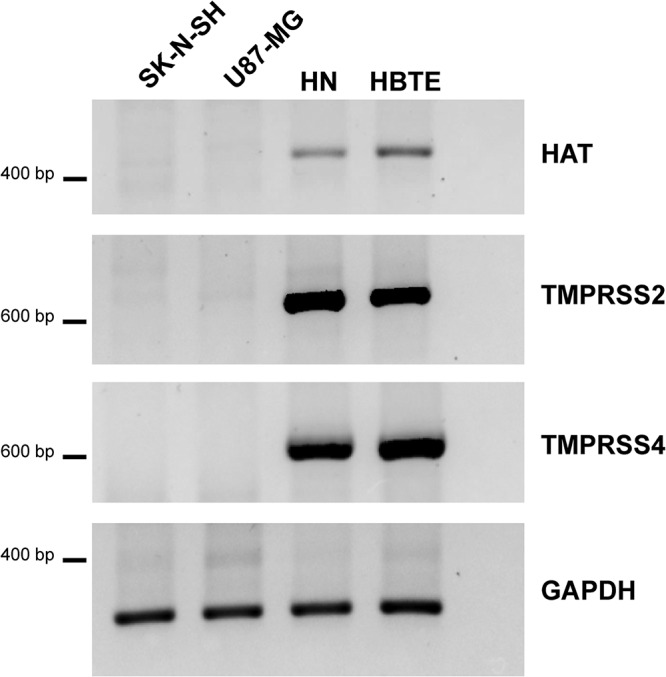
HAT, TMPRSS2, and TMPRSS4 mRNAs are not present in SK-N-SH and U87-MG cells. Presence of three known HA cleaving enzymes: human airway trypsin (HAT), transmembrane serine protease 2 (TMPRSS2), and TMPRSS4. Positive-control cell lines human nasal cells (HN) and human bronchial/tracheal epithelial (HBTE) cells did express HAT, TMPRSS2, and TMPRSS4 mRNA.
FIG 6
FIG 6
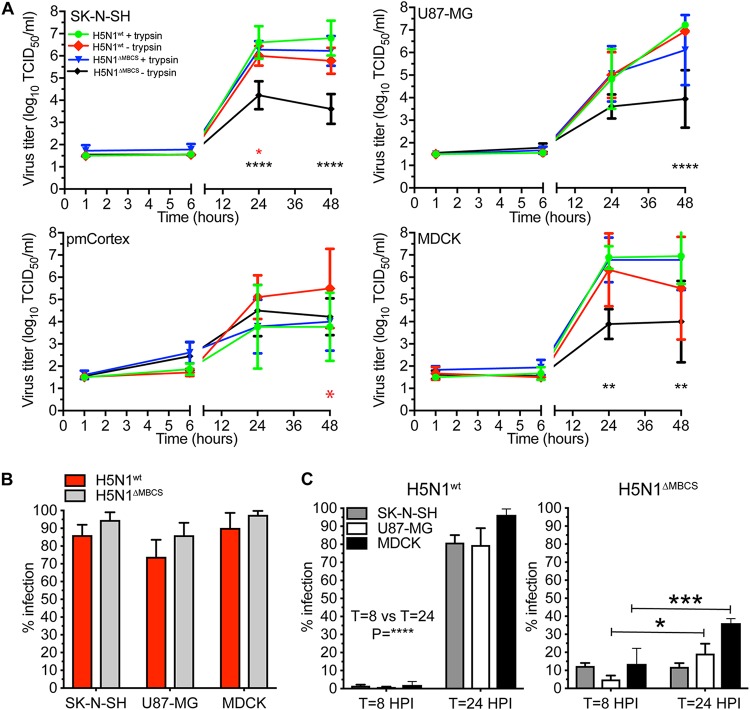
H5N1 virus without an MBCS replicates less efficiently in the absence of trypsin. (A) Replication kinetics of HPAI H5N1WT and H5N1ΔMBCS viruses in SK-N-SH, U87-MG, and MDCK cells (MOI of 0.1) in the presence or absence of trypsin. Statistical analysis was performed using a two-way ANOVA with Tukey’s multiple-comparison test against “H5N1WT + trypsin.” (B) Percentages of infection in SK-N-SH, U87-MG, and MDCK cells were determined by FACS at 8 hpi with HPAI H5N1WT and H5N1ΔMBCS viruses (MOI of 3). Statistical analysis was performed using the two-way ANOVA with Bonferroni’s multiple-comparison test. (C) Percentages of infection in SK-N-SH, U87-MG, and MDCK cells were determined by FACS at 8 and 24 hpi with HPAI H5N1WT and H5N1ΔMBCS viruses at an MOI of 0.1 in the absence of trypsin. Statistical analysis was performed using the two-way ANOVA with Bonferroni’s multiple-comparison test (8 versus 24 hpi). All data are presented as means ± SDs from at least three independent experiments. *, P ≤ 0.05; **, P ≤ 0.01; ***, P ≤ 0.001; ****, P ≤ 0.0001.

References

    1. Kuiken T, Taubenberger JK. 2008. Pathology of human influenza revisited. Vaccine 26:D59–D66. doi:10.1016/j.vaccine.2008.07.025. - DOI - PMC - PubMed
    1. Sellers SA, Hagan RS, Hayden FG, Fischer WA II.. 2017. The hidden burden of influenza: a review of the extra-pulmonary complications of influenza infection. Influenza Other Respir Viruses 11:372–393. doi:10.1111/irv.12470. - DOI - PMC - PubMed
    1. Toovey S. 2008. Influenza-associated central nervous system dysfunction: a literature review. Travel Med Infect Dis 6:114–124. doi:10.1016/j.tmaid.2008.03.003. - DOI - PubMed
    1. Popescu CP, Florescu SA, Lupulescu E, Zaharia M, Tardei G, Lazar M, Ceausu E, Ruta SM. 2017. Neurologic complications of influenza B virus infection in adults, Romania. Emerg Infect Dis 23:574–581. doi:10.3201/eid2304.161317. - DOI - PMC - PubMed
    1. Maurizi CP. 2010. Influenza caused epidemic encephalitis (encephalitis lethargica): the circumstantial evidence and a challenge to the nonbelievers. Med Hypotheses 74:798–801. doi:10.1016/j.mehy.2009.12.012. - DOI - PubMed

Publication types