


Review
doi: 10.1104/pp.18.01224.
Epub 2019 Mar 13.
Genetic Engineering for Disease Resistance in Plants: Recent Progress and Future Perspectives
Affiliations
- PMID: 30867331
- PMCID: PMC6501101
- DOI: 10.1104/pp.18.01224
Item in Clipboard
Review
Genetic Engineering for Disease Resistance in Plants: Recent Progress and Future Perspectives
Plant Physiol.
2019 May.
Abstract
A review of the recent progress in plant genetic engineering for disease resistance highlights future challenges and opportunities in the field.
Figures

CRISPR-Cas platforms for engineering viral resistance in plants. Plant viruses complete their life cycles in the host cells. Viral particles with geminate capsids, and rod-shaped capsids are used as examples to illustrate DNA viruses and RNA viruses, respectively. One of the Cas nuclease genes (SpCas9, FnCas9, or LshCas13a) and the matching guide RNA(s) are expressed transgenically to generate sequence-specific ribonucleoproteins that target viral DNA or RNA substrates for degradation. SpCas9 targets nuclear dsDNA, while FnCas9 and LshCas13a have been used to target single-stranded RNA (ssRNA) substrates in the cytoplasm. For simplicity, only one generic Cas nuclease is drawn. ssDNA, single-stranded DNA.
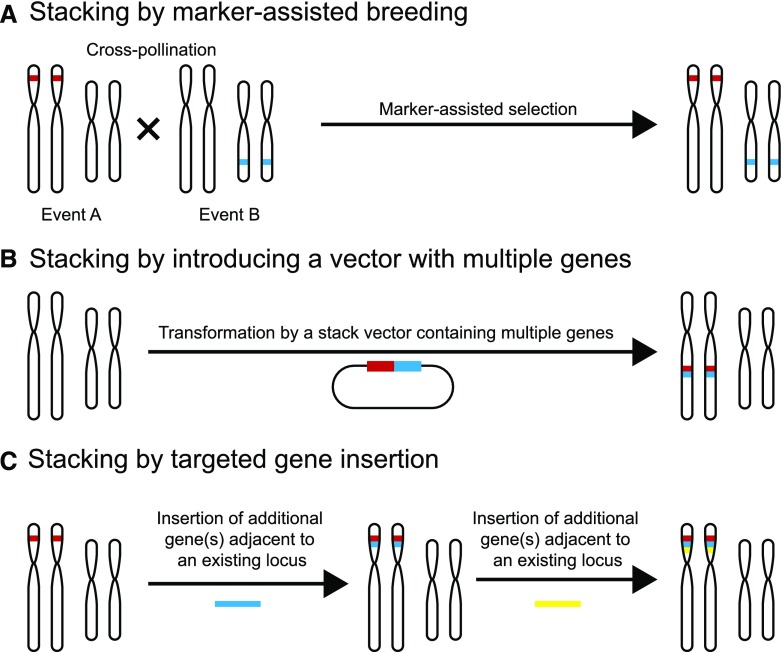
Methods of R gene stacking. A, Stacking by marker-assisted breeding is performed by cross pollinating individuals with existing trait loci followed by marker-assisted selection for progeny with combined trait loci. B, Stacking can be completed by combining multiple genes into a single stack vector and introducing them together as a single transgenic event. C, Stacking by targeted insertion aims at placing new gene(s) adjacent to an existing locus. This process can be performed iteratively to stack large numbers of genes. In B and C, the stacked genes are genetically linked and thus can be easily introduced into a different genetic background as a single locus through breeding.

References
-
- Abel PP, Nelson RS, De B, Hoffmann N, Rogers SG, Fraley RT, Beachy RN (1986) Delay of disease development in transgenic plants that express the tobacco mosaic virus coat protein gene. Science 232: 738–743 - PubMed
-
- Ahuja I, Kissen R, Bones AM (2012) Phytoalexins in defense against pathogens. Trends Plant Sci 17: 73–90 - PubMed
-
- Ai T, Zhang L, Gao Z, Zhu CX, Guo X (2011) Highly efficient virus resistance mediated by artificial microRNAs that target the suppressor of PVX and PVY in plants. Plant Biol (Stuttg) 13: 304–316 - PubMed
Publication types
MeSH terms
Grants and funding
LinkOut - more resources
Full Text Sources
Other Literature Sources
