. 2019 Mar 13;11(5):1524-1536.
doi: 10.18632/aging.101850.

Influence of metabolic syndrome on the relationship between fatty acids and the selected parameters in men with benign prostatic hyperplasia

Affiliations

Influence of metabolic syndrome on the relationship between fatty acids and the selected parameters in men with benign prostatic hyperplasia

Katarzyna Grzesiak et al. Aging (Albany NY). .

Abstract

The purpose of our investigation was to analyze the relationship between the serum levels of fatty acids and their metabolites and the levels of the selected metabolic and hormonal parameters in patients with benign prostatic hyperplasia (BPH) with regard to concomitant metabolic syndrome (MetS). We determined serum concentrations of total (TT) and free testosterone (FT), insulin (I), dehydroepiandrosterone sulphate (DHEAS), luteinizing hormone and insulin-like growth factor 1 (IGF-1) and sex hormone-binding globulin (SHBG). Gas chromatography was performed. The patients differed in terms of hormone levels, but only the differences in SHBG and IGF-1 levels were statistically significant. Analysis of the levels of polysaturated fatty acids in BPH patients showed that MetS contributed to changes in the levels of these acids. We also analyzed the relationship between the levels of fatty acids and diagnostic parameters for MetS. Particular abnormalities were associated with single changes in the levels of fatty acids. In the diabetic patients, changes in the levels of pentadecanoic acid, heptadecanoic acid and cis-11-eicosenoic acid were demonstrated. Our findings indicate the necessity for further investigation concerning the levels of fatty acids and their impact on the development of MetS, as well as the course and clinical picture of BPH.

Keywords: benign prostatic hyperplasia; fatty acids; metabolic syndrome.


Conflict of interest statement

CONFLICTS OF INTEREST: The authors all declare that they have no competing interests.

Figures

Figure 1
Figure 1
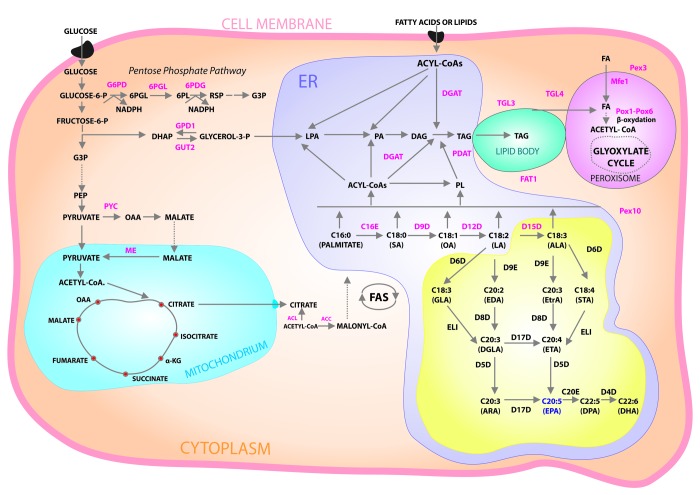
Cytosolic glucose enters glycolysis and pentose phosphate pathways. Pyruvate enters mitochondria where it is converted into acetyl-CoA then used in TCA cycle. Excess citrate is transported from the mitochondria into cytosol. ATP citrate lyase (ACL) converts the cytosolic citrate into acetyl-CoA that is converted into malonyl-CoA by acetyl-CoA carboxylase (ACC), the first committing step of fatty acid (FA) synthesis. After FA synthesis, triacylglycerol (TAG) is synthesized in the endoplasmic reticulum (ER) via Kennedy pathway and then accumulated in lipid bodies (LB). Acyl-CoA is used for acylation of glycerol-3- phosphate to form lysophosphatidic acid (LPA) that is further acylated to form phosphatidicacid (PA). PA is dephosphorylated to form diacylglycerol (DAG), which is then acylated to produce TAG catalyzed by DAG acyltransferase (DGAT). TAG can also be synthesized by phospholipid (PL):DAG acyltransferase (PDAT) using PL and DAG as substrates. Ex novo FA accumulation also uses Kennedy pathway. FA is metabolized by β- oxidation pathway in peroxisome. Abbreviations: 6PGL, 6-Phosphogluconolactonase; 6PDG, 6-Phosphogluconate dehydrogenase; α-KG, alpha-ketoglutarate; DHAP, dihydroxyacetone phosphate; FAT1, FAT Atypical Cadherin 1; G3P, glyceraldehyde3-phosphate; G6PD, glucose-6-phosphate dehydrogenase; GPD1, glycerol-3-phosphate dehydrogenase; GUT2, glycerol-kinase; Mfe1, multifunctional enzyme 1; ME, malic enzyme; OAA, oxaloacetate; PEP, phosphoenolpyruvate; Pex3 and Pex10, peroxisome biogenesis factor 3 and 10, respectively; Pox1 to Pox6, acyl-CoA oxidases 1–6, respectively; TGL3 and TGL4, TAG lipase 3 and 4, respectively; PYC, pyruvatecarboxylase; TCA, tricarboxylic acid cycle. Yellow box: schematic diagram of aerobic pathways for ω-3 and ω-6 FA biosynthesis. Abbreviations: C16E, EL1, C20E and D9E are C16/C18, C18, C20/C22, Δ-9 elongases, respectively. D4D, D5D, D6D, D8D, D9D, D12D, D15D and D17D are Δ-4, Δ-5, Δ-6, Δ-8, Δ-9, Δ-12, Δ-15, and Δ-17 desaturases, respectively.

Comment in

  • Benign Prostatic Hyperplasia.
    Kaplan SA. Kaplan SA. J Urol. 2021 Mar;205(3):902-905. doi: 10.1097/JU.0000000000001543. Epub 2020 Dec 23. J Urol. 2021. PMID: 33356455 No abstract available.

References

    1. Roehrborn C, McConnell J. (2002). Etiology, pathophysiology, epidemiology and natural history of benign prostatic hyperplasia. In: Walsh P, Retik A, Vaughan E, Wein A, editors. Campbell’s Urology. 8th ed. Philadelphia: Saunders, 1297–1336.
    1. Gacci M, Corona G, Vignozzi L, Salvi M, Serni S, De Nunzio C, Tubaro A, Oelke M, Carini M, Maggi M. Metabolic syndrome and benign prostatic enlargement: a systematic review and meta-analysis. BJU Int. 2015; 115:24–31. 10.1111/bju.12728 - DOI - PubMed
    1. Giles GG, Severi G, English DR, McCredie MR, MacInnis R, Boyle P, Hopper JL. Early growth, adult body size and prostate cancer risk. Int J Cancer. 2003; 103:241–45. 10.1002/ijc.10810 - DOI - PubMed
    1. Owens GK, Kumar MS, Wamhoff BR. Molecular regulation of vascular smooth muscle cell differentiation in development and disease. Physiol Rev. 2004; 84:767–801. 10.1152/physrev.00041.2003 - DOI - PubMed
    1. Rył A, Rotter I, Miazgowski T, Słojewski M, Dołęgowska B, Lubkowska A, Laszczyńska M. Metabolic syndrome and benign prostatic hyperplasia: association or coincidence? Diabetol Metab Syndr. 2015; 7:94. 10.1186/s13098-015-0089-1 - DOI - PMC - PubMed

Publication types