


Using Cognitive Interviewing and Behavioral Coding to Determine Measurement Equivalence across Linguistic and Cultural Groups: An Example from the International Tobacco Control Policy Evaluation Project
- PMID: 30867657
- PMCID: PMC6410349
- DOI: 10.1177/1525822X11418176
Using Cognitive Interviewing and Behavioral Coding to Determine Measurement Equivalence across Linguistic and Cultural Groups: An Example from the International Tobacco Control Policy Evaluation Project
Abstract
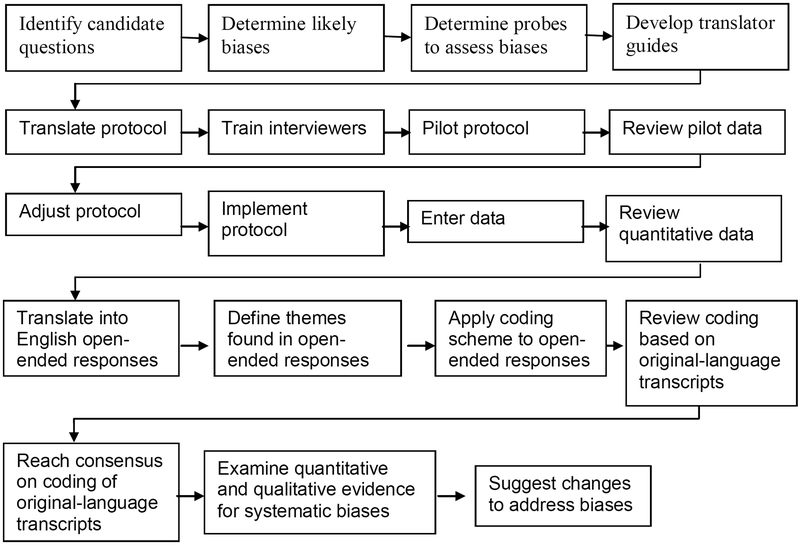
The present study aimed to examine and compare results from two questionnaire pretesting methods (i.e., behavioral coding and cognitive interviewing) in order to assess systematic measurement bias in survey questions for adult smokers across six countries (USA, Australia, Uruguay, Mexico, Malaysia and Thailand). Protocol development and translation involved multiple bilingual partners in each linguistic/cultural group. The study was conducted with convenience samples of 20 adult smokers in each country. Behavioral coding and cognitive interviewing methods produced similar conclusions regarding measurement bias for some questions; however, cognitive interviewing was more likely to identify potential response errors than behavioral coding. Coordinated survey qualitative pretesting (or post-survey evaluation) is feasible across cultural groups, and can provide important information on comprehension and comparability. Cognitive interviewing appears a more robust technique than behavioral coding, although combinations of the two might be even better.
References
-
- Blair J, Ackerman A, Piccinino L, & Levenstein R (2007). Using behavior coding to validate cognitive interview findings.Paper presented at the Proceedings of the American Statistical Association: Section on Survey Research Methods.
-
- Bollen KA, Entwisle B, & Alderson AS (1993). Macrocomparative research methods. Annual Review of Sociology, 19, 321–351.
-
- Cannell CF, L. S, Hausser DL. (1975). A Technique for Evaluating Interviewer Performance. Ann Arbor, MI: University of Michigan.
-
- Coronado I, & Earle D (2002). Effectiveness of the American Community Survey of the U.S. Census in a borderlands colonia setting. Washington, DC: US Census Bureau.
Grants and funding
LinkOut - more resources
Full Text Sources