


Neonatal seizures: Is there a relationship between ictal electroclinical features and etiology? A critical appraisal based on a systematic literature review
- PMID: 30868112
- PMCID: PMC6398099
- DOI: 10.1002/epi4.12298
Neonatal seizures: Is there a relationship between ictal electroclinical features and etiology? A critical appraisal based on a systematic literature review
Abstract
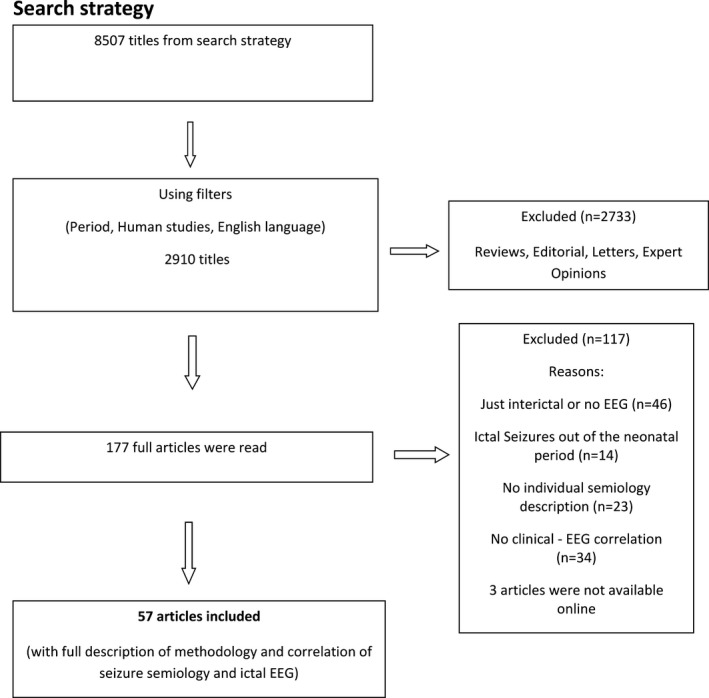
The aim of this study was to evaluate whether specific etiologies of neonatal seizures have distinct ictal electroclinical features. A systematic review of English articles using the PubMed database since 2004 (last update 9/26/16). Search terms included text words and Medical Subject Headings (MeSH) terms related to neonatal seizures. Eligible articles included reports of neonates with seizures with a full description of seizure semiology and electroclinical findings. Independent extraction of data was performed by 2 authors using predefined data fields, including study quality indicators. Data were collected for every individual patient described in the articles. The dataset was analyzed with the Fisher exact test. The initial search led to 8507 titles; using filters, 2910 titles and abstracts were identified, with 177 full texts selected to be read. Fifty-seven studies were included in the analysis with 151 neonates (37.7 male and 62.9% term). Genetic etiologies (51%) and sequential seizures (41.1%) predominated in this sample and hypoxic-ischemic encephalopathy (HIE) accounted for only 4%. The low prevalence of HIE observed was probably due to a publication bias. A significant association was found between etiology and seizure type: hemorrhage with autonomic seizures (P = 0.003), central nervous system (CNS) infection and stroke with clonic seizures (P = 0.042, P < 0.001, respectively), metabolic/vitamin-related disorders, and inborn errors of metabolism with myoclonic seizures (P < 0.001). There were also specific electroencephalography (EEG) patterns seen with certain etiologies: vascular disorders and electrolyte imbalance with focal ictal discharges (P < 0.001, P = 0.049 respectively), vitamin-related disorders with multifocal (P = 0.003), and all categories of genetic disorders with burst-suppression (P < 0.001). Clonic and autonomic seizures were more frequently present with focal EEG abnormalities (P = 0.001 and P < 0.001), whereas tonic and myoclonic seizures present with burst-suppression (P = 0.001, P = 0.005). In conclusion, our data suggest that specific associations of etiologies of neonatal seizures with distinct clinical features and EEG patterns might help in the decision to establish appropriate treatment.
Keywords: electroclinical features; neonatal EEG; neonatal seizures; semiology.
Conflict of interest statement
6Magda L Nunes was supported by CNPq‐Brazil, PQ grant 306338/2017‐3. Solomon L. Moshé was funded by grants from NIH U54NS100064 and NS43209, and from the Heffer Family, the Segal Family Foundations, and the Abbe Goldstein/Joshua Lurie and Laurie March/Dan Levitz families. Serves as an associate editor of Neurobiology of Disease and is on the editorial boards of Brain and Development, Pediatric Neurology, and Physiological Research. He receives from Elsevier an annual compensation for his work as associate editor of Neurobiology of Disease and royalties from books he coedited. He received a consultant fee from Mallinckrodt and UCB and is a member of a UCB Data Safety Monitoring Board (for work unrelated to this publication). Ronit M Pressler receives consultant fees from UCB (for work unrelated to this publication). The remaining authors have no conflicts of interest to declare. We confirm that we have read the Journal's position on issues involved in ethical publication and affirm that this report is consistent with those guidelines.
References
-
- Mizrahi EM, Kellaway P. Characterization and classification of neonatal seizures. Neurology. 1987;37:1837–44. - PubMed
-
- Mizrahi EM. Neonatal seizures: problems in diagnosis and classification. Epilepsia. 1987;28(suppl 1):S46–55. - PubMed
-
- WHO . Guidelines on neonatal seizures. Geneva, Switzerland: World Health Organization; 2011. - PubMed
-
- Scher MS. Controversies regarding neonatal seizure recognition. Epileptic Disord. 2002;4:139–58. - PubMed
-
- Tekgul H, Gauvreau K, Soul J, et al. The current etiologic profile and neurodevelopmental outcome of seizures in term newborn infants. Pediatrics. 2006;117:1270–80. - PubMed
Publication types
Grants and funding
LinkOut - more resources
Full Text Sources
Medical
