Review
. 2019 Mar 12;15(3):41.
doi: 10.1007/s11306-019-1493-6.

Mass spectrometry-based metabolomics of volatiles as a new tool for understanding aroma and flavour chemistry in processed food products

Affiliations
Review

Mass spectrometry-based metabolomics of volatiles as a new tool for understanding aroma and flavour chemistry in processed food products

Carmen Diez-Simon et al. Metabolomics. .

Abstract

Background: When foods are processed or cooked, many chemical reactions occur involving a wide range of metabolites including sugars, amino acids and lipids. These chemical processes often lead to the formation of volatile aroma compounds that can make food tastier or may introduce off-flavours. Metabolomics tools are only now being used to study the formation of these flavour compounds in order to understand better the beneficial and less beneficial aspects of food processing.

Aim of review: To provide a critical overview of the diverse MS-based studies carried out in recent years in food metabolomics and to review some biochemical properties and flavour characteristics of the different groups of aroma-related metabolites. A description of volatiles from processed foods, and their relevant chemical and sensorial characteristics is provided. In addition, this review also summarizes the formation of the flavour compounds from their precursors, and the interconnections between Maillard reactions and the amino acid, lipid, and carbohydrate degradation pathways.

Key scientific concepts of review: This review provides new insights into processed ingredients and describes how metabolomics will help to enable us to produce, preserve, design and distribute higher-quality foods for health promotion and better flavour.

Keywords: Flavour chemistry; Food processing; Gas chromatography; Maillard reaction; Mass spectrometry; Process flavours; Volatiles.


Conflict of interest statement

Conflict of interest

The author declares no potential conflict of interest related to the presented work.

Ethical approval

There are no ethical issues associated with this publication.

Research involving human and animal participants

This article is a review and does not contain any studies with human and/or animal participants performed by any of the authors.

Figures
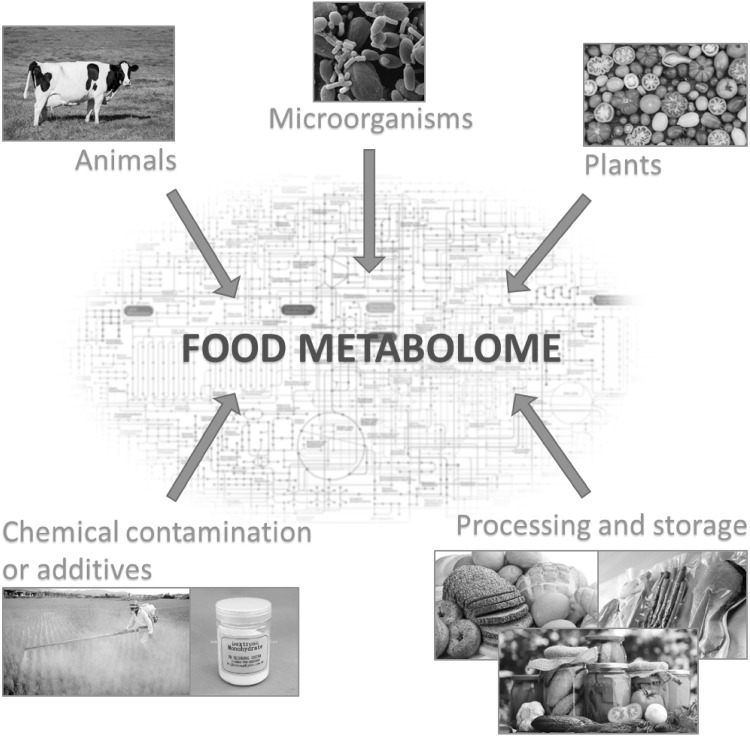
Fig. 1
Fig. 1
In terms of metabolites, food is a very complex material. Plant, animal and microbial materials cannot only be directly consumed but also often after highly-influential processing steps. Here the main sources of food metabolites are given which together constitute the food metabolome (modified from Johanningsmeier et al. 2016)
Fig. 2
Fig. 2
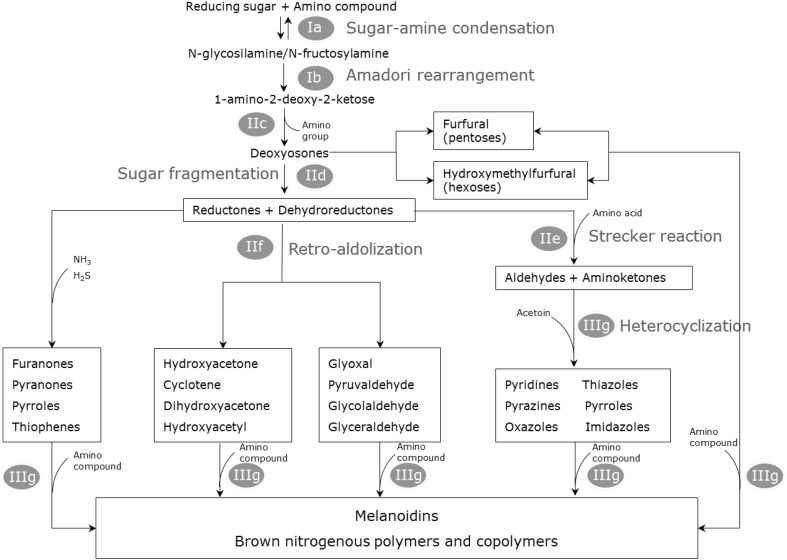
One of the most important sources of typical food metabolites which are of great influence to food flavour and quality arise through usually heat-induced chemical reactions generally grouped under the term ‘Maillard reactions’. Here we present a schematic overview of the Maillard reaction, based on Hodge (1953) and van Boekel (2006), that shows the main-end products contributing to flavour. (I) Early stage (a: sugar-amine condensation; b:amadori rearrangement); (II) Intermediate stage (c: sugar dehydration; d: sugar fragmentation; e: strecker degradation/amino acid degradation); (III) final stage (f: aldol condensation; g: aldehyde-amine condensation and formation of melanoidins)
Fig. 3
Fig. 3
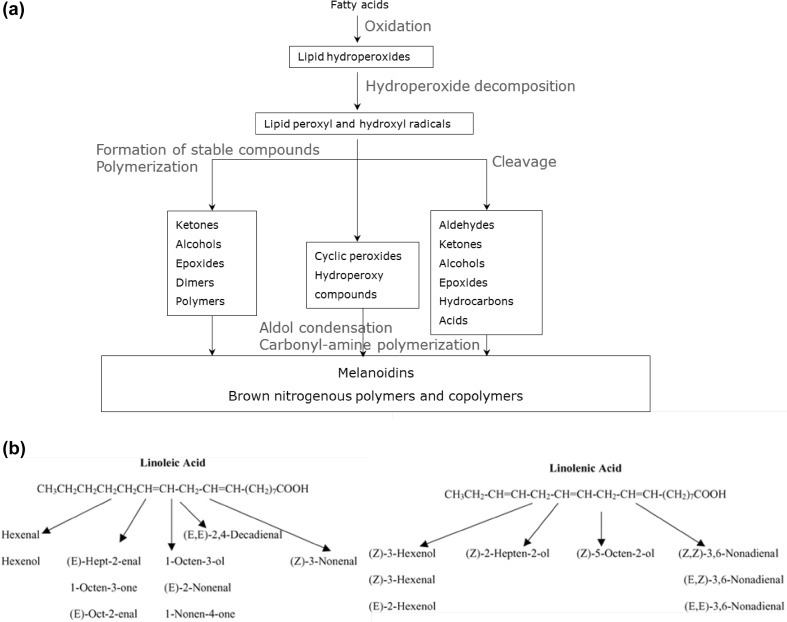
Lipids and their breakdown products are often hugely influential to the overall quality and flavour of food. These compounds can have both a positive or a negative influence on (off-) flavour. Here we present an overview of the lipid degradation pathway: a provides an overall picture of the different fatty acid degradation routes and b illustrates the complexity using two specific examples of important common fatty acids and their diversity in breakdown products of sensory relevance
Fig. 4
Fig. 4
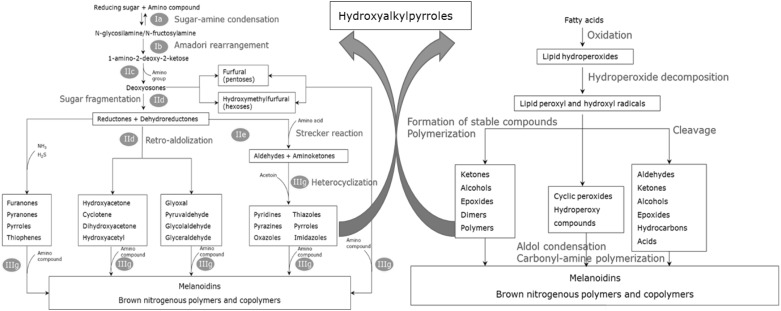
Foods generally have a more complex chemical composition that the fresh materials used for their production. Many new compounds are formed during the main processing steps involving non-enzymic reactions. Here as an example, we show an overview of the common volatile products formed from the interaction of Maillard reaction and lipid autoxidation (modified from Whitfield 1992)
Fig. 5
Fig. 5
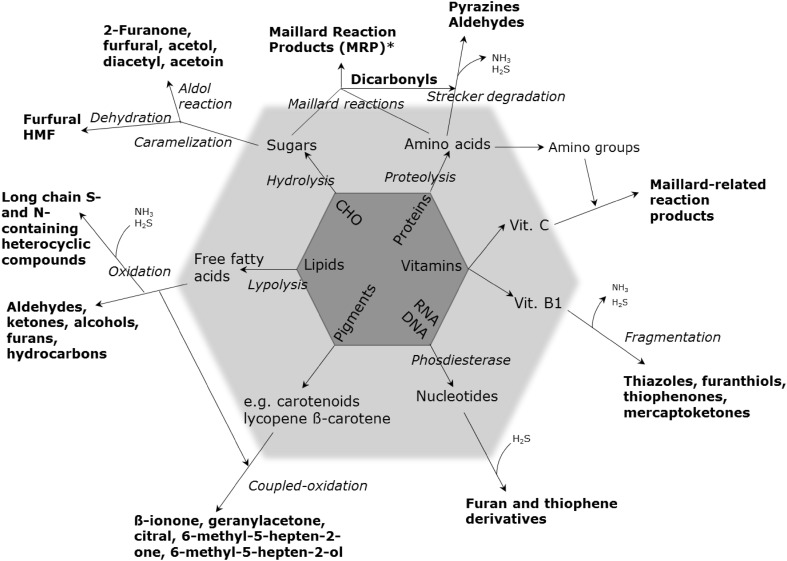
An overview of the chemical reactions relevant to flavour formation, modified from Sucan and Weerasinghe (2005). The typical complexity of the volatile components in food products is the result of both the modification of the original chemical constituents of the raw materials during processing as well as the subsequent interactions within and between the different chemical groups catalysed by enzymatic and thermo/chemical reactions

References

    1. Adams AN, Polizzi V, Van Boekel M, De Kimpe N. Formation of pyrazines and a novel pyrrole in Maillard model systems of 1,3-dihydroxyacetone and 2-oxopropanal. Journal of Agricultural and Food Chemistry. 2008;56(6):2147–2153. doi: 10.1021/jf0726785. - DOI - PubMed
    1. Adams RL, Mottram DS, Parker JK, Brown HM. Flavor—protein binding: Disulfide interchange reactions between ovalbumin- and volatile disulfides. Journal of Agricultural and Food Chemistry. 2001;49(9):4333–4336. doi: 10.1021/jf0100797. - DOI - PubMed
    1. Aernouts B, Polshin E, Saeys W, Lammertyn J. Mid-infrared spectrometry of milk for dairy metabolomics: A comparison of two sampling techniques and effect of homogenization. Analytica Chimica Acta. 2011;705(1–2):88–97. doi: 10.1016/j.aca.2011.04.018. - DOI - PubMed
    1. Allwood JW, Cheung W, Xu Y, Mumm R, De Vos RCH, Deborde C, et al. Metabolomics in melon: A new opportunity for aroma analysis. Phytochemistry. 2014;99:61–72. doi: 10.1016/j.phytochem.2013.12.010. - DOI - PMC - PubMed
    1. Alonso A, Marsal S, Julia A. Analytical methods in untargeted metabolomics: State of the art in 2015. Frontiers in Bioengineering and Biotechnology. 2015;3(23):1–20. doi: 10.3389/fbioe.2015.00023. - DOI - PMC - PubMed

Publication types

LinkOut - more resources