


Viral Infection of Human Natural Killer Cells
- PMID: 30870969
- PMCID: PMC6466310
- DOI: 10.3390/v11030243
Viral Infection of Human Natural Killer Cells
Abstract
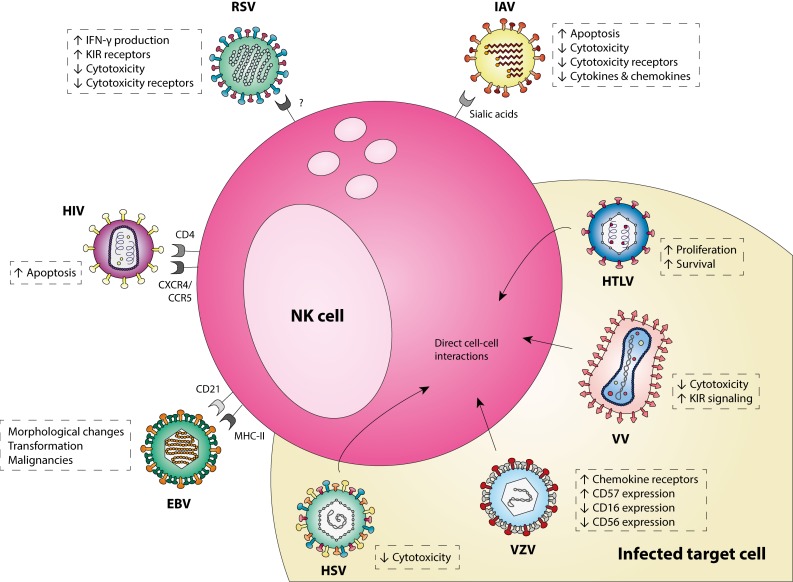
Natural killer (NK) cells are essential in the early immune response against viral infections, in particular through clearance of virus-infected cells. In return, viruses have evolved multiple mechanisms to evade NK cell-mediated viral clearance. Several unrelated viruses, including influenza virus, respiratory syncytial virus, and human immunodeficiency virus, can directly interfere with NK cell functioning through infection of these cells. Viral infection can lead to immune suppression, either by downregulation of the cytotoxic function or by triggering apoptosis, leading to depletion of NK cells. In contrast, some viruses induce proliferation or changes in the morphology of NK cells. In this review article, we provide a comprehensive overview of the viruses that have been reported to infect NK cells, we discuss their mechanisms of entry, and describe the interference with NK cell effector function and phenotype. Finally, we discuss the contribution of virus-infected NK cells to viral load. The development of specific therapeutics, such as viral entry inhibitors, could benefit from an enhanced understanding of viral infection of NK cells, opening up possibilities for the prevention of NK cell infection.
Keywords: NK cells; effector functions; immune evasion; infection; receptors; virus.
Conflict of interest statement
The authors declare no conflict of interest.
Figures
References
-
- Wiley S.R., Schooley K., Smolak P.J., Din W.S., Huang C.P., Nicholl J.K., Sutherland G.R., Smith T.D., Rauch C., Smith C.A., et al. Identification and characterization of a new member of the TNF family that induces apoptosis. Immunity. 1995;3:673–682. doi: 10.1016/1074-7613(95)90057-8. - DOI - PubMed
Publication types
MeSH terms
LinkOut - more resources
Full Text Sources
Medical
