Review
. 2019 Mar 13;20(6):1257.
doi: 10.3390/ijms20061257.

IL-36, IL-37, and IL-38 Cytokines in Skin and Joint Inflammation: A Comprehensive Review of Their Therapeutic Potential

Affiliations
Review

IL-36, IL-37, and IL-38 Cytokines in Skin and Joint Inflammation: A Comprehensive Review of Their Therapeutic Potential

Marie-Astrid Boutet et al. Int J Mol Sci. .

Abstract

The interleukin (IL)-1 family of cytokines is composed of 11 members, including the most recently discovered IL-36α, β, γ, IL-37, and IL-38. Similar to IL-1, IL-36 cytokines are initiators and amplifiers of inflammation, whereas both IL-37 and IL-38 display anti-inflammatory activities. A few studies have outlined the role played by these cytokines in several inflammatory diseases. For instance, IL-36 agonists seem to be relevant for the pathogenesis of skin psoriasis whereas, despite being expressed within the synovial tissue, their silencing or overexpression do not critically influence the course of arthritis in mice. In this review, we will focus on the state of the art of the molecular features and biological roles of IL-36, IL-37, and IL-38 in representative skin- and joint-related inflammatory diseases, namely psoriasis, rheumatoid arthritis, and psoriatic arthritis. We will then offer an overview of the therapeutic potential of targeting the IL-36 axis in these diseases, either by blocking the proinflammatory agonists or enhancing the physiologic inhibitory feedback on the inflammation mediated by the antagonists IL-37 and IL-38.

Keywords: TLR; interleukin-36; interleukin-37; interleukin-38; interleukine-1; psoriasis; psoriatic arthritis; rheumatoid arthritis.


Conflict of interest statement

The authors declare no conflict of interest.

Figures
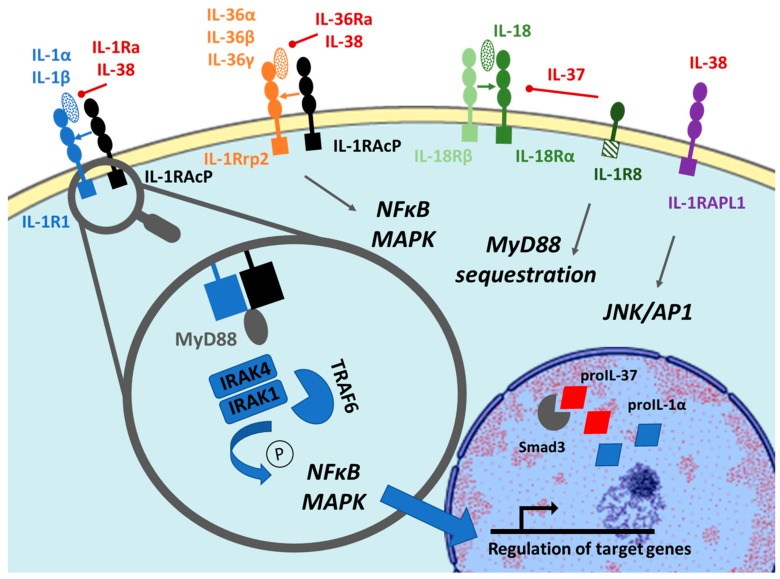
Figure 1
Figure 1
Overview of the IL-1, IL-36, IL-37, and IL-38 receptors and intracellular signaling. IL-1β binds the IL-1R1 receptor. Activated IL-1R1 recruits the IL-1RAcP common subunit and enables MyD88 to form a complex of signalization with IRAK and TRAF, which leads in turn to the phosphorylation/activation of the downstream signaling. A counter-regulatory pathway is represented by IL-1β binding its decoy receptor IL-1R2 (membrane-bound or soluble) (not shown). IL-36α, β, and γ bind to the IL-1Rrp2 and recruit the common subunit IL-1RAcP, inducing similar downstream signaling cascades as IL-1β. IL-37 binds IL-18Rα, which recruits IL-1R8 instead of the usual IL-18Rβ, causing sequestration of Myd88 and transduction of a weak signal because of the IL-1R8 mutated intracellular domain. IL-38 might be able to bind IL-1R1, IL-1Rrp2 and/or IL-1RAPL1 but further studies need to confirm its preferential intracellular mechanism of action. IL1R = IL-1 Receptor; IL-1RAcp = IL-1 Receptor Accessory Protein; IL-1RAPL1 = IL-1 Receptor Accessory Protein Like 1; IL-1Rrp2 (or IL-1RL2) = IL-1 Receptor Like 2; MyD88 = Myeloid Differentiation Primary Response Protein 88; IRAK = IL-1R-Associated Kinase; TRAF = TNF Receptor-Associated Factor; JNK = Jun N-terminal Kinase; AP1 = Activator Protein 1; NFκB = Nuclear Factor-kappa B; MAPK = Mitogen-Activated Protein Kinases.
Figure 2
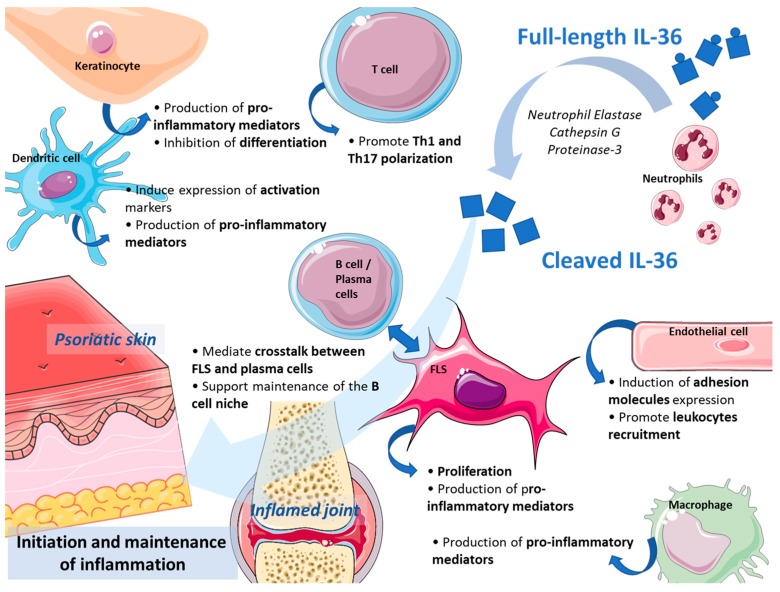
Figure 2
IL-36 agonists drive skin and joint inflammation. IL-36 cytokines are cleaved and activated by neutrophil proteases and act on multiple immune and resident stromal cells through their specific receptor complex IL-36R to initiate and amplify the inflammatory cascade. FLS = fibroblast-like synoviocytes; Th = T helper.
Figure 3
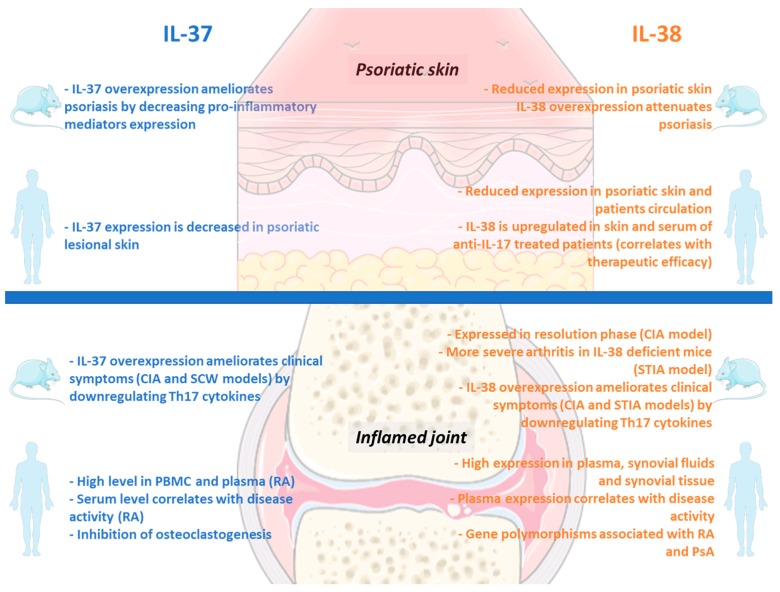
Figure 3
Main activities of IL-37 and IL-38 on skin and joints inflammation in mice and human. CIA = Collagen-Induced Arthritis; SCW = Streptococcal Cell Wall; PBMC = Peripheral Blood Mononuclear cells; RA = Rheumatoid Arthritis; STIA = Serum Transfer Induced Arthritis; Th = T helper; PsA = Psoriatic Arthritis.

References

    1. Kumar S., McDonnell P.C., Lehr R., Tierney L., Tzimas M.N., Griswold D.E., Capper E.A., Tal-Singer R., Wells G.I., Doyle M.L., et al. Identification and initial characterization of four novel members of the interleukin-1 family. J. Biol. Chem. 2000;275:10308–10314. doi: 10.1074/jbc.275.14.10308. - DOI - PubMed
    1. Parisi R., Symmons D.P.M., Griffiths C.E.M., Ashcroft D.M. Global Epidemiology of Psoriasis: A Systematic Review of Incidence and Prevalence. J. Investig. Dermatol. 2013;133:377–385. doi: 10.1038/jid.2012.339. - DOI - PubMed
    1. Ogdie A., Weiss P. The Epidemiology of Psoriatic Arthritis. Rheum. Dis. Clin. N. Am. 2015;41:545–568. doi: 10.1016/j.rdc.2015.07.001. - DOI - PMC - PubMed
    1. Ritchlin C.T., Colbert R.A., Gladman D.D. Psoriatic Arthritis. N. Engl. J. Med. 2017;376:957–970. doi: 10.1056/NEJMra1505557. - DOI - PubMed
    1. Boutet M.-A., Nerviani A., Gallo Afflitto G., Pitzalis C. Role of the IL-23/IL-17 Axis in Psoriasis and Psoriatic Arthritis: The Clinical Importance of Its Divergence in Skin and Joints. Int. J. Mol. Sci. 2018;19:530. doi: 10.3390/ijms19020530. - DOI - PMC - PubMed