Review
. 2019 Mar 13;8(3):238.
doi: 10.3390/cells8030238.

CIDE Proteins in Human Health and Disease

Affiliations
Review

CIDE Proteins in Human Health and Disease

Mark Slayton et al. Cells. .

Abstract

Cell death-Inducing DNA Fragmentation Factor Alpha (DFFA)-like Effector (CIDE) proteins have emerged as lipid droplet-associated proteins that regulate fat metabolism. There are three members in the CIDE protein family-CIDEA, CIDEB, and CIDEC (also known as fat-specific protein 27 (FSP27)). CIDEA and FSP27 are primarily expressed in adipose tissue, while CIDEB is expressed in the liver. Originally, based upon their homology with DNA fragmentation factors, these proteins were identified as apoptotic proteins. However, recent studies have changed the perception of these proteins, redefining them as regulators of lipid droplet dynamics and fat metabolism, which contribute to a healthy metabolic phenotype in humans. Despite various studies in humans and gene-targeting studies in mice, the physiological roles of CIDE proteins remains elusive. This review will summarize the known physiological role and metabolic pathways regulated by the CIDE proteins in human health and disease.

Keywords: CIDEA; CIDEB; FSP27; adipose; fat metabolism; lipid droplets; liver.


Conflict of interest statement

The authors declare no conflict of interest.

Figures
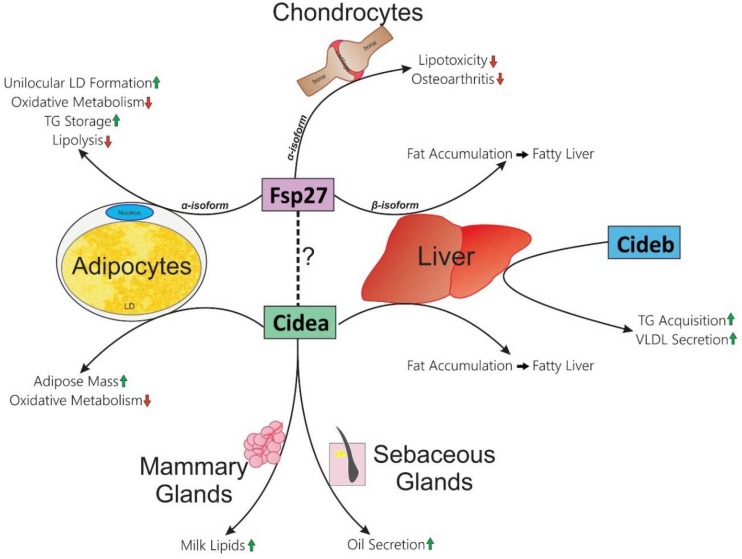
Figure 1
Figure 1
Tissue-specific functions of CIDE proteins in mice. Each CIDE protein is indicated with colored rectangles. The known functions within respective tissues are listed at the end of arrows which pass by them (Cidea: adipocytes, liver, mammary glands, and sebaceous glands; Cideb: liver; Fsp27: adipocytes, chondrocytes, and liver). Green up-arrows indicate an increase; red down-arrows indicate a decrease. Dotted line indicates that Fsp27 and Cidea could form a heteromeric complex, which could be essential for one or more of their functions.
Figure 2
Figure 2
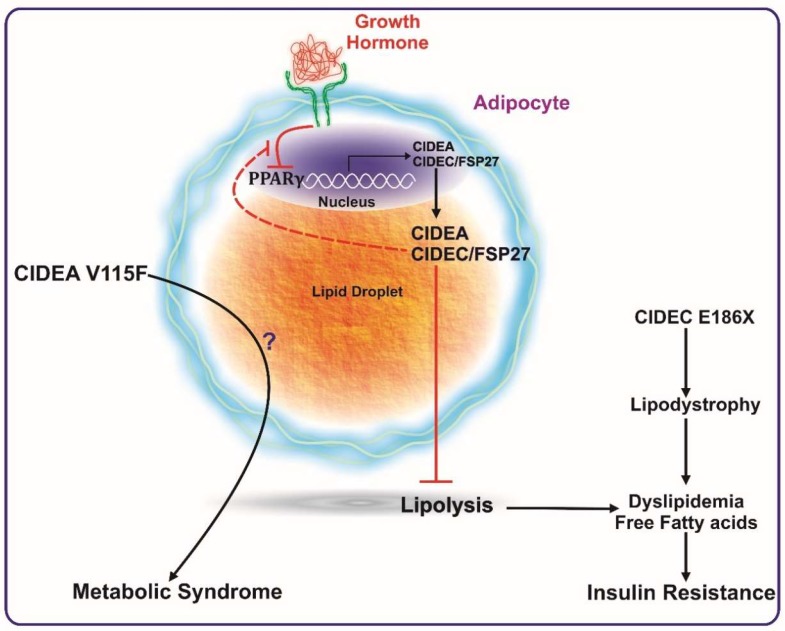
CIDEA and CIDEC/FSP27 are transcriptionally activated by PPARγ expression. CIDEA and FSP27 bind to lipid droplets and inhibit lipolysis. Reduction in PPARγ activation (such as by growth hormone) reduces the expression levels of these proteins, which ultimately causes enhanced lipolysis, leading to a higher concentration of systemic free fatty acids. The increase in serum free fatty acids culminates in insulin resistance. A mutation in FSP27 (CIDEC E186X) causes lipodystrophy and insulin-resistant type 2 diabetes. The V115F polymorphism in CIDEA is reported to be positively associated with metabolic syndrome. Excess growth hormone levels (such as in acromegaly patients) inactivate PPARγ causing reduced expression of FSP27. FSP27 protects against GH-mediated destabilization of PPARγ to maintain insulin sensitivity.

References

    1. Inohara N., Koseki T., Chen S., Wu X., Núñez G. CIDE, a novel family of cell death activators with homology to the 45 kDa subunit of the DNA fragmentation factor. EMBO J. 1998;17:2526–2533. doi: 10.1093/emboj/17.9.2526. - DOI - PMC - PubMed
    1. Lugovskoy A.A., Zhou P., Chou J.J., McCarty J.S., Li P., Wagner G. Solution Structure of the CIDE-N Domain of CIDE-B and a Model for CIDE-N/CIDE-N Interactions in the DNA Fragmentation Pathway of Apoptosis. Cell. 1999;99:747–755. doi: 10.1016/S0092-8674(00)81672-4. - DOI - PubMed
    1. Li J.Z., Ye J., Xue B., Qi J., Zhang J., Zhou Z., Li Q., Wen Z., Li P. Cideb regulates diet-induced obesity, liver steatosis, and insulin sensitivity by controlling lipogenesis and fatty acid oxidation. Diabetes. 2007;56:2523–2532. doi: 10.2337/db07-0040. - DOI - PubMed
    1. Nordström E.A., Rydén M., Backlund E.C., Dahlman I., Kaaman M., Blomqvist L., Cannon B., Nedergaard J., Arner P. A Human-Specific Role of Cell Death-Inducing DFFA (DNA Fragmentation Factor-α)-Like Effector A (CIDEA) in Adipocyte Lipolysis and Obesity. Diabetes. 2005;54:1726–1734. doi: 10.2337/diabetes.54.6.1726. - DOI - PubMed
    1. Puri V., Konda S., Ranjit S., Aouadi M., Chawla A., Chouinard M., Chakladar A., Czech M.P. Fat-specific Protein 27, a Novel Lipid Droplet Protein That Enhances Triglyceride Storage. J. Biol. Chem. 2007;282:34213–34218. doi: 10.1074/jbc.M707404200. - DOI - PubMed

Substances

LinkOut - more resources