Review
. 2019 Mar 13;11(3):608.
doi: 10.3390/nu11030608.

Methyl Donor Micronutrients that Modify DNA Methylation and Cancer Outcome

Affiliations
Review

Methyl Donor Micronutrients that Modify DNA Methylation and Cancer Outcome

Abeer M Mahmoud et al. Nutrients. .

Abstract

DNA methylation is an epigenetic mechanism that is essential for regulating gene transcription. However, aberrant DNA methylation, which is a nearly universal finding in cancer, can result in disturbed gene expression. DNA methylation is modified by environmental factors such as diet that may modify cancer risk and tumor behavior. Abnormal DNA methylation has been observed in several cancers such as colon, stomach, cervical, prostate, and breast cancers. These alterations in DNA methylation may play a critical role in cancer development and progression. Dietary nutrient intake and bioactive food components are essential environmental factors that may influence DNA methylation either by directly inhibiting enzymes that catalyze DNA methylation or by changing the availability of substrates required for those enzymatic reactions such as the availability and utilization of methyl groups. In this review, we focused on nutrients that act as methyl donors or methylation co-factors and presented intriguing evidence for the role of these bioactive food components in altering DNA methylation patterns in cancer. Such a role is likely to have a mechanistic impact on the process of carcinogenesis and offer possible therapeutic potentials.

Keywords: DNA methylation; Vitamin B; betaine; cancer; choline; dietary; folate; methyl donors; methyltransferase; nutrients.


Conflict of interest statement

No potential conflicts of interest were disclosed.

Figures
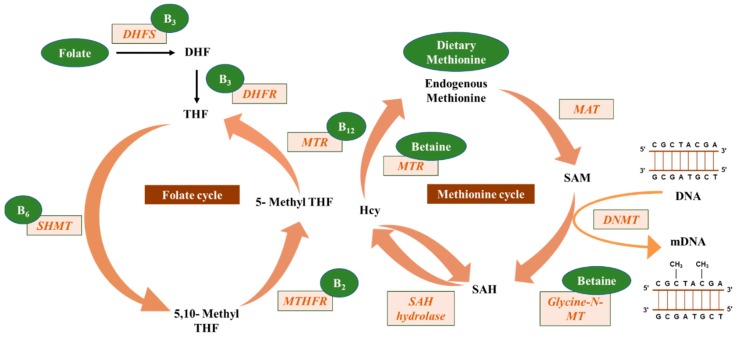
Figure 1
Figure 1
Micronutrient methyl donors that are involved in the one carbon metabolism and subsequently in DNA methylation. Dietary folate is converted to dihydrofolate (DHF) via the dihydrofolate synthase (DHFS) enzyme then to tetrahydrofolate (THF) by the dihydrofolate reductase (DHFR) enzyme; in both steps, vitamin B3 (B3) acts as a co-factor. THF is then converted to 5,10-methyl THF via the enzyme serine hydroxymethyltransferase (SHMT) that has vitamin B6 (B6) as a coenzyme. This reaction is followed by a reduction of 5,10-methyl THF to 5-methyl THF via the enzyme methylenetetrahydrofolate reductase (MTHFR) and the co-enzyme, vitamin B2 (B2). At the end of this cycle, 5-methyl THF is transformed back to THF by the enzyme 5-methyltetrahydrofolate-homocysteine methyltransferase (MTR) that utilizes vitamin B2 as a co-enzyme. The same enzyme, MTR, converts homocysteine (Hcy) to methionine. Betaine acts as an indirect methyl donor for the latter reaction. Methionine, whether it is endogenously synthesized or diet-derived is critical for the synthesis of S-adenosylmethionine (SAM), which acts as a DNA methyltransferase (DNMT) cofactor and a universal methyl-donor for DNA methylation. The enzyme that catalyzes this reaction is methionine adenosyltransferase (MAT). Glycine N-methyltransferase (Glycine N-MT) converts SAM to s-adenosylhomocysteine (SAH), which could be reversibly converted to Hcy via the enzyme SAH hydrolase. Finally, the activated DNMT enzyme will catalyze the transfer of a methyl group to carbon 5 of cytosines in the DNA to produce methylated DNA (mDNA).
Figure 2
Figure 2
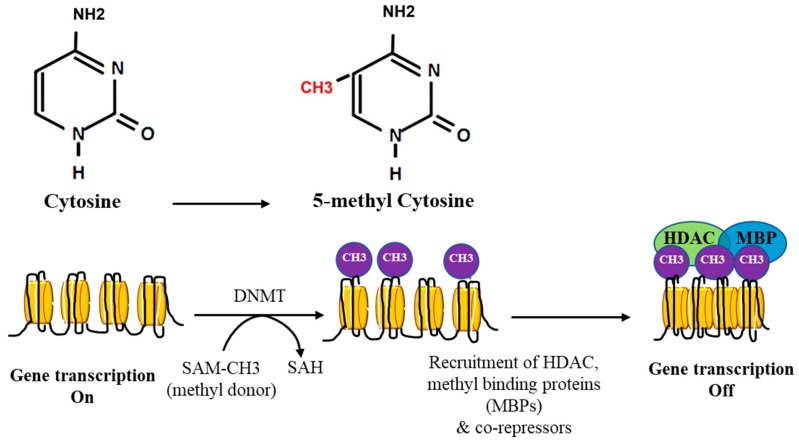
Schematic representation of DNA methylation and its effect on gene transcription. DNA methyltransferase (DNMT) converts cytosine to 5′methyl-cytosine. The process involves the transfer of a methyl group from S-adenosylmethionine (SAM) to the cytosine resulting in the conversion of DNA to methylated DNA and methylated SAM to non-methylated S-adenosylhomocysteine (SAH). DNA methylation recruits histone deacetylase (HDAC), methyl binding proteins (MBPs), and other transcription repressing factors. These modifications result in closed chromatin conformation, inaccessibility to transcriptional machinery, and eventually gene silencing.

References

    1. Biswas S., Rao C.M. Epigenetics in cancer: Fundamentals and beyond. Pharmacol. Ther. 2017;173:118–134. doi: 10.1016/j.pharmthera.2017.02.011. - DOI - PubMed
    1. Ducker G.S., Rabinowitz J.D. One-carbon metabolism in health and disease. Cell Metab. 2017;25:27–42. doi: 10.1016/j.cmet.2016.08.009. - DOI - PMC - PubMed
    1. Zeisel S. Choline, other methyl-donors and epigenetics. Nutrients. 2017;9:445. doi: 10.3390/nu9050445. - DOI - PMC - PubMed
    1. Jung M., Pfeifer G.P. Aging and DNA methylation. BMC Biol. 2015;13:7. doi: 10.1186/s12915-015-0118-4. - DOI - PMC - PubMed
    1. Lillycrop K.A., Burdge G.C. Epigenetic mechanisms linking early nutrition to long term health. Best Pract. Res. Clin. Endocrinol. Metab. 2012;26:667–676. doi: 10.1016/j.beem.2012.03.009. - DOI - PubMed

MeSH terms

LinkOut - more resources