


Race-, Age-, and Anatomic Site-Specific Gender Differences in Cutaneous Melanoma Suggest Differential Mechanisms of Early- and Late-Onset Melanoma
- PMID: 30871230
- PMCID: PMC6466415
- DOI: 10.3390/ijerph16060908
Race-, Age-, and Anatomic Site-Specific Gender Differences in Cutaneous Melanoma Suggest Differential Mechanisms of Early- and Late-Onset Melanoma
Abstract
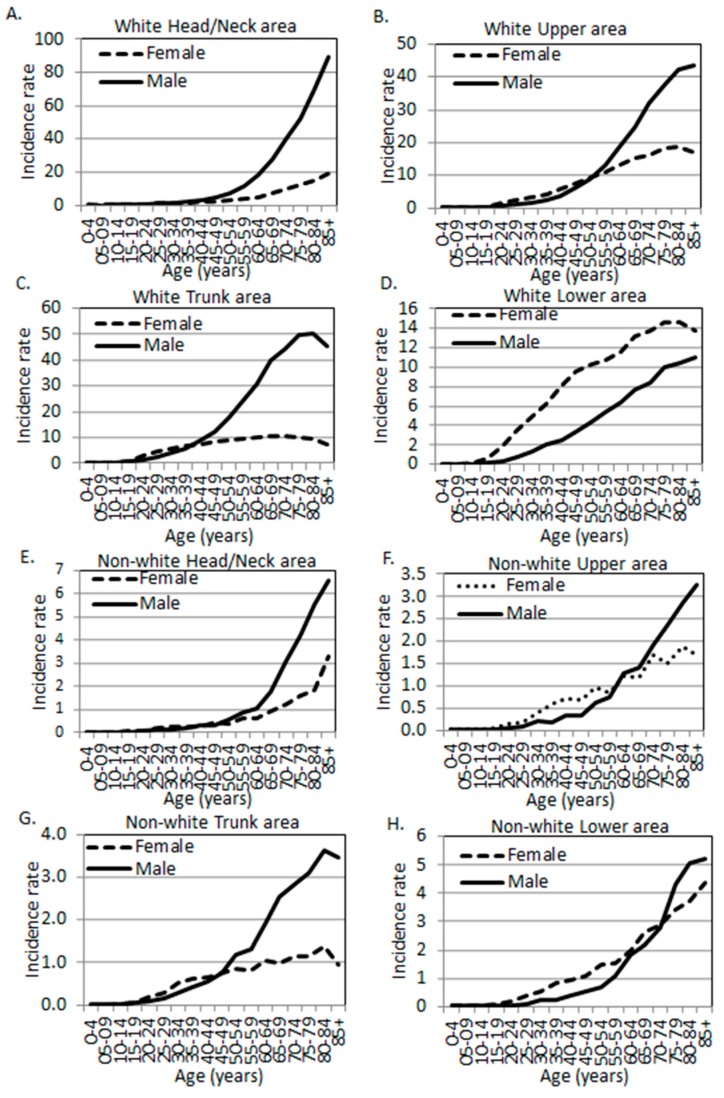
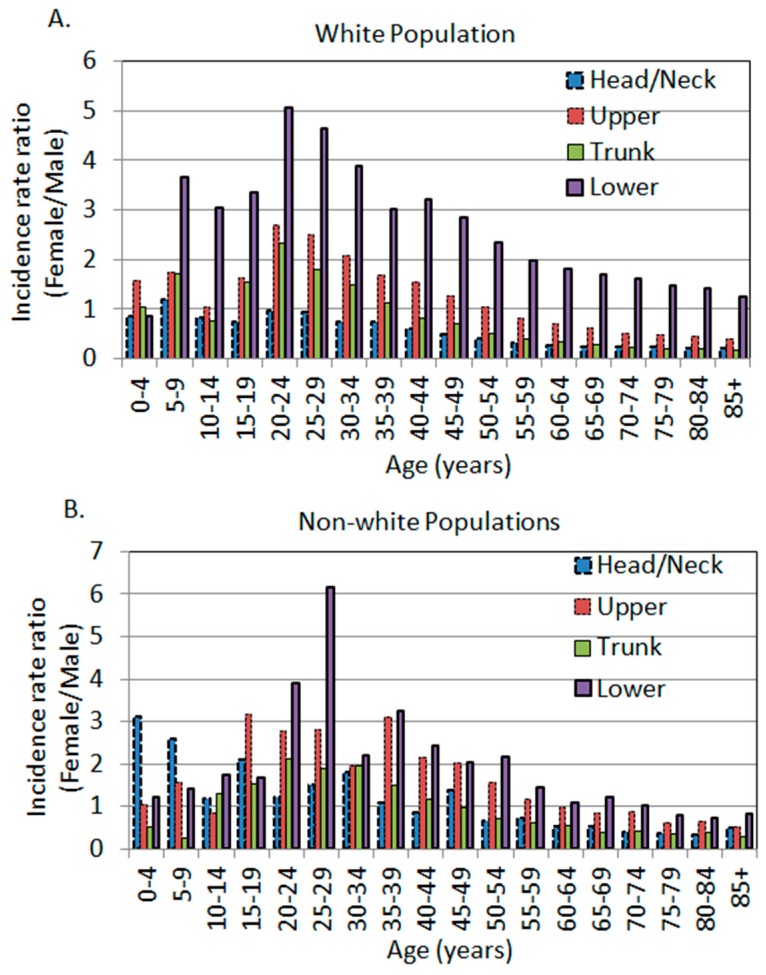
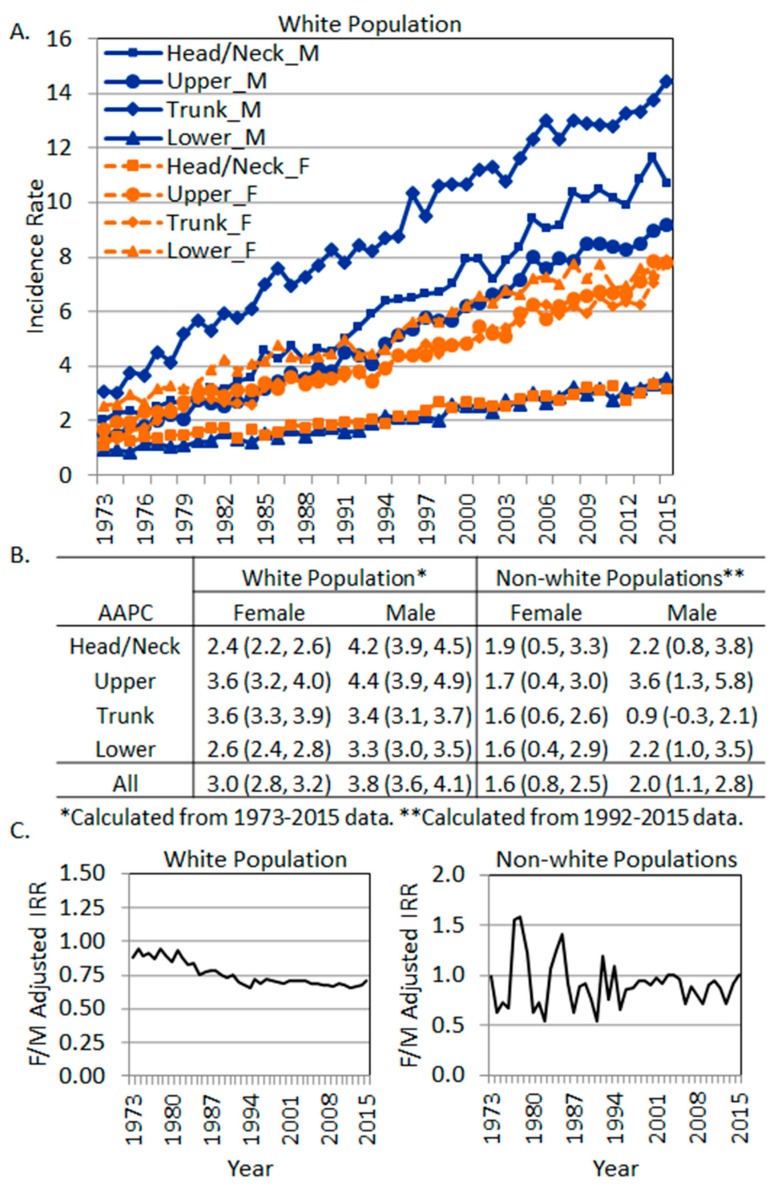
In order to explore melanoma risk factors through gender-, age-, race-, and site-specific incidence rates, malignant melanoma cases from the Caucasian whites and non-whites were retrieved from the US SEER database. Age-standardized, age-, and site-specific tumor rates were calculated. All races and both genders showed positive annual average percentage changes (AAPCs) over the years, but AAPCs varied at different body sites, with men's trunk exhibiting the fastest increase. Non-whites were diagnosed at a significantly younger age than whites and showed a trend towards fewer gender differences in the age of diagnosis. However, non-whites and whites showed a similar pattern of age-specific gender differences in the incidence rate ratios. A consistent spiked difference (female vs. male, incidence rate ratio (IRR) >2) was observed at or near the age of 20⁻24 in all race groups and at all body sites. The highest female vs. male IRR was found in the hip and lower extremities, and the lowest IRR was found in the head and neck region in all races. These race-, gender-, and site-dependent differences suggest that age-associated cumulative sun exposure weighs significantly more in late-onset melanomas, while genetics and/or pathophysiological factors make important contributions to early-onset melanomas.
Keywords: UV; anatomic body site; annual average percentage change; gender difference; incidence rate; incidence rate ratio; melanoma; non-white; race difference.
Conflict of interest statement
The authors declare no conflict of interest.
Figures
References
-
- CDC Melanoma Incidence Rates and Death Rates by Race and Ethnicity: 1999–2012. [(accessed on 2 October 2018)];2018 Available online: http://www.cdc.gov/cancer/skin/statistics/race.htm.
-
- Liu F., Bessonova L., Taylor T.H., Ziogas A., Meyskens F.L., Jr., Anton-Culver H. A unique gender difference in early onset melanoma implies that in addition to ultraviolet light exposure other causative factors are important. Pigm. Cell Melanoma Res. 2013;26:128–135. doi: 10.1111/pcmr.12035. - DOI - PMC - PubMed
