Review
. 2019 Mar 13;20(6):1272.
doi: 10.3390/ijms20061272.

Causes and Mechanisms of Hematopoietic Stem Cell Aging

Affiliations
Review

Causes and Mechanisms of Hematopoietic Stem Cell Aging

Jungwoon Lee et al. Int J Mol Sci. .

Abstract

Many elderly people suffer from hematological diseases known to be highly age-dependent. Hematopoietic stem cells (HSCs) maintain the immune system by producing all blood cells throughout the lifetime of an organism. Recent reports have suggested that HSCs are susceptible to age-related stress and gradually lose their self-renewal and regeneration capacity with aging. HSC aging is driven by cell-intrinsic and -extrinsic factors that result in the disruption of the immune system. Thus, the study of HSC aging is important to our understanding of age-related immune diseases and can also provide potential strategies to improve quality of life in the elderly. In this review, we delineate our understanding of the phenotypes, causes, and molecular mechanisms involved in HSC aging.

Keywords: differentiation; hematopoietic stem cell aging; rejuvenation; self-renewal.


Conflict of interest statement

The authors declare no conflict of interest.

Figures
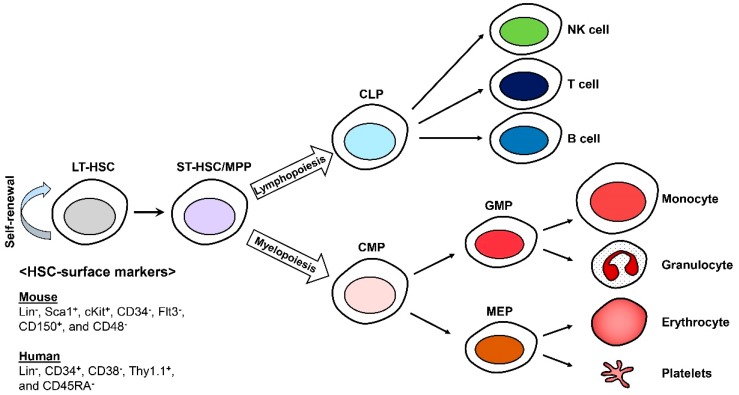
Figure 1
Figure 1
Differentiation of hematopoietic stem cells (HSCs). Long-term HSCs (LT-HSCs) are able to self-renew and are responsible for generating blood cells. CLP; the common lymphoid progenitor, CMP; the common myeloid progenitor, GMP; the granulocyte macrophage progenitor, and MEP; the megakaryocytic and erythroid progenitor.
Figure 2
Figure 2
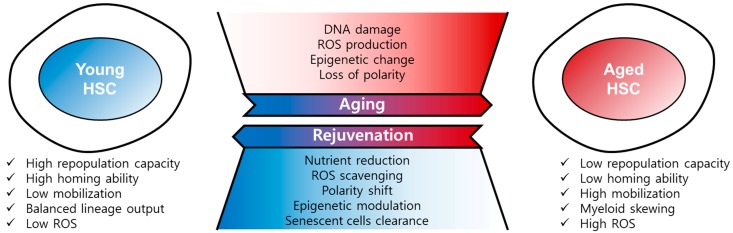
Regulation of HSC aging and rejuvenation. Aged HSCs have the hallmarks of low repopulation capacity, low homing ability, high mobility, myeloid skewing, and high ROS, among others. HSC aging is driven by DNA damage, ROS, epigenetic change, and loss of polarity. Aged HSCs can be rejuvenated by nutrient reduction, ROS scavenging, polarity shift, epigenetic modulation, and senescent cells clearance.

References

    1. Akunuru S., Geiger H. Aging, Clonality, and Rejuvenation of Hematopoietic Stem Cells. Trends Mol. Med. 2016;22:701–712. doi: 10.1016/j.molmed.2016.06.003. - DOI - PMC - PubMed
    1. Moehrle B.M., Geiger H. Aging of hematopoietic stem cells: DNA damage and mutations? Exp. Hematol. 2016;44:895–901. doi: 10.1016/j.exphem.2016.06.253. - DOI - PMC - PubMed
    1. Ergen A.V., Goodell M.A. Mechanisms of hematopoietic stem cell aging. Exp. Gerontol. 2010;45:286–290. doi: 10.1016/j.exger.2009.12.010. - DOI - PMC - PubMed
    1. Kiel M.J., Yilmaz O.H., Iwashita T., Yilmaz O.H., Terhorst C., Morrison S.J. SLAM family receptors distinguish hematopoietic stem and progenitor cells and reveal endothelial niches for stem cells. Cell. 2005;121:1109–1121. doi: 10.1016/j.cell.2005.05.026. - DOI - PubMed
    1. Jung H., Kim M.J., Kim D.O., Kim W.S., Yoon S.J., Park Y.J., Yoon S.R., Kim T.D., Suh H.W., Yun S., et al. TXNIP maintains the hematopoietic cell pool by switching the function of p53 under oxidative stress. Cell Metab. 2013;18:75–85. doi: 10.1016/j.cmet.2013.06.002. - DOI - PubMed