


ACL reconstruction with quadriceps tendon graft and press-fit fixation versus quadruple hamstring graft and interference screw fixation - a matched pair analysis after one year follow up
- PMID: 30871508
- PMCID: PMC6419498
- DOI: 10.1186/s12891-019-2499-y
ACL reconstruction with quadriceps tendon graft and press-fit fixation versus quadruple hamstring graft and interference screw fixation - a matched pair analysis after one year follow up
Abstract
Background: The objective of the study was to compare the results of a primary anterior cruciate ligament reconstruction (ACLR) using the press-fit fixation technique for a quadriceps tendon (QT) graft to a standard quadrupled hamstring (HT) graft with interference screw fixation.
Methods: A retrospective cohort study with a 12-month follow up provided data for 92 patients. Exclusion criteria were accompanying ligament injuries and contralateral ACL injury. Patients who suffered a graft failure, which was defined as a side-to-side difference of > 3 mm, or infection were rated 'D' according to the IKDC and excluded from further evaluation. Forty-six patients underwent primary ACLR using the press-fit fixation technique for autologous bone QT graft. These patients were matched in terms of age, gender, accompanying meniscus tear and cartilage injury to 46 patients who underwent standard HT graft with interference screw fixation. Patients were evaluated according to the Lachman test, Pivot-Shift test, IKDC score, Tegner score, Rolimeter measurements, one-leg hop test, thigh circumference and donor side morbidity.
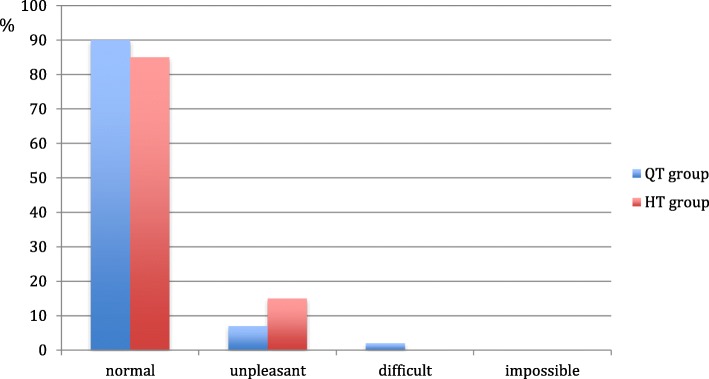
Results: No significant differences in Tegner score (p = 0.9), subjective or objective IKDC score (p = 0.9;p = 0.6), knee stability (Lachman Test p = 0.6; Pivot-Shift Test p = 0.4; Side-to-Side Difference p = 0.4), functioning testing (One-Leg Hop Test p = 0.6; Thigh Circumference p = 0.4) or donor side morbidity (p = 0.4) were observed at the follow up. The Lachman test was negative for 85% of the QT group and 83% of the HT group. The Pivot Shift Test was negative for 80% of the QT group and 85% of the HT group. The mean side-to-side difference was 1.6 ± 0 .2mm in both groups. The one-leg hop test revealed a collateral-side jumping distance of 96.2 ± 8.5% for the QT group and 95.5 ± 8.5% for the HT group. The thigh circumference of the injured leg was 98.3 ± 3.0% on the uninjured side in the QT group and 99.7 ± 3.0% in the HT group. A knee walking test resulted in no discomfort for 90% of the QT group and 85% of the HT group. The graft failure rate was 7.3% in the QT group and 9.8% in the HT group.
Conclusion: QT grafts fixated using the press-fit technique are a reliable alternative for primary ACL surgery.
Keywords: ACL reconstruction; Press-fit fixation; Quadriceps tendon.
Conflict of interest statement
Ethics approval and consent to participate
This study was approved by the ethical committee of Witten/Herdecke University (Application No. 109/2010). Written informed consent was obtained from all study participants.
Consent for publication
Not applicable.
Competing interests
The authors declare that they have no competing interests.
Publisher’s Note
Springer Nature remains neutral with regard to jurisdictional claims in published maps and institutional affiliations.
Figures

References
-
- Leys T, Salmon L, Waller A, Linklater J, Pinczewski L. Clinical results and risk factors for reinjury 15 years after anterior cruciate ligament reconstruction: a prospective study of hamstring and patellar tendon grafts. Am J Sports Med. 2012;40(3):595–605. doi: 10.1177/0363546511430375. - DOI - PubMed
Publication types
MeSH terms
LinkOut - more resources
Full Text Sources
Other Literature Sources
Medical
