. 2019 Apr;18(4):762-770.
doi: 10.1158/1535-7163.MCT-18-0972. Epub 2019 Mar 14.

Inhibition of the Replication Stress Response Is a Synthetic Vulnerability in SCLC That Acts Synergistically in Combination with Cisplatin

Affiliations

Inhibition of the Replication Stress Response Is a Synthetic Vulnerability in SCLC That Acts Synergistically in Combination with Cisplatin

Remco Nagel et al. Mol Cancer Ther. 2019 Apr.

Abstract

Small cell lung cancer (SCLC) is generally regarded as very difficult to treat, mostly due to the development of metastases early in the disease and a quick relapse with resistant disease. SCLC patients initially show a good response to treatment with the DNA damaging agents cisplatin and etoposide. This is, however, quickly followed by the development of resistant disease, which urges the development of novel therapies for this type of cancer. In this study, we set out to compile a comprehensive overview of the vulnerabilities of SCLC. A functional genome-wide screen where all individual genes were knocked out was performed to identify novel vulnerabilities of SCLC. By analysis of the knockouts that were lethal to these cancer cells, we identified several processes to be synthetic vulnerabilities in SCLC. We were able to validate the vulnerability to inhibition of the replication stress response machinery by use of Chk1 and ATR inhibitors. Strikingly, SCLC cells were more sensitive to these inhibitors than nontransformed cells. In addition, these inhibitors work synergistically with either etoposide and cisplatin, where the interaction is largest with the latter. ATR inhibition by VE-822 treatment in combination with cisplatin also outperforms the combination of cisplatin with etoposide in vivo Altogether, our study uncovered a critical dependence of SCLC on the replication stress response and urges the validation of ATR inhibitors in combination with cisplatin in a clinical setting.


Conflict of interest statement

Conflicts of interest statement:

The authors declare no potential conflicts of interest

Figures
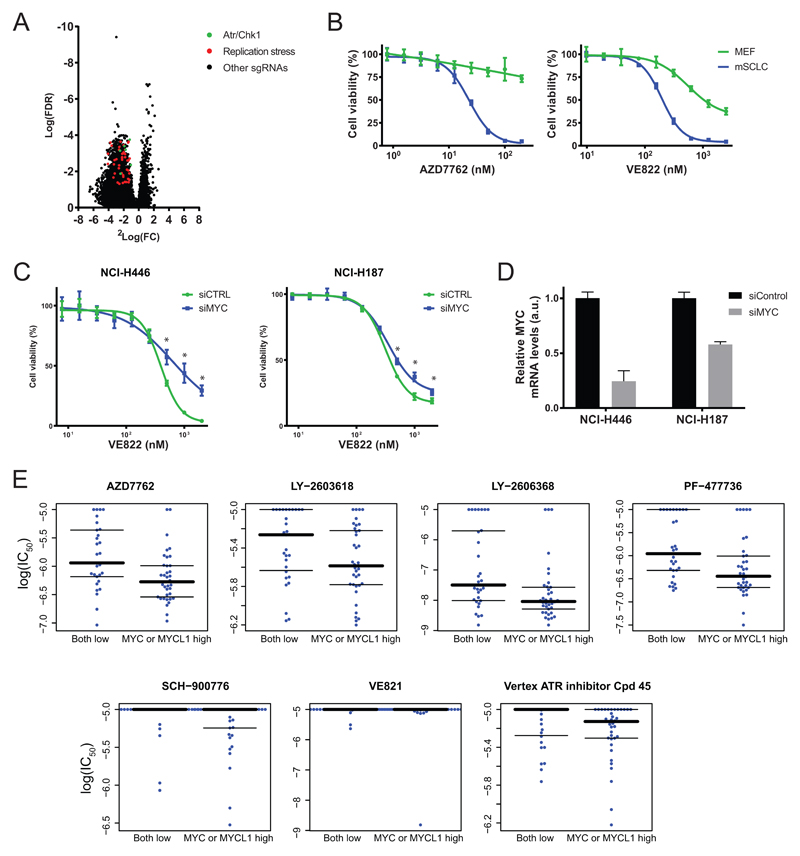
Figure 1
Figure 1. Replication stress inhibition is a synthetic vulnerability in SCLC.
A. Graph representing results from a genome-wide CRISPR-Cas9 screen for synthetic vulnerabilities in SCLC. The screen was performed in triplicate. Each dot represents the effect of a unique sgRNA. The sgRNAs targeting Atr and Chk1 are indicated in green, sgRNAs targeting genes that function in the replication stress response are indicated in red. B. Dose response curves of mSCLC and primary MEFs exposed to the CHK1 inhibitor AZD7762 and the ATR inhibitor VE-822. Values represent the mean +/- standard deviation from three independent experiments. C. Dose response curves from NCI-H446 and NCI-H187 cells with and without MYC knockdown. Values represent the mean +/- standard deviation from three independent experiments. * p=0.01 D. Relative MYC mRNA levels of the cell lines used in C. E. Graphs showing the 2log(IC50) for a selection of CHK1 and ATR inhibitors of a panel of 63 human SCLC cell lines screened by Polley at al. (21). Cell lines were grouped on the basis of absence or presence of MYC or MYCL1 expression. p-values were calculated using a Mann-Whitney U test; CHK1 inhibitors: AZD7762 (p=0.01), LY-2603618 (p=0.01), LY-2606368 (p=0.04), PF-477736 (p=0.01), SCH-900776 (p=0.05), and ATR inhibitors: VE-821 (p=0.29) and Vertex ATR inhibitor Cpd 45 (p=0.11).
Figure 2
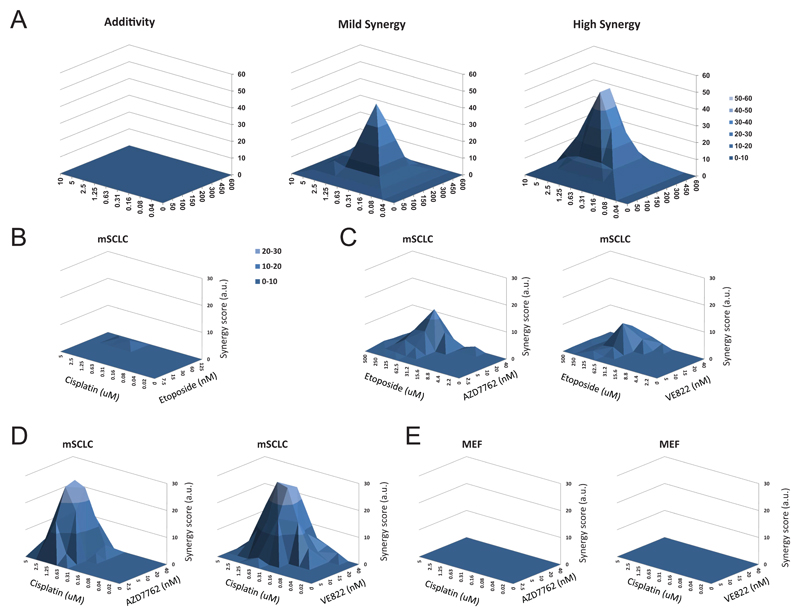
Figure 2. Replication stress inhibition synergizes with DNA damaging agents in mouse cells.
A. Graphs showing hypothetical combinations of two drugs in a combination matrix. The different doses of the drugs are indicated on the x- and y-axis. Graphs were produced using MacSynergyII software, which determines the degree of interaction between two drugs. Three potential outcomes are shown, with additive effects represented as a flat plane (left panel), mild synergism as a peak (middle panel)_and high synergy as a peak with an increase in volume. B. Graph showing the synergy score of the combination matrix of cisplatin and etoposide in a mSCLC cell line. C and D Synergy scores of the combinations of AZD7762 (CHK1 inhibitor) and VE-822 (ATR inhibitor) with etoposide (B) or cisplatin (C) in mSCLC. E. Synergy scores of the combinations of AZD7762 and VE-822 with cisplatin in primary MEFs. All synergy scores were calculated using the MAC Synergy II algorithm using data from three independent experiments.
Figure 3
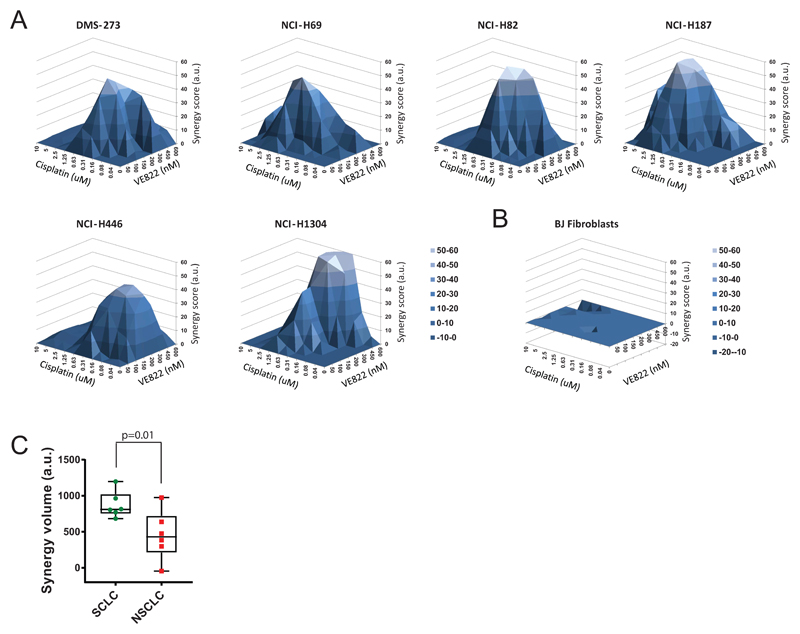
Figure 3. Replication stress inhibition synergizes with DNA damaging agents in human cells.
A. Synergy scores of the combination matrix of cisplatin and the ATR inhibitor VE-822 tested in a panel of 6 human SCLC cell lines. B. Synergy score of the combination of cisplatin and VE-822 tested on primary human fibroblasts. All synergy scores were calculated using the MAC Synergy II algorithm using data from three independent experiments. C. Comparison of the synergy volumes of a panel of 6 SCLC and 6 NSCLC cell lines. Synergy volumes were obtained from the experiments represented in figure 3A and supplementary figure 2C. Statistical significance was calculated using a Student’s t-test.
Figure 4
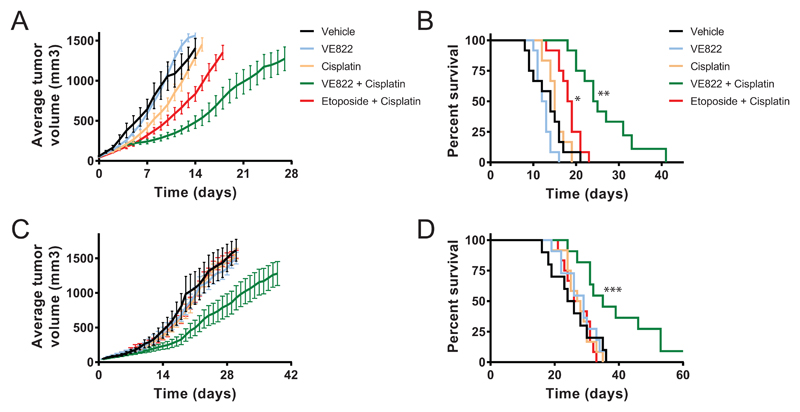
Figure 4. ATR inhibition in combination with cisplatin in vivo.
A. Graph representing the average tumor volumes +/- standard error of the mean (SEM) of xenografted DMS-273 cells. B. Survival curve of mice bearing DMS-273 xenografts treated with the indicated compounds. End point of this analysis is the time until the xenografts reach a tumor volume of 1500 mm3. Average survival: Vehicle 13.4 ± 3.9; VE-822 12.5 ± 1.7; Cisplatin 15.3 ± 2.3; Cisplatin + Etoposide 18.3 ± 2.7 and Cisplatin + VE-822 26 ± 6.5 days. *p=0.002, **p=1.8x10⁻⁵ C. Average tumor volumes +/- SEM of xenografted NCI-H187 cells. D. Survival curve of mice bearing NCI-H187 xenografts treated with the indicated compounds. End point of this analysis is the time until the xenografts reach a tumor volume of 1500 mm3. For all groups 12 mice were used. Average survival: Vehicle 25.5 ± 6.9; VE-822 27.8 ± 5.4; Cisplatin 27.4 ± 4.4; Cisplatin + Etoposide 27.1 ± 4.9 and Cisplatin + VE-822 39.2 ± 12 days. ***p=0.005

References

    1. Semenova EA, Nagel R, Berns A. Origins, genetic landscape, and emerging therapies of small cell lung cancer. Genes & Development. 2015;29:1447–62. - PMC - PubMed
    1. Johnson DH. Management of small cell lung cancer: current state of the art. Chest. 1999;116:525S–30S. - PubMed
    1. Chute JP, Chen T, Feigal E, Simon R, Johnson BE. Twenty Years of Phase III Trials for Patients With Extensive-Stage Small-Cell Lung Cancer: Perceptible Progress. Journal of Clinical Oncology. 1999;17:1794. - PubMed
    1. Ardizzoni A, Hansen H, Dombernowsky P, Gamucci T, Kaplan S, Postmus P, et al. Topotecan, a new active drug in the second-line treatment of small-cell lung cancer: a phase II study in patients with refractory and sensitive disease. The European Organization for Research and Treatment of Cancer Early Clinical Studies Group and New Drug Development Office, and the Lung Cancer Cooperative Group. Journal of Clinical Oncology. 1997;15:2090–6. - PubMed
    1. Spigel DR, Greco FA, Burris HA, Shipley DL, Clark BL, Whorf RC, et al. A Phase II Study of Higher Dose Weekly Topotecan in Relapsed Small-Cell Lung Cancer. Clinical Lung Cancer. 2011;12:187–91. - PubMed

Publication types

MeSH terms