


Management of patients with an advance decision and suicidal behaviour: a systematic review
- PMID: 30872542
- PMCID: PMC6429970
- DOI: 10.1136/bmjopen-2018-023978
Management of patients with an advance decision and suicidal behaviour: a systematic review
Erratum in
-
Correction: Management of patients with an advance decision and suicidal behaviour: a systematic review.BMJ Open. 2019 May 5;9(5):e023978corr1. doi: 10.1136/bmjopen-2018-023978corr1. BMJ Open. 2019. PMID: 31061064 Free PMC article. No abstract available.
Abstract
Background: The use of advance care planning and advance decisions for psychiatric care is growing. However, there is limited guidance on clinical management when a patient presents with suicidal behaviour and an advance decision and no systematic reviews of the extant literature.
Objectives: To synthesise existing literature on the management of advance decisions and suicidal behaviour.
Design: A systematic search of seven bibliographic databases was conducted to identify studies relating to advance decisions and suicidal behaviour. Studies on terminal illness or end-of-life care were excluded to focus on the use of advance decisions in the context of suicidal behaviour. A textual synthesis of data was conducted, and themes were identified by using an adapted thematic framework analysis approach.
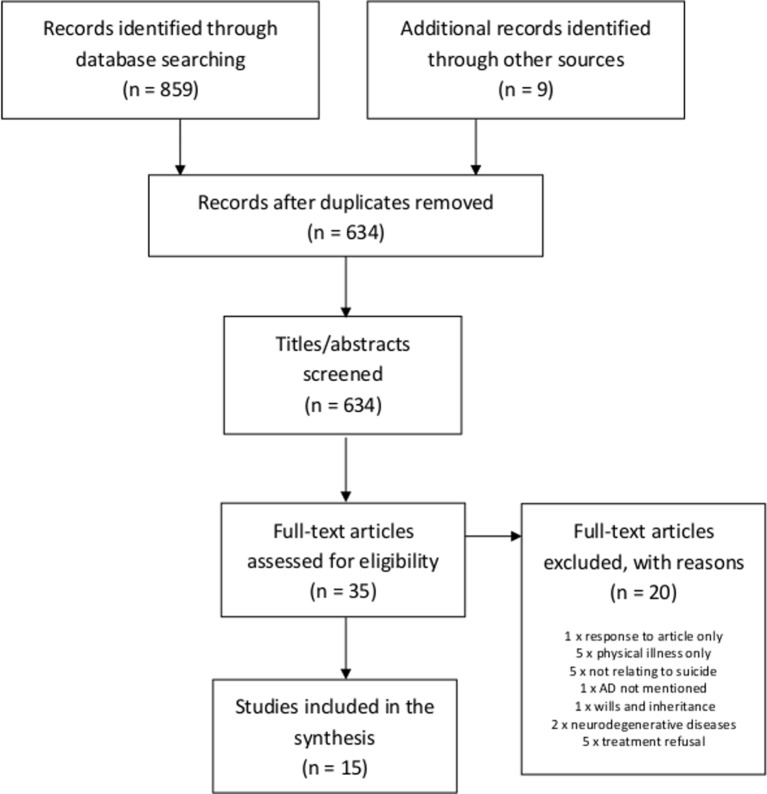
Results: Overall 634 articles were identified, of which 35 were retained for full text screening. Fifteen relevant articles were identified following screening. Those articles pertained to actual clinical cases or fictional scenarios. Clinical practice and rationale for management decisions varied. Five themes were identified: (1) tension between patient autonomy and protecting a vulnerable person, (2) appropriateness of advance decisions for suicidal behaviour, (3) uncertainty about the application of legislation, (4) the length of time needed to consider all the evidence versus rapid decision-making for treatment and (5) importance of seeking support and sharing decision-making.
Conclusions: Advance decisions present particular challenges for clinicians when associated with suicidal behaviour. Recommendations for practice and supervision for clinicians may help to reduce the variation in clinical practice.
Keywords: Ulysses directives; advance decisions; advance directives; living wills; self-harm; suicidal behaviour.
© Author(s) (or their employer(s)) 2019. Re-use permitted under CC BY. Published by BMJ.
Conflict of interest statement
Competing interests: DG, KH and NK are members of the Department of Health’s (England) National Suicide Prevention Advisory Group. NK chaired the NICE guideline development group for the longer-term management of self-harm and the NICE Topic Expert Group (which developed the quality standards for self-harm services). He is currently chair of the updated NICE guideline for Depression. KH and DG are NIHR Senior Investigators. KH is also supported by the Oxford Health NHS Foundation Trust and NK by the Greater Manchester Mental Health NHS Foundation Trust.
Figures
References
-
- Department of Health. Mental capacity act. London: Stationery Office, 2005.
-
- Byrne M. The use of advance directives Nursing monograph. Melbourne: St. Vincent Healthcare Campus, 2002:13–16.
Publication types
MeSH terms
Grants and funding
LinkOut - more resources
Full Text Sources
