. 2019 Mar 14;9(1):4454.
doi: 10.1038/s41598-019-40790-5.

Analyses of 202 plastid genomes elucidate the phylogeny of Solanum section Petota

Affiliations

Analyses of 202 plastid genomes elucidate the phylogeny of Solanum section Petota

Binquan Huang et al. Sci Rep. .

Abstract

Our paper analyzes full plastid DNA sequence data of 202 wild and cultivated diploid potatoes, Solanum section Petota, to explore its phylogenetic utility compared to prior analyses of the same accessions using genome-wide nuclear SNPs, and plastid DNA restriction site data. The present plastid analysis discovered the same major clades as the nuclear data but with some substantial differences in topology within the clades. The considerably larger plastid and nuclear data sets add phylogenetic resolution within the prior plastid DNA restriction site data, highlight plastid/nuclear incongruence that supports hypotheses of hybridization/introgression to help explain the taxonomic difficulty in the section.


Conflict of interest statement

The authors declare no competing interests.

Figures

Figure 1
Figure 1
Cladistic relationships of the diploid species of wild potatoes (black) and immediate outgroups (blue) in tomatoes (Solanum section Lycopersicon) and Solanum section Etuberosum.
Figure 2
Figure 2
Circular variation map of potato plastid genome. The innermost circle is the plastid genome map showing its corresponding genes; the two inverted repeat regions (IRA and IRB) divided the large (LSC) and small (SSC) single regions, respectively; the relative density of SNPs is indicated in red and the density of indels in blue.
Figure 3
Figure 3
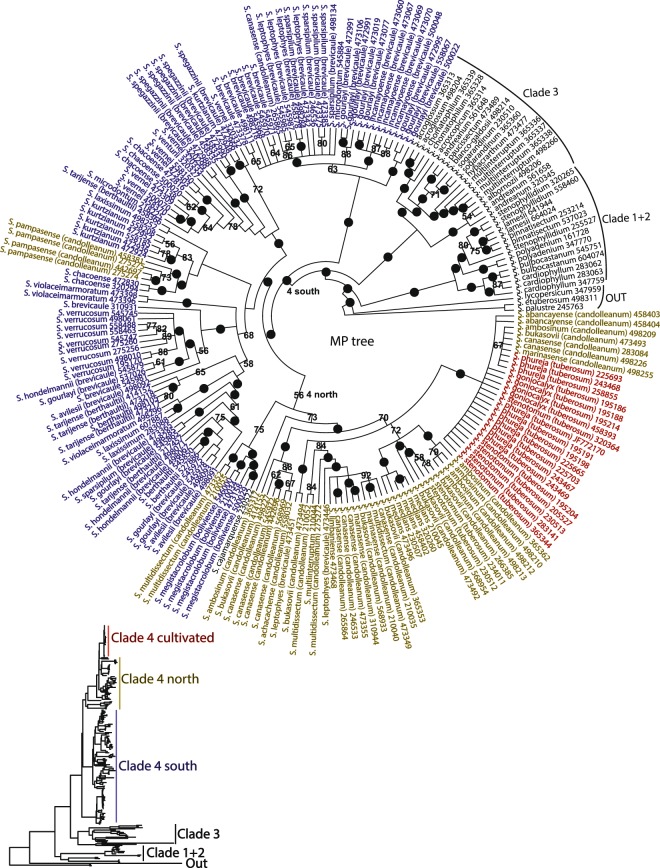
The phylogenetic relationship of all clades of section Petota as determined by strict consensus maximum parsimony (MP) analysis of 5000 equally parsimonious trees; the bottom figure is a phylogram of one of these trees to show relative branching lengths of the clades; the nodes with black dots are supported by bootstrap support values ≥ 90% and those from 50% to 89% shown numerically; the outgroup, clades 1 + 2 (see text) and clade 3 are indicated by black text and bracketed with their clade names, clade 4 south (Bolivia and south) wild species by blue text, clade 4 north (Peru) by brown text, and the cultivated species in red text; the blue color of the four accessions of S. boliviense (prior name S. megistacrolobum), the brown color of the four accessions of S. pampasense, and the brown color of the wild species in the cultivated species clade represents their former placement in the nuclear data.

References

    1. Palmer JD, Zamir D. Chloroplast DNA evolution and phylogenetic relationships in Lycopersicon. Proceedings of the National Academy of Science of the United State America. 1982;79:5006–5010. doi: 10.1073/pnas.79.16.5006. - DOI - PMC - PubMed
    1. Hosaka K, Ogihara Y, Matsubayashi M, Tsunewaki K. Phylogenetic relationship between the tuberous Solanum species as revealed by restriction endonuclease analysis of chloroplast DNA. Japanese Journal of Genetics. 1984;59:349–369. doi: 10.1266/jjg.59.349. - DOI
    1. Sytsma KJ, Gottlieb LD. Chloroplast DNA evidence for the origin of the genus Heterogaura from a species of Clarkia (Onagraceae) Proceedings of the National Academy of Science of the United States of America. 1986;83:5554–5557. doi: 10.1073/pnas.83.15.5554. - DOI - PMC - PubMed
    1. Jansen, R. K. & Ruhlman, T. A. Plastid genomes of seed plants. In Genomics of chloroplasts and mitochondria (ed Bock, R. & Knoop V.) 103–126 (Springer, 2012).
    1. Wendel, J. E. & Doyle, J. J. Phylogenetic incongruence: Window into genome history and molecular evolution in Plant molecular systematics II. (ed. Soltis, P. S. & Doyle, J. J.), 265–296), (Kluwer Academic Publishers, 1998).

Publication types