


Identification of Key Genes and Pathways in Post-traumatic Stress Disorder Using Microarray Analysis
- PMID: 30873067
- PMCID: PMC6403462
- DOI: 10.3389/fpsyg.2019.00302
Identification of Key Genes and Pathways in Post-traumatic Stress Disorder Using Microarray Analysis
Abstract
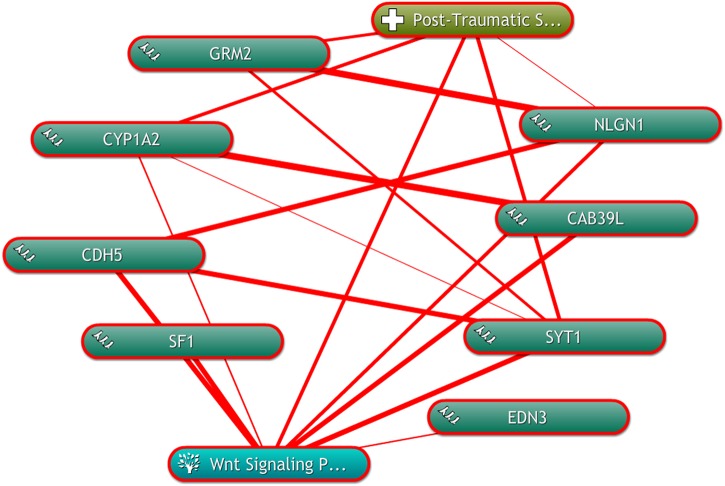
Introduction: Post-traumatic stress disorder (PTSD) is characterized by impaired fear extinction, excessive anxiety, and depression. However, the potential pathogenesis and cause of PTSD are not fully understood. Hence, the purpose of this study was to identify key genes and pathway involved in PTSD and reveal underlying molecular mechanisms by using bioinformatics analysis. Methods: The mRNA microarray expression profile dataset was retrieved and downloaded from the Gene Expression Omnibus (GEO) database. The differentially expressed genes (DEGs) were screened using GEO2R. Gene ontology (GO) was used for gene function annotations and Kyoto Encyclopedia of Genes and Genomes (KEGG) pathway was performed for enrichment analysis. Subsequently, protein-protein interaction (PPI) network and module analysis by the plugin MCODE were mapped by Cytoscape software. Finally, these key genes were verified in stress-exposed models by Real-Time quantitative (qRT-PCR). In addition, we performed text mining among the key genes and pathway with PTSD by using COREMINE. Results: A total of 1004 DEGs were identified. Gene functional annotations and enrichment analysis indicated that the most associated pathway was closely related to the Wnt signaling pathway. Using PPI network and module analysis, we identified a group of "seed" genes. These genes were further verified by qRT-PCR. In addition, text mining indicated that the altered CYP1A2, SYT1, and NLGN1 affecting PTSD might work via the Wnt signaling pathway. Conclusion: By using bioinformatics analysis, we identified a number of genes and relevant pathway which may represent key mechanisms associated with PTSD. However, these findings require verification in future experimental studies.
Keywords: PTSD; bioinformatics analysis; key genes; key pathways; microarray analysis.
Figures
References
-
- Chen C., Ji M., Xu Q., Zhang Y., Sun Q., Liu J., et al. (2015). Sevoflurane attenuates stress-enhanced fear learning by regulating hippocampal BDNF expression and Akt/GSK-3beta signaling pathway in a rat model of post-traumatic stress disorder. J. Anesth. 29 600–608. 10.1007/s00540-014-1964-x - DOI - PubMed
-
- Dennis P. A., Weinberg J. B., Calhoun P. S., Watkins L. L., Sherwood A., Dennis M. F., et al. (2016). An investigation of vago-regulatory and health-behavior accounts for increased inflammation in posttraumatic stress disorder. J. Psychosom. Res. 83 33–39. 10.1016/j.jpsychores.2016.02.008 - DOI - PMC - PubMed
-
- Duan Z., He M., Zhang J., Chen K., Li B., Wang J., et al. (2015). Assessment of functional tag single nucleotide polymorphisms within the DRD2 gene as risk factors for post-traumatic stress disorder in the Han Chinese population. J. Affect. Disord. 188 210–217. 10.1016/j.jad.2015.08.066 - DOI - PubMed
LinkOut - more resources
Full Text Sources
