


Development and Validation of the Problematic Media Use Measure: A Parent Report Measure of Screen Media "Addiction" in Children
- PMID: 30873299
- PMCID: PMC6411079
- DOI: 10.1037/ppm0000163
Development and Validation of the Problematic Media Use Measure: A Parent Report Measure of Screen Media "Addiction" in Children
Abstract
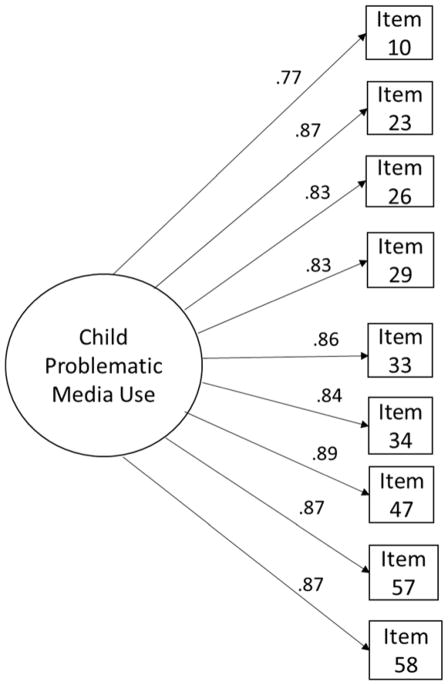
Although problematic media use among adolescents is of wide interest, less is known regarding problematic media use among younger children. The current study reports on the development and validation of a parent-report measure of one potential aspect of children's problematic use-screen media addiction-via the Problematic Media Use Measure (PMUM). Items were based on the nine criteria for Internet Gaming Disorder in the DSM-5. The first study describes the development and preliminary validation of the PMUM in a sample of 291 mothers. Mothers (80.8% identified as White) of children 4 through 11 years of age completed the PMUM and measures of child screen time and child psychosocial functioning. EFA indicated a unidimensional construct of screen media addiction. The final versions of the PMUM (27 items) and PMUM Short Form (PMUM-SF, 9 items) evidenced high internal consistency (Cronbach α = .97 and α = .93, respectively). Regression analyses were conducted to examine convergent validity of the PMUM with indicators of child psychosocial functioning. Convergent validity was supported and the PMUM scales also independently predicted children's total difficulties in functioning, over and above hours of screen time, indicating incremental validity. The second study sought to confirm the factor structure of the PMUM-SF and test for measurement invariance across gender. In a sample of 632 parents, we confirmed the factor structure of the PMUM-SF and found measurement invariance for boys and girls. These studies support the use of the PMUM-SF as a measure of screen media addiction in children ages 4 through 11 years old.
Keywords: children; internet gaming disorder; mobile device; problematic media use; screen addiction.
Conflict of interest statement
Author Disclosure Statement The authors have no conflicts of interest to disclose.
Figures
References
-
- American Psychiatric Association. Diagnostic and statistical manual of mental disorders. 5. Washington, DC: Author; 2013.
-
- Berinsky AJ, Huber GA, Lenz GS. Evaluating Online Labor Markets for Experimental Research: Amazon.com's Mechanical Turk. Political Analysis. 2012;20:351–368. doi: 10.1093/pan/mpr057. - DOI
-
- Billieux J. Problematic use of the mobile phone: a literature review and a pathways model. Current Psychiatry Reviews. 2012;8:299–307.
-
- Billieux J, Maurage P, Lopez-Fernandez O, Kuss DJ, Griffiths MD. Can Disordered Mobile Phone Use Be Considered a Behavioral Addiction? An Update on Current Evidence and a Comprehensive Model for Future Research. Current Addiction Reports. 2015;2:156–162. doi: 10.1007/s40429-015-0054-y. - DOI
-
- Buhrmester M, Kwang T, Gosling SD. Amazon's Mechanical Turk a new source of inexpensive, yet high-quality, data? Perspectives on psychological science. 2011;6:3–5. - PubMed
Grants and funding
LinkOut - more resources
Full Text Sources
Medical