


The Influence of Number and Timing of Pregnancies on Breast Cancer Risk for Women With BRCA1 or BRCA2 Mutations
- PMID: 30873510
- PMCID: PMC6405439
- DOI: 10.1093/jncics/pky078
The Influence of Number and Timing of Pregnancies on Breast Cancer Risk for Women With BRCA1 or BRCA2 Mutations
Abstract
Background: Full-term pregnancy (FTP) is associated with a reduced breast cancer (BC) risk over time, but women are at increased BC risk in the immediate years following an FTP. No large prospective studies, however, have examined whether the number and timing of pregnancies are associated with BC risk for BRCA1 and BRCA2 mutation carriers.
Methods: Using weighted and time-varying Cox proportional hazards models, we investigated whether reproductive events are associated with BC risk for mutation carriers using a retrospective cohort (5707 BRCA1 and 3525 BRCA2 mutation carriers) and a prospective cohort (2276 BRCA1 and 1610 BRCA2 mutation carriers), separately for each cohort and the combined prospective and retrospective cohort.
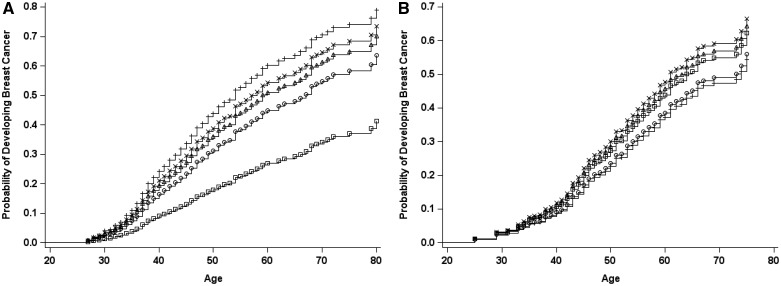
Results: For BRCA1 mutation carriers, there was no overall association with parity compared with nulliparity (combined hazard ratio [HRc] = 0.99, 95% confidence interval [CI] = 0.83 to 1.18). Relative to being uniparous, an increased number of FTPs was associated with decreased BC risk (HRc = 0.79, 95% CI = 0.69 to 0.91; HRc = 0.70, 95% CI = 0.59 to 0.82; HRc = 0.50, 95% CI = 0.40 to 0.63, for 2, 3, and ≥4 FTPs, respectively, P trend < .0001) and increasing duration of breastfeeding was associated with decreased BC risk (combined cohort P trend = .0003). Relative to being nulliparous, uniparous BRCA1 mutation carriers were at increased BC risk in the prospective analysis (prospective hazard ration [HRp] = 1.69, 95% CI = 1.09 to 2.62). For BRCA2 mutation carriers, being parous was associated with a 30% increase in BC risk (HRc = 1.33, 95% CI = 1.05 to 1.69), and there was no apparent decrease in risk associated with multiparity except for having at least 4 FTPs vs. 1 FTP (HRc = 0.72, 95% CI = 0.54 to 0.98).
Conclusions: These findings suggest differential associations with parity between BRCA1 and BRCA2 mutation carriers with higher risk for uniparous BRCA1 carriers and parous BRCA2 carriers.
Figures
References
-
- Kuchenbaecker KB, Hopper JL, Barnes DR, et al. Risks of breast, ovarian, and contralateral breast cancer for BRCA1 and BRCA2 mutation carriers. JAMA. 2017;317(23):2402–2416. - PubMed
-
- Kelsey JL, Gammon MD, John EM.. Reproductive factors and breast cancer. Epidemiol Rev. 1993;15(1):36–47. - PubMed
-
- Beral V, Bull D, Doll R, et al. Breast cancer and abortion: collaborative reanalysis of data from 53 epidemiological studies, including 83 000 women with breast cancer from 16 countries. Lancet. 2004;363(9414):1007–1016. - PubMed
-
- Palmer JR, Wise LA, Adams-Campbell LL, et al. A prospective study of induced abortion and breast cancer in African-American women. Cancer Causes Control. 2004;15(2):105–111. - PubMed
-
- Mahue-Giangreco M, Ursin G, Sullivan-Halley J, et al. Induced abortion, miscarriage, and breast cancer risk of young women. Cancer Epidemiol Biomarkers Prev. 2003;12(3):209–214. - PubMed
Grants and funding
LinkOut - more resources
Full Text Sources
Molecular Biology Databases
Miscellaneous