


Mechanosensing and Mechanoregulation of Endothelial Cell Functions
- PMID: 30873580
- PMCID: PMC6697421
- DOI: 10.1002/cphy.c180020
Mechanosensing and Mechanoregulation of Endothelial Cell Functions
Abstract
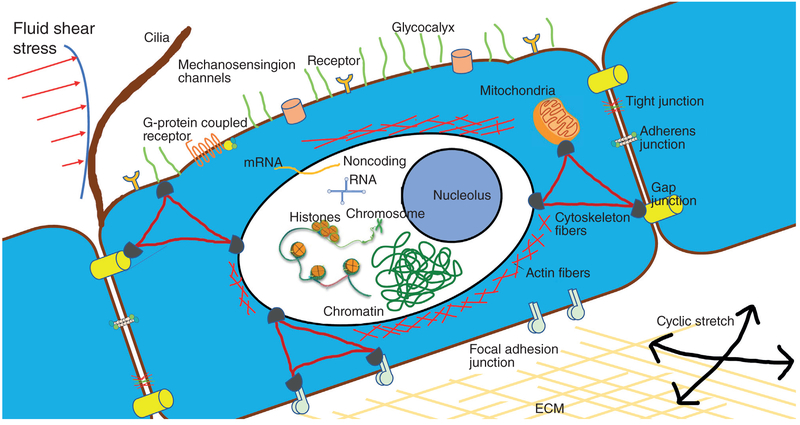
Vascular endothelial cells (ECs) form a semiselective barrier for macromolecules and cell elements regulated by dynamic interactions between cytoskeletal elements and cell adhesion complexes. ECs also participate in many other vital processes including innate immune reactions, vascular repair, secretion, and metabolism of bioactive molecules. Moreover, vascular ECs represent a unique cell type exposed to continuous, time-dependent mechanical forces: different patterns of shear stress imposed by blood flow in macrovasculature and by rolling blood cells in the microvasculature; circumferential cyclic stretch experienced by the arterial vascular bed caused by heart propulsions; mechanical stretch of lung microvascular endothelium at different magnitudes due to spontaneous respiration or mechanical ventilation in critically ill patients. Accumulating evidence suggests that vascular ECs contain mechanosensory complexes, which rapidly react to changes in mechanical loading, process the signal, and develop context-specific adaptive responses to rebalance the cell homeostatic state. The significance of the interactions between specific mechanical forces in the EC microenvironment together with circulating bioactive molecules in the progression and resolution of vascular pathologies including vascular injury, atherosclerosis, pulmonary edema, and acute respiratory distress syndrome has been only recently recognized. This review will summarize the current understanding of EC mechanosensory mechanisms, modulation of EC responses to humoral factors by surrounding mechanical forces (particularly the cyclic stretch), and discuss recent findings of magnitude-specific regulation of EC functions by transcriptional, posttranscriptional and epigenetic mechanisms using -omics approaches. We also discuss ongoing challenges and future opportunities in developing new therapies targeting dysregulated mechanosensing mechanisms to treat vascular diseases. © 2019 American Physiological Society. Compr Physiol 9:873-904, 2019.
Copyright © 2019 American Physiological Society. All rights reserved.
Figures
References
-
- Abdulnour RE, Peng X, Finigan JH, Han EJ, Hasan EJ, Birukov KG, Reddy SP, Watkins JE III, Kayyali US, Garcia JG, Tuder RM, Hassoun PM. Mechanical stress activates xanthine oxidoreductase through MAP kinase-dependent pathways. Am J Physiol Lung Cell Mol Physiol 291: L345–L353, 2006. - PubMed
-
- Alenghat FJ, Nauli SM, Kolb R, Zhou J, Ingber DE. Global cytoskeletal control of mechanotransduction in kidney epithelial cells. Exp Cell Res 301: 23–30, 2004. - PubMed
Publication types
MeSH terms
Grants and funding
LinkOut - more resources
Full Text Sources
