


Radiation risk of incident colorectal cancer by anatomical site among atomic bomb survivors: 1958-2009
- PMID: 30873589
- PMCID: PMC6916284
- DOI: 10.1002/ijc.32275
Radiation risk of incident colorectal cancer by anatomical site among atomic bomb survivors: 1958-2009
Abstract
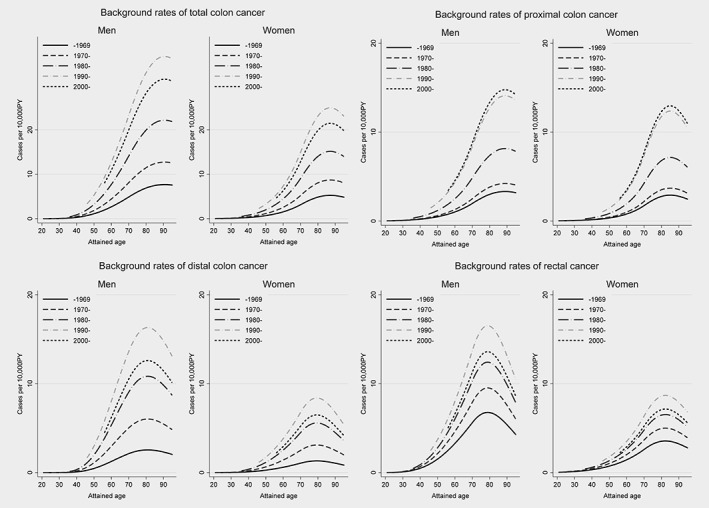
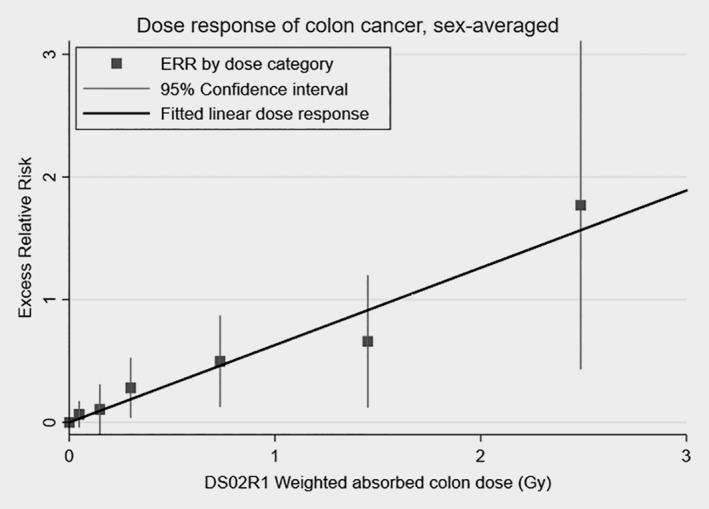
Radiation effects on colorectal cancer rates, adjusted for smoking, alcohol intake and frequency of meat consumption and body mass index (BMI) by anatomical subsite (proximal colon, distal colon and rectum) were examined in a cohort of 105,444 atomic bomb survivors. Poisson regression methods were used to describe radiation-associated excess relative risks (ERR) and excess absolute rates (EAR) for the 1958-2009 period. There were 2,960 first primary colorectal cancers including 894 proximal, 871 distal and 1,046 rectal cancers. Smoking, alcohol intake and BMI were associated with subsite-specific cancer background rates. Significant linear dose-responses were found for total colon (sex-averaged ERR/Gy for 70 years old exposed at age 30 = 0.63, 95% confidence interval [CI]: 0.34; 0.98), proximal [ERR = 0.80, 95% CI: 0.32; 1.44] and distal colon cancers [ERR = 0.50, 95% CI: 0.04; 0.97], but not for rectal cancer [ERR = 0.023, 95% CI: -0.081; 0.13]. The ERRs for proximal and distal colon cancers were not significantly different (p = 0.41). The ERR decreased with attained age for total colon, but not for proximal colon cancer, and with calendar year for distal colon cancer. The ERRs and EARs did not vary by age at exposure, except for decreasing trend in EAR for proximal colon cancer. In conclusion, ionizing radiation is associated with increased risk of proximal and distal colon cancers. The ERR for proximal cancer persists over time, but that for distal colon cancer decreases. There continues to be no indication of radiation effects on rectal cancer incidence in this population.
Keywords: colorectal cancer; distal colon; ionizing radiation; proximal colon; radiation risk.
© 2019 The Authors. International Journal of Cancer published by John Wiley & Sons Ltd on behalf of UICC.
Figures
References
-
- Silver K, Greene T, Latowsky G. Cancer and workers exposed to ionizing radiation, a review of the research literature, vol. 34 Boston, MA: Center for Environmental Health Studies, 2003. 37.
-
- Kamran SC, Berrington De Gonzalez A, Ng A, et al. Therapeutic radiation and the potential risk of second malignancies. Cancer 2016;122:1809–21. - PubMed
-
- Nakatsuka H, Shimizu Y, Yamamoto T, et al. Colorectal cancer incidence among atomic bomb survivors, 1950‐80. J Radiat Res 1992;33:342–61. - PubMed
-
- Thompson DE, Mabuchi K, Ron E, et al. Cancer incidence in atomic bomb survivors. Part II: solid tumors, 1958‐1987. Radiat Res 1994;137:S17–67. - PubMed
-
- Preston DL, Ron E, Tokuoka S, et al. Solid cancer incidence in atomic bomb survivors: 1958‐1998. Radiat Res 2007;168:1–64. - PubMed
Publication types
MeSH terms
Grants and funding
LinkOut - more resources
Full Text Sources
