Prenatal Exposure to Endocrine Disruptors and Cardiometabolic Risk in Preschoolers: A Systematic Review Based on Cohort Studies
- PMID: 30873814
- PMCID: PMC6748211
- DOI: 10.29024/aogh.911
Prenatal Exposure to Endocrine Disruptors and Cardiometabolic Risk in Preschoolers: A Systematic Review Based on Cohort Studies
Abstract
Background: Follow-up studies have reported both positive and negative associations between prenatal exposure to endocrine disrupting chemicals (EDCs) and some anthropometric indicators of overweight and obesity in children. However, few studies have evaluated the effect of this exposure on cardiometabolic risk factors in preschool-age children. The health and disease development paradigm (DOHaD) proposes that the physiological and metabolic adaptations triggered by the exposure to these compounds, coupled with postnatal conditions, can modify the risk of disease. In this context, cardiometabolic risk factors in children are not only an important outcome derived from prenatal exposure but a predictor/mediator of the children's future health.
Objective: To conduct a systematic review of the evidence published in the last 10 years from cohort studies on the association between prenatal exposure to EDCs and cardiometabolic risk factors in preschoolers.
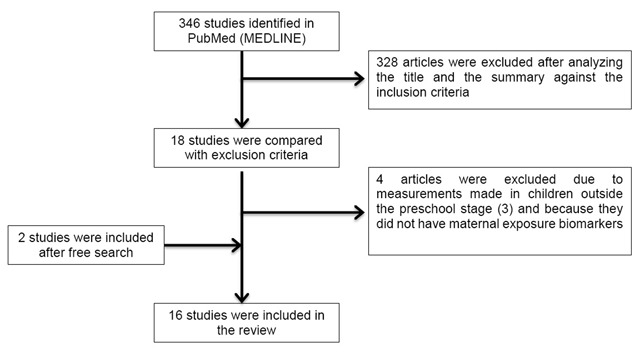
Design: Studies published from January 1, 2007 to May 1, 2017 in PubMed were analyzed. The research strategy was based on specified keywords and following the application of strict inclusion/exclusion criteria, 16 studies were identified and reviewed. Data were extracted and aspects of quality were assessed using an adapted Newcastle-Ottawa scale for cohort studies.
Results: Only 5 of the 16 studies reviewed analyzed cardiometabolic risk factors in addition to anthropometric measures in children. The cohort studies included in this review suggest that prenatal exposure to low concentrations of EDCs has an impact on anthropometric variables and biochemical parameters in preschool-age children. Positive associations between prenatal exposure to EDCs and percentage of fat mass, body mass index, waist circumference, skinfolds and risk of overweight persisted after adjustment for important confounding variables. No association was found with lipid profile and glucose levels.
Conclusions: Evidence was found to suggest that prenatal exposure to EDCs is positively associated with cardiometabolic risk factors in preschool children.
© 2018 The Author(s). This is an open-access article distributed under the terms of the Creative Commons Attribution 4.0 International License (CC-BY 4.0), which permits unrestricted use, distribution, and reproduction in any medium, provided the original author and source are credited. See http://creativecommons.org/licenses/by/4.0/.
Conflict of interest statement
The authors have no competing interests to declare.
Figures
References
-
- Wells G, Shea B, O’Connell D, et al. The Newcastle-Ottawa Scale (NOS) for assessing the quality of nonrandomised studies in meta-analyses. July 2017. http://www.ohri.ca/programs/clinical_epidemiology/oxford.asp.