. 2019 May;110(5):1599-1608.
doi: 10.1111/cas.13997. Epub 2019 Apr 13.

DLL3 regulates the migration and invasion of small cell lung cancer by modulating Snail

Affiliations

DLL3 regulates the migration and invasion of small cell lung cancer by modulating Snail

Megumi Furuta et al. Cancer Sci. 2019 May.

Abstract

Delta-like protein 3 (DLL3) is a ligand of Notch signaling, which mediates cell-fate decisions and is tumor-suppressive or oncogenic depending on the cellular context. Previous studies show that DLL3 is highly expressed in small cell lung cancer (SCLC) but not in normal lung tissue, suggesting that DLL3 might be associated with neuroendocrine tumorigenesis. However, its role in SCLC remains unclear. To investigate the role of DLL3 in tumorigenesis in SCLC, we performed loss-of-function and gain-of-function assays using SCLC cell lines. In vitro analysis of cell migration and invasion by transwell assay showed that DLL3 knockdown reduced migration and invasion of SCLC cells, whereas DLL3 overexpression increased these activities. In addition, DLL3 positively regulated SNAI1 expression and knockdown of SNAI1 attenuated the migration and invasion ability of SCLC cells. Moreover, upregulated DLL3 expression induced subcutaneous tumor growth in mouse models. These results indicate that DLL3 promoted tumor growth, migration and invasion in an SCLC model by modulating SNAI1/Snail.

Keywords: NOTCH; SNAI1; delta-like protein 3; migration; small cell lung cancer.


Conflict of interest statement

The authors have no conflict of interest.

Figures
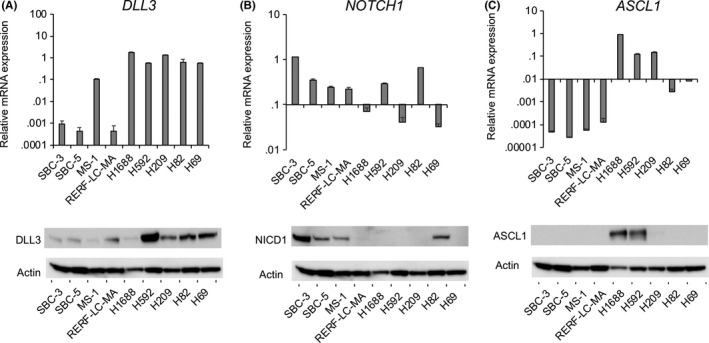
Figure 1
Figure 1
DLL3, NOTCH1 and ASCL1 expression in small cell lung cancer (SCLC) cell lines. The mRNA and protein expression of (A) DLL3, (B) NOTCH1 and (C) ASCL1 were measured by quantitative RTPCR and western blot. The mRNA data were normalized to GAPDH expression (n = 3; mean ± SD)
Figure 2
Figure 2
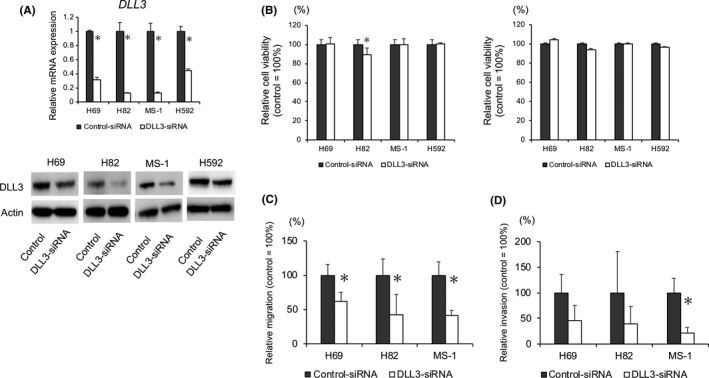
Effect of DLL3 downregulation on small cell lung cancer (SCLC) cell proliferation, migration and invasion. A, DLL3 mRNA and protein levels in H69, H82, MS‐1 and H592 cells transfected with control or DLL3‐siRNA and measured by qRTPCR and western blot at 72 h post–transfection. B, Anchorage‐dependent (left) and anchorage‐independent (right) cell growth measured by MTT assays using 96‐well plates with or without poly‐HEMA coating at 72 h after control or DLL3‐siRNA transfection (n = 3; mean ± SD). C, H69, H82 or MS‐1 cells were plated in the upper chamber 48 h after transfection with control or DLL3‐siRNA. After incubation for 4 h in MS‐1 or 6 h in H69 and H82, the number of migrated cells was counted in 5 random fields of view (n = 3; mean ± SD). D, H69, H82 or MS‐1 cells were plated in the upper chamber pre–coated with Matrigel at 48 h after transfection with control or DLL3‐siRNA. After incubation for 24 h in H69 cells or 48 h in H82 and MS‐1 cells, the number of invaded cells was counted in 5 random fields of view (n = 3; mean ± SD). *< 0.05
Figure 3
Figure 3
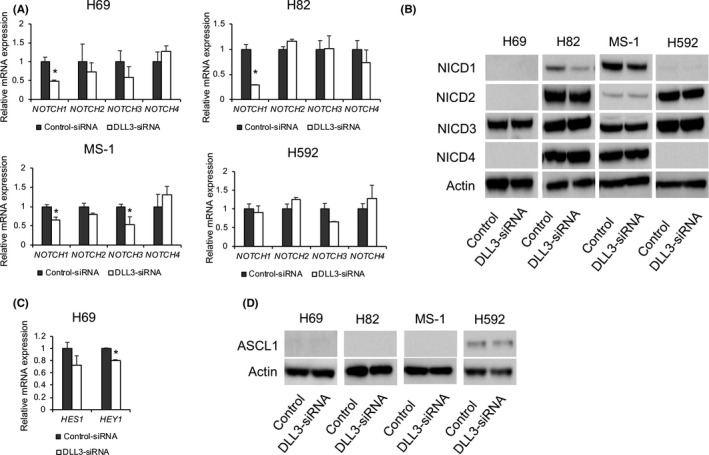
Effect of DLL3 downregulation on Notch signaling in small cell lung cancer (SCLC)‐cell. A, mRNA and B, protein levels of Notch receptors in H69, H82, MS‐1 and H592 cells transfected with control or DLL3‐siRNA and measured by quantitative RTPCR and western blot at 72‐h post–transfection (n = 3; mean ± SD). C, mRNA levels of HES1 and HEY1 in cells transfected with control or DLL3‐siRNA and measured by quantitative qRTPCR at 72‐h post–transfection (n = 3; mean ± SD). D, Protein levels of ASCL1 in H69, H82, MS‐1 and H592 cells transfected with control or DLL3‐siRNA and measured by western blot at 72‐h post–transfection. *< 0.05
Figure 4
Figure 4
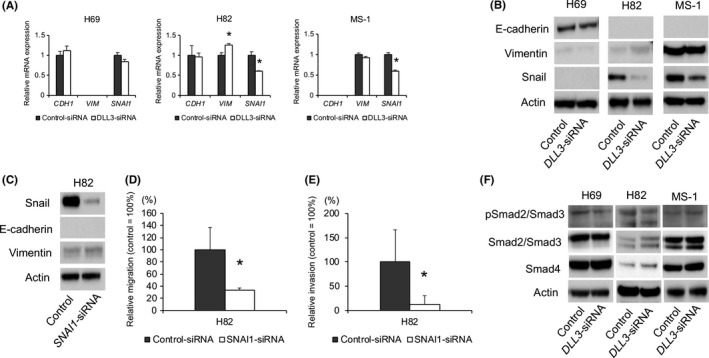
Effect of DLL3 or Snail downregulation on epithelial‐mesenchymal transition (EMT)‐marker levels in small cell lung cancer (SCLC)‐cells. (A) mRNA and (B) protein levels of EMT markers in H69, H82 and MS‐1 cells transfected with control or DLL3‐siRNA and measured by quantitative RTPCR and western blot at 72‐h post–transfection (n = 3; mean ± SD). C, Snail, E‐cadherin and VIM protein levels in H82 cells transfected with control or SNAI1‐siRNA and measured by western blot at 72‐h post–transfection. D, Cells were plated in the upper chamber 48 h after transfection with control or SNAI1‐siRNA and after incubation for 6 h, the number of migrated cells was counted in 5 random fields of view (n = 3; mean ± SD). E, Cells were plated in the upper chamber pre–coated with Matrigel at 48 h after transfection with control or SNAI1‐siRNA. After incubation for 48 h in H82 cells, the number of invaded cells was counted in 5 random fields of view (n = 3; mean ± SD). F, Protein levels of phospho‐Smad2/Smad3, Smad2/Smad3 and Smad4 in H69, H82 and MS‐1 cells transfected with control or DLL3‐siRNA and measured by western blot at 72‐h post–transfection. *< 0.05
Figure 5
Figure 5
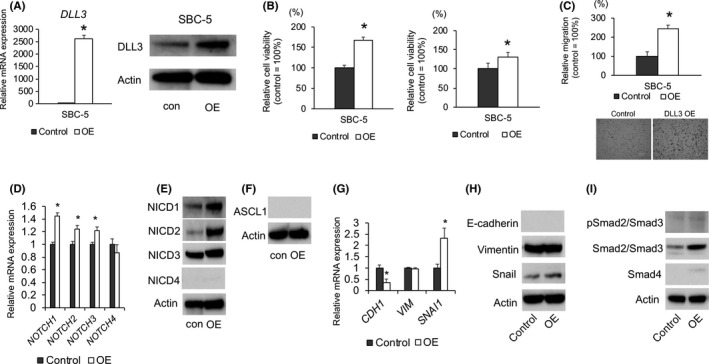
Effect of DLL3 overexpression on the proliferation, migration, NOTCH signaling and epithelial‐mesenchymal transitionmarker levels in SBC‐5 cells. A, quantitative RTPCR (left) and western blot (right) confirmation of elevated DLL3 mRNA and protein levels in SBC‐5 cells transfected with a DLL3‐expression vector (n = 3; mean ± SD). B, Anchorage‐dependent (left) and anchorage‐independent (right) cell growth measured by MTT assays using 96‐well plates with or without poly‐HEMA coating at 72 h after seeding of SBC‐5 cells transfected with an empty vector or the DLL3‐expression vector (n = 3; mean ± SD). C, SBC‐5 cells transfected with an empty vector or the DLL3‐expression vector were plated in the upper chamber and after incubation for 6 h, the number of migrated cells was counted in 5 random fields of view (n = 3; mean ± SD). Quantitative RTPCR and western blot analyses of (D) mRNA and (E) protein levels of Notch receptors in SBC‐5 cells transfected with an empty vector or DLL3‐ expression vector (n = 3; mean ± SD). F, Protein levels of ASCL1 in SBC‐5 cells transfected with an empty vector or DLL3‐expression vector. (G) mRNA and (H) protein levels of epithelial‐mesenchymal transition markers in SBC‐5 cells transfected with an empty vector or the DLL3‐expression vector (n = 3; mean ± SD). I, Protein levels of phospho‐Smad2/Smad3, Smad2/Smad3 and Smad4 in SBC‐5 cells transfected with a control or DLL3‐expression vector and measured by western blot. *< 0.05. con, control; OE:DLL3 overexpression
Figure 6
Figure 6
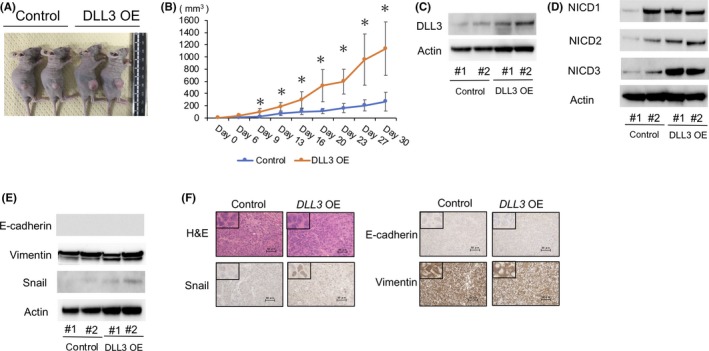
Effect of DLL3 overexpression on SBC‐5 subcutaneous tumor formation in vivo. SBC‐5 cells transfected with an empty vector or the DLL3‐expression vector were implanted into nude mice. A, Photograph of representative tumors on day 20 after implantation. B, Tumor‐growth curves following injection of DLL3 overexpressing or control cells into nude mice. Data indicate the average tumor volume (n = 5/group; mean ± SD). C, Western blot verification of DLL3 levels in DLL3‐overexpressing tumors, relative to those in control tumors on day 20 after implantation. D, Western blot analysis of protein levels of NOTCH1 intracellular domain (NICD1), NICD2 and NICD3 in DLL3‐overexpressing tumors, relative to those in control tumors on day 20 after implantation. E, Western blot analysis of protein levels of epithelial‐mesenchymal transition markers in DLL3‐overexpressing tumors, relative to those in control tumors on day 20 after implantation. F, Representative low‐magnification and high‐magnification images of xenograft tumors subjected to H&E staining and immunohistochemical staining for Snail, E‐cadherin and VIM. Scale bars, 50 μm. *< 0.05. DLL3 OE,DLL3 overexpression

References

    1. Siegel RL, Miller KD, Jemal A. Cancer statistics, 2017. CA Cancer J Clin. 2017;67:7‐30. - PubMed
    1. Kalemkerian GA, Akerley W, Bogner P, et al. Small cell lung cancer. J Natl Compr Canc Netw. 2013;11:78‐98. - PMC - PubMed
    1. Puglisi M, Dolly S, Faria A, Myerson JS, Popat S, O'Brien ME. Treatment options for small cell lung cancer – do we have more choice? Br J Cancer. 2010;102:629‐638. - PMC - PubMed
    1. Fiuza UM, Arias AM. Cell and molecular biology of Notch. J Endocrinol. 2007;194:459‐474. - PubMed
    1. Lobry C, Oh P, Aifantis I. Oncogenic and tumor suppressor functions of Notch in cancer: it's NOTCH what you think. J Exp Med. 2011;208:1931‐1935. - PMC - PubMed

MeSH terms

Substances