. 2019 May;66(3):1370-1378.
doi: 10.1111/tbed.13169. Epub 2019 Apr 5.

Genetic relationship between poultry and wild bird viruses during the highly pathogenic avian influenza H5N6 epidemic in the Netherlands, 2017-2018

Affiliations

Genetic relationship between poultry and wild bird viruses during the highly pathogenic avian influenza H5N6 epidemic in the Netherlands, 2017-2018

N Beerens et al. Transbound Emerg Dis. 2019 May.

Abstract

In the Netherlands, three commercial poultry farms and two hobby holdings were infected with highly pathogenic avian influenza (HPAI) H5N6 virus in the winter of 2017-2018. This H5N6 virus is a reassortant of HPAI H5N8 clade 2.3.4.4 group B viruses detected in Eurasia in 2016. H5N6 viruses were also detected in several dead wild birds during the winter. However, wild bird mortality was limited compared to the caused by the H5N8 group B virus in 2016-2017. H5N6 virus was not detected in wild birds after March, but in late summer infected wild birds were found again. In this study, the complete genome sequences of poultry and wild bird viruses were determined to study their genetic relationship. Genetic analysis showed that the outbreaks in poultry were not the result of farm-to-farm transmissions, but rather resulted from separate introductions from wild birds. Wild birds infected with viruses related to the first outbreak in poultry were found at short distances from the farm, within a short time frame. However, no wild bird viruses related to outbreaks 2 and 3 were detected. The H5N6 virus isolated in summer shares a common ancestor with the virus detected in outbreak 1. This suggests long-term circulation of H5N6 virus in the local wild bird population. In addition, the pathogenicity of H5N6 virus in ducks was determined, and compared to that of H5N8 viruses detected in 2014 and 2016. A similar high pathogenicity was measured for H5N6 and H5N8 group B viruses, suggesting that biological or ecological factors in the wild bird population may have affected the mortality rates during the H5N6 epidemic. These observations suggest different infection dynamics for the H5N6 and H5N8 group B viruses in the wild bird population.

Keywords: Avian influenza; H5N6; full genome sequencing; genetic analysis.


Conflict of interest statement

The authors declare no conflict of interest.

Figures
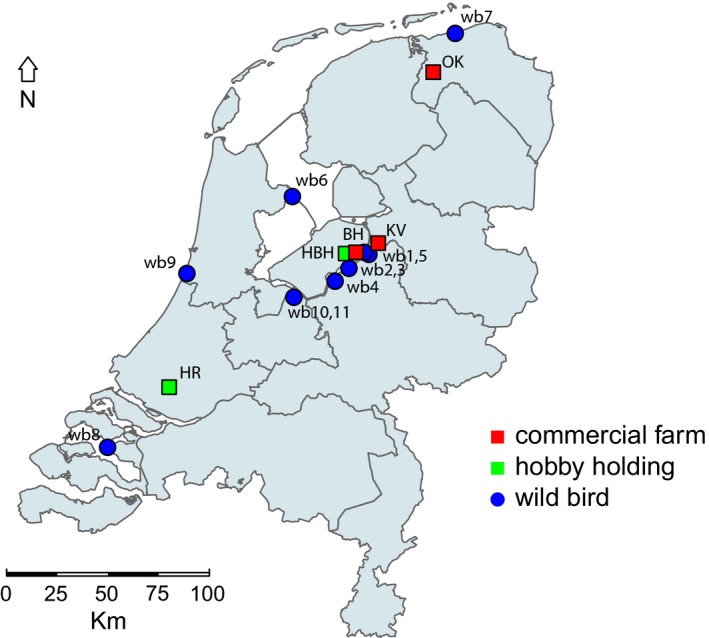
Figure 1
Figure 1
Map of the Netherlands, showing the location of commercial poultry farms (red), hobby holdings (green) and dead wild birds infected with HPAI H5N6 virus (blue). Commercial poultry farms: BH, Biddinghuizen; OK, Oldekerk; KV, Kamperveen; Hobby holdings: HBH, hobbyfarm Biddinghuizen; HR, hobbyfarm Rhoon; wild birds, wb 1–9
Figure 2
Figure 2
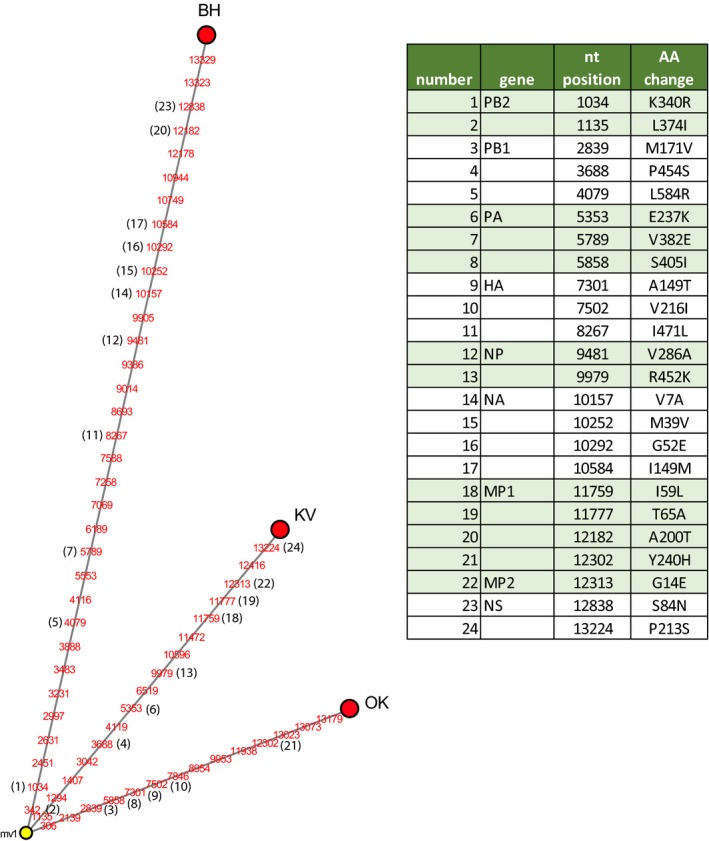
Median‐joining network analysis of HPAI H5N6 viruses isolated from three commercial farms in the Netherlands. The median‐joining network was generated for the full genome sequence of the viruses. The full genome sequence was obtained by combining the sequences from the eight individual gene segments. This network includes all the most parsimonious trees linking the three sequences. Each sequence genotype is represented by a red circle; the median vector is represented by a yellow circle. The numbers (red) refer to nucleotide (nt) positions that are different between the sequences. A number between brackets (black) marks the mutations resulting in amino acid (AA) change. The specific AA changes are listed in the table. BH, Biddinghuizen; OK, Oldekerk; KV, Kamperveen
Figure 3
Figure 3
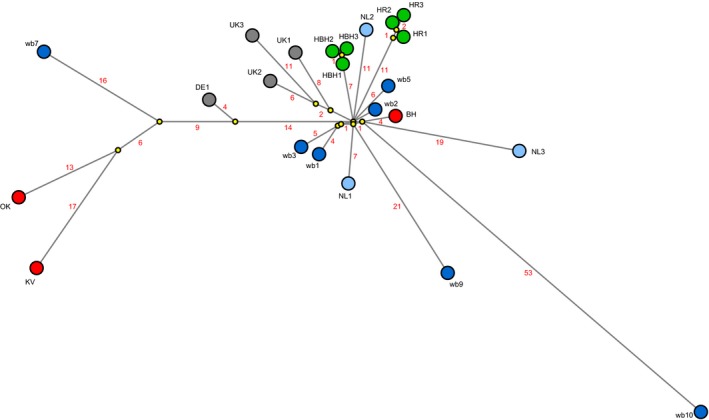
Median‐joining network showing the genetic relationship between HPAI H5N6 viruses isolated from commercial poultry farms (red), hobby holdings (green) and from dead wild birds tested in the passive surveillance programme (dark blue) in the Netherlands. Also shown are viruses isolated from wild birds in other (research) programmes in the Netherlands (light blue), and other European countries (grey). Predicted median vectors are shown in yellow. The virus isolates used for this analysis are listed in Table 1, which also provides the GISAID accession numbers
Figure 4
Figure 4
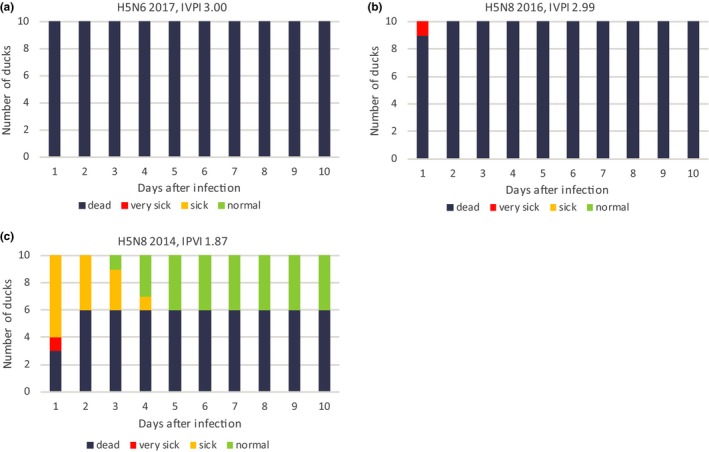
The intravenous pathogenicity index (IVPI) scores in ducks. The results of the experiment for (a) H5N6 2017, (b) H5N8 2016 and (c) H5N8 2014 are shown. Ten 6‐week‐old Pekin ducks were inoculated and monitored for clinical signs for 10 days. For every day the number of normal (green), sick (orange), very sick (red) and dead (dark grey) ducks is shown

References

    1. Bandelt, H. J. , Yao, Y. G. , Bravi, C. M. , Salas, A. , & Kivisild, T. (2009). Median network analysis of defectively sequenced entire mitochondrial genomes from early and contemporary disease studies. Journal of Human Genetics, 54, 174–181. 10.1038/jhg.2009.9 - DOI - PubMed
    1. Bataille, A. , van der Meer, F. , Stegeman, A. , & Koch, G. (2011). Evolutionary analysis of inter‐farm transmission dynamics in a highly pathogenic avian influenza epidemic. PLoS Pathogens, 7, e1002094 10.1371/journal.ppat.1002094 - DOI - PMC - PubMed
    1. Beerens, N. , Heutink, R. , Bergervoet, S. A. , Harders, F. , Bossers, A. , & Koch, G. (2017). Multiple reassorted viruses as cause of highly pathogenic avian influenza A(H5N8) virus epidemic, the Netherlands, 2016. Emerging Infectious Diseases, 23, 1974–1981. 10.3201/eid2312.171062 - DOI - PMC - PubMed
    1. Beerens, N. , Koch, G. , Heutink, R. , Harders, F. , Vries, D. P. E. , Ho, C. , … Elbers, A. (2018). Novel highly pathogenic avian influenza A(H5N6) virus in the Netherlands, December 2017. Emerging Infectious Diseases, 24, 770 10.3201/eid2404.172124 - DOI - PMC - PubMed
    1. Bouwstra, R. , Heutink, R. , Bossers, A. , Harders, F. , Koch, G. , & Elbers, A. (2015). Full‐Genome sequence of influenza A(H5N8) virus in poultry linked to sequences of strains from Asia, the Netherlands, 2014. Emerging Infectious Diseases, 21, 872–874. 10.3201/eid2105.141839 - DOI - PMC - PubMed

MeSH terms