. 2019 Apr 2;58(13):1705-1708.
doi: 10.1021/acs.biochem.9b00131. Epub 2019 Mar 20.

Quantifying the Oligomeric State of hZIP4 on the Surface of Cells

Affiliations

Quantifying the Oligomeric State of hZIP4 on the Surface of Cells

Meghan E Ahern et al. Biochemistry. .

Abstract

The human (h) zinc transporter ZIP4 is expressed on the plasma membrane and functions to increase cytosolic zinc levels. Mutations in hZIP4 cause the disease acrodermatitis enteropathica. Dysfunction in the regulation of hZIP4 has also been indicated in solid tissue cancers, including pancreatic and prostate cancer. Although structural studies of the extracellular domain and computational modeling of the membrane domain suggest hZIP4 exists as a dimer, the oligomerization status of hZIP4 in the plasma membrane of mammalian cells has not been directly quantified in vivo. Here, the oligomeric state of hZIP4 expressed in HEK293 cells was quantified using fluorescence correlation spectroscopy. hZIP4 was tagged with eGFP, and by comparing brightness values (ε) of monomer and tandem eGFP constructs to that of an hZIP4/eGFP, we show that hZIP4 is a dimer. Determining that hZIP4 is a dimer is an important step toward understanding the function and processing of the protein, which can provide more insight into how diseases affected by hZIP4 occur and can be managed.


Conflict of interest statement

The authors declare no competing financial interest.

Figures
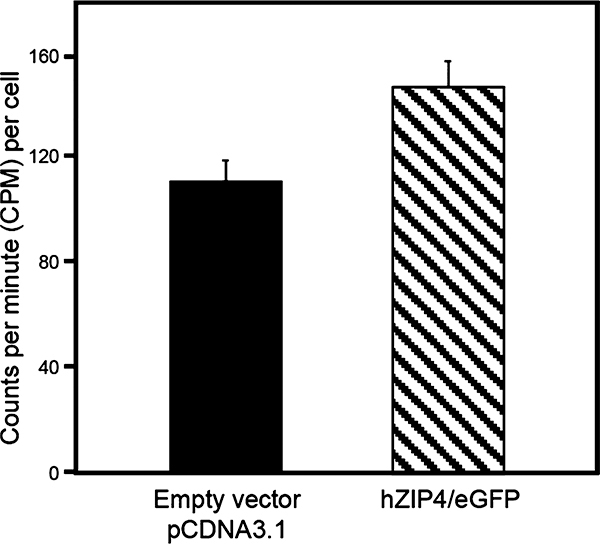
Figure 1.
Figure 1.
hZIP4 is functional with the eGFP tag. HEK293 cells were transfected with either the empty vector (pcDNA3.1) as a negative control or hZIP4/eGFP (black or dashed bar, respectively). After 48 h, cells were lysed and incubated with 5 μM 65Zn for 10 min. The cells were then washed, and the amount of 65Zn that accumulated was measured. This is a representative data set in which n = 8; a total of three independent experiments were completed with similar results. Error bars here represent the standard error of the mean. Data were found to be significant using a t test with p < 0.05.
Figure 2.
Figure 2.
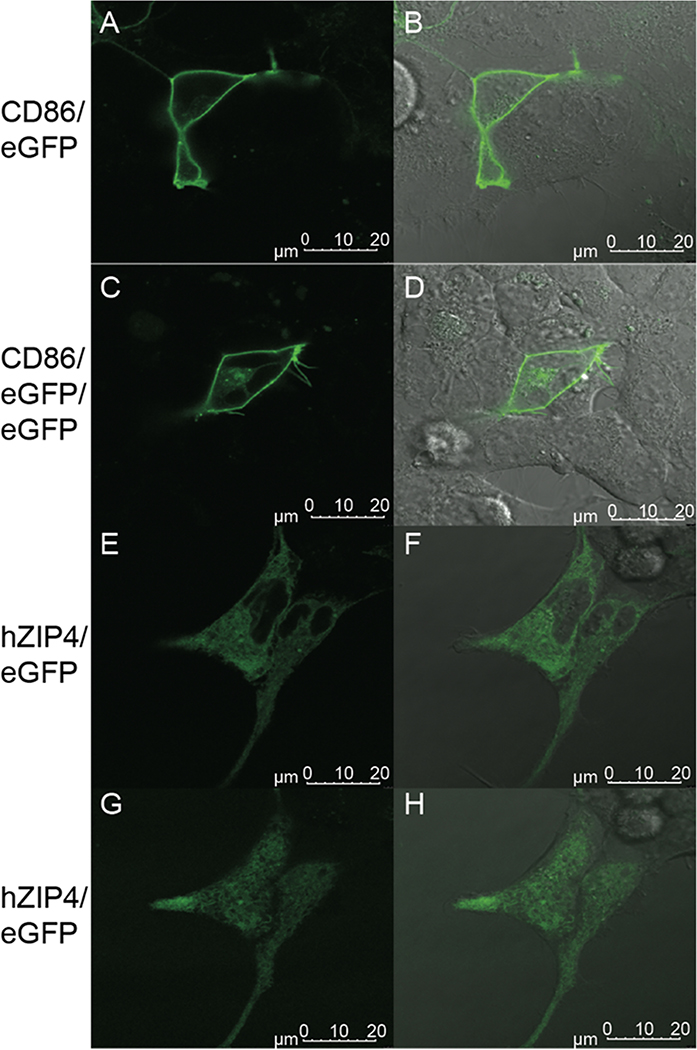
Confocal microscopy showing plasma membrane localization of proteins. HEK293 cells were transfected with either (A and B) monomeric CD-86/eGFP, (C and D) tandem CD-86/eGFP/eGFP, or (E–H) hZIP4/eGFP. After 24 h, cells were imaged using confocal microscopy. Images A–F represent the focus on the center of a cell on the z-axis, while images G and H show the focus on the upper plasma membrane, where FCS measurements were taken. Images G and H also demonstrate the high level of expression of hZIP4/eGFP on the cell membrane. Images B, D, F, and H show an overlay of fluorescence excitation with a DIC image of the cells.
Figure 3.
Figure 3.
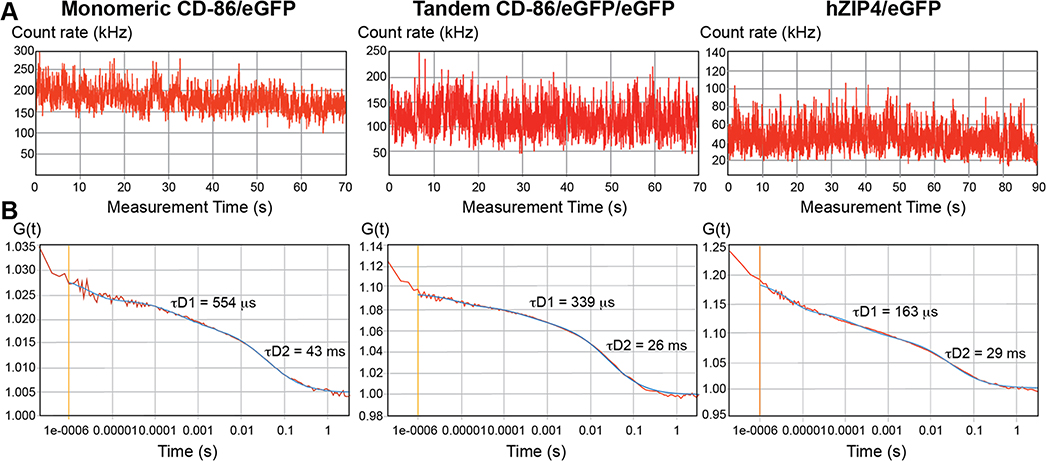
Fluorescence correlation spectroscopy (FCS) autocorrelation curves of eGFP-tagged membrane proteins. FCS recordings were made on the plasma membrane of transiently transfected HEK293 cells expressing the indicated eGFP-tagged proteins. These graphs are representative examples taken from one of three independent studies with multiple samples. (A) Fluorescence intensity fluctuations from which recordings outside the range of 50–250 kHz were excluded. (B) Autocorrelation curve of FCS data (red line) with a model curve fitting a two-dimensional two-component model (blue line). Diffusion times for the fast (τD1) and slow (τD2) components are shown.

References

    1. Jeong J, and Eide DJ (2013) The SLC39 family of zinc transporters. Mol. Aspects Med. 34, 612–619. - PMC - PubMed
    1. Andrews GK (2008) Regulation and function of Zip4, the acrodermatitis enteropathica gene. Biochem. Soc. Trans. 36, 1242–1246. - PMC - PubMed
    1. Kambe T, and Andrews GK (2009) Novel proteolytic processing of the ectodomain of the zinc transporter ZIP4 (SLC39A4) during zinc deficiency is inhibited by acrodermatitis enteropathica mtations. Mol. Cell. Biol. 29, 129–139. - PMC - PubMed
    1. Weaver BP, Zhang Y, Hiscox S, Guo GL, Apte U, Taylor KM, Sheline CT, Wang L, and Andrews GK (2010) Zip4 (Slc39a4) expression is activated in hepatocellular carcinomas and functions to repress apoptosis, enhance cell cycle and increase migration. PLoS One 5, e13158. - PMC - PubMed
    1. Lin Y, Chen Y, Wang Y, Yang J, Zhu VF, Liu Y, Cui X, Chen L, Yan W, Jiang T, Hergenroeder GW, Fletcher SA, Levine JM, Kim DH, Tandon N, Zhu J, and Li M (2013) ZIP4 is a novel molecular marker for glioma. Neuro-Oncol. 15, 1008–1016. - PMC - PubMed

Publication types

Substances