Review
. 2019 May;12(3):589-600.
doi: 10.1038/s41385-019-0158-0. Epub 2019 Mar 15.

Regulatory cytokine function in the respiratory tract

Affiliations
Review

Regulatory cytokine function in the respiratory tract

William J Branchett et al. Mucosal Immunol. 2019 May.

Abstract

The respiratory tract is an important site of immune regulation; required to allow protective immunity against pathogens, while minimizing tissue damage and avoiding aberrant inflammatory responses to inhaled allergens. Several cell types work in concert to control pulmonary immune responses and maintain tolerance in the respiratory tract, including regulatory and effector T cells, airway and interstitial macrophages, dendritic cells and the airway epithelium. The cytokines transforming growth factor β, interleukin (IL-) 10, IL-27, and IL-35 are key coordinators of immune regulation in tissues such as the lung. Here, we discuss the role of these cytokines during respiratory infection and allergic airway disease, highlighting the critical importance of cellular source and immunological context for the effects of these cytokines in vivo.


Conflict of interest statement

The authors declare no competing interests.

Figures
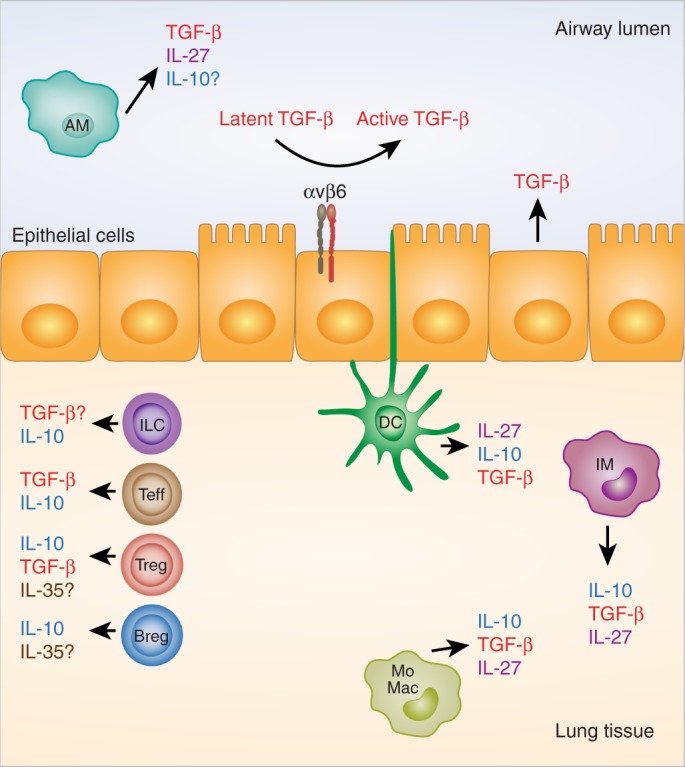
Fig. 1
Fig. 1
Cellular sources of immune regulatory cytokines in the lung. Transforming growth factor β (TGF-β) is produced by both stromal cells (e.g., bronchial, bronchiolar, and alveolar epithelial cells) and leukocytes in the lung, including resident macrophages, recruited monocyte-derived macrophages (MoMacs), and infiltrating regulatory and effector T cells (Tregs and Teffs). It remains to be seen whether innate lymphoid cells (ILCs) can produce TGF-β in the lung, as they do in the intestine. Integrin αvβ6 on lung epithelial cells is important for activation of latent TGF-β. T cells and interstitial macrophages (IMs) are major IL-10-producing cells in the lung, with expression also reported in dendritic cells (DCs), regulatory B cells (Bregs) and ILCs. Some studies report IL-10 production from airway macrophages (AMs), whereas others suggest that these cells produce little to no IL-10. IL-27 is produced by pulmonary myeloid cells, including AMs, DCs, and likely also resident IMs and recruited MoMacs. IL-35 expression is restricted to Tregs and Bregs and its expression in the lung requires further evaluation
Fig. 2
Fig. 2
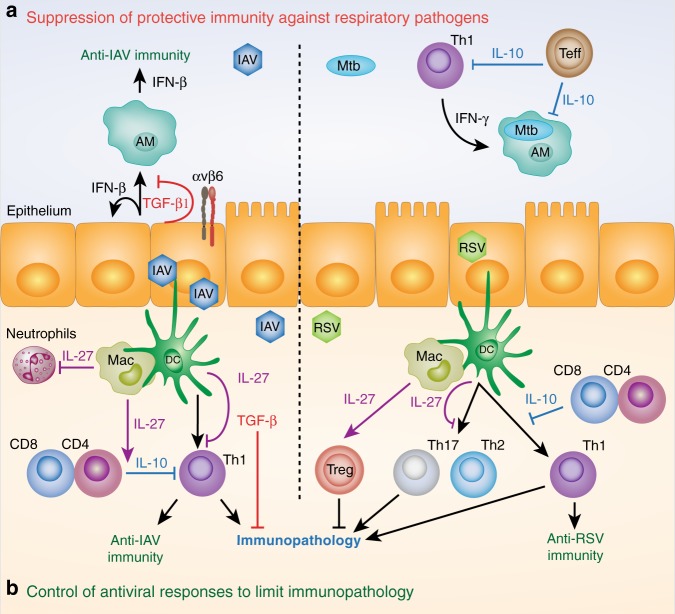
Regulatory cytokine function during respiratory infection. a Regulatory cytokine activity can hamper clearance of respiratory pathogens. Influenza A virus (IAV) increases expression of transforming growth factor β (TGF-β) 1 by airway epithelial cells, which is activated by viral neuraminidase and integrin αvβ6. Bioactive TGF-β suppresses interferon (IFN)-β production by epithelial cells and AMs thus, facilitating IAV infection and dissemination. Control of intracellular Mycobacterium tuberculosis (Mtb) infection in pulmonary macrophages (including, but not restricted to, AMs) is dependent on activation by IFN-γ and is suppressed by T-cell-derived IL-10. b Selected mechanisms of restriction of immunopathology during respiratory viral infection are shown. During IAV infection, T-cell-derived IL-10 limits Th1-dependent immunopathology and its expression is enhanced by myeloid-derived IL-27. IL-27 can also suppress the Th1 response to IAV independently of IL-10 and limit infiltration of innate cells such as neutrophils. TGF-β is required to limit T-cell-dependent immunopathology late in IAV infection. During respiratory syncytial virus (RSV) infection, IL-27 favors protective Th1 immunity over pathogenic Th2 and Th17 cell responses and T-cell-derived IL-10 controls Th1 responses to limit immunopathology. IL-27 can also limit RSV immunopathology by augmenting the suppressive capacity of regulatory T cells (Tregs)
Fig. 3
Fig. 3
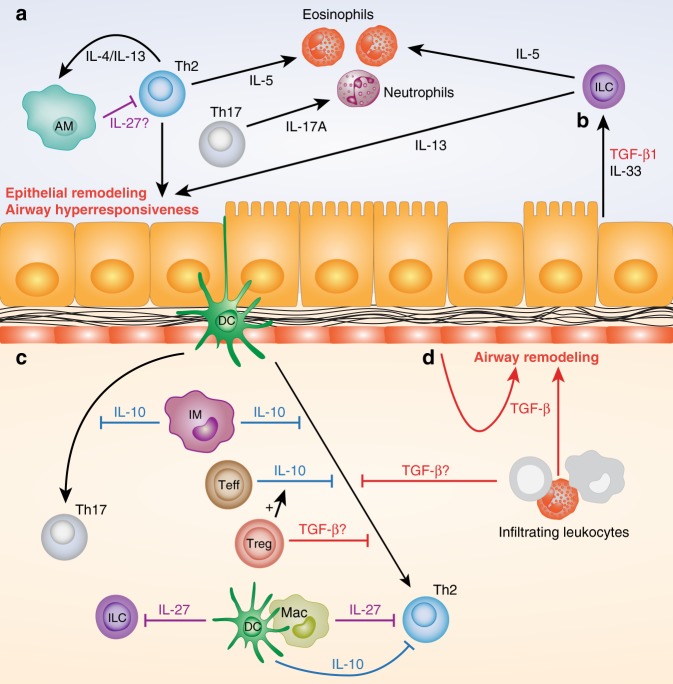
Cytokine regulation of allergic lung inflammation. a Type 2 cytokines (IL-4, IL-5, and IL-13) drive multiple pathogenic features of allergic airway disease (AAD), including eosinophilic inflammation, structural changes to epithelium, and activation of macrophages. Airway macrophages (AMs) are required to limit the pathogenic Th2 response to allergen, possibly via IL-27. b Epithelial club cells release transforming growth factor β (TGF-β) 1 following allergen or IL-33 exposure, which acts in concert with IL-33 to drive type 2 innate lymphoid cell (ILC2) recruitment and activation. c IL-10 from interstitial macrophages (IMs) can limit both Th2 and Th17 responses to allergen, depending on the experimental model. Effector T-cell (Teff) -derived IL-10 limits Th2-cell responses to allergen, and this IL-10 expression can be enhanced by regulatory T cells (Tregs). TGF-β also limits Th2-cell responses to allergen, although the functionally dominant source (Tregs, infiltrating leukocytes, or other cell types) is unclear. Myeloid-derived IL-27 can limit both ILC2 and Th2-cell responses to allergen and dendritic cell (DC)-derived IL-10 has been suggested to promote tolerance and suppress Th2 responses. d TGF-β, potentially derived from leukocytes and stromal cells, may also promote remodeling of the epithelium, mesenchymal cells, and extracellular matrix of the airway wall

References

    1. Lambrecht BN, Hammad H. The immunology of asthma. Nat. Immunol. 2015;16:45–56. - PubMed
    1. Wenzel SE. Asthma phenotypes: the evolution from clinical to molecular approaches. Nat. Med. 2012;18:716–725. - PubMed
    1. Medzhitov R, Schneider DS, Soares MP. Disease tolerance as a defense strategy. Science. 2012;335:936–941. - PMC - PubMed
    1. Iwasaki A, Pillai PS. Innate immunity to influenza virus infection. Nat. Rev. Immunol. 2014;14:315–328. - PMC - PubMed
    1. Kash JC, et al. Genomic analysis of increased host immune and cell death responses induced by 1918 influenza virus. Nature. 2006;443:578–581. - PMC - PubMed

Publication types